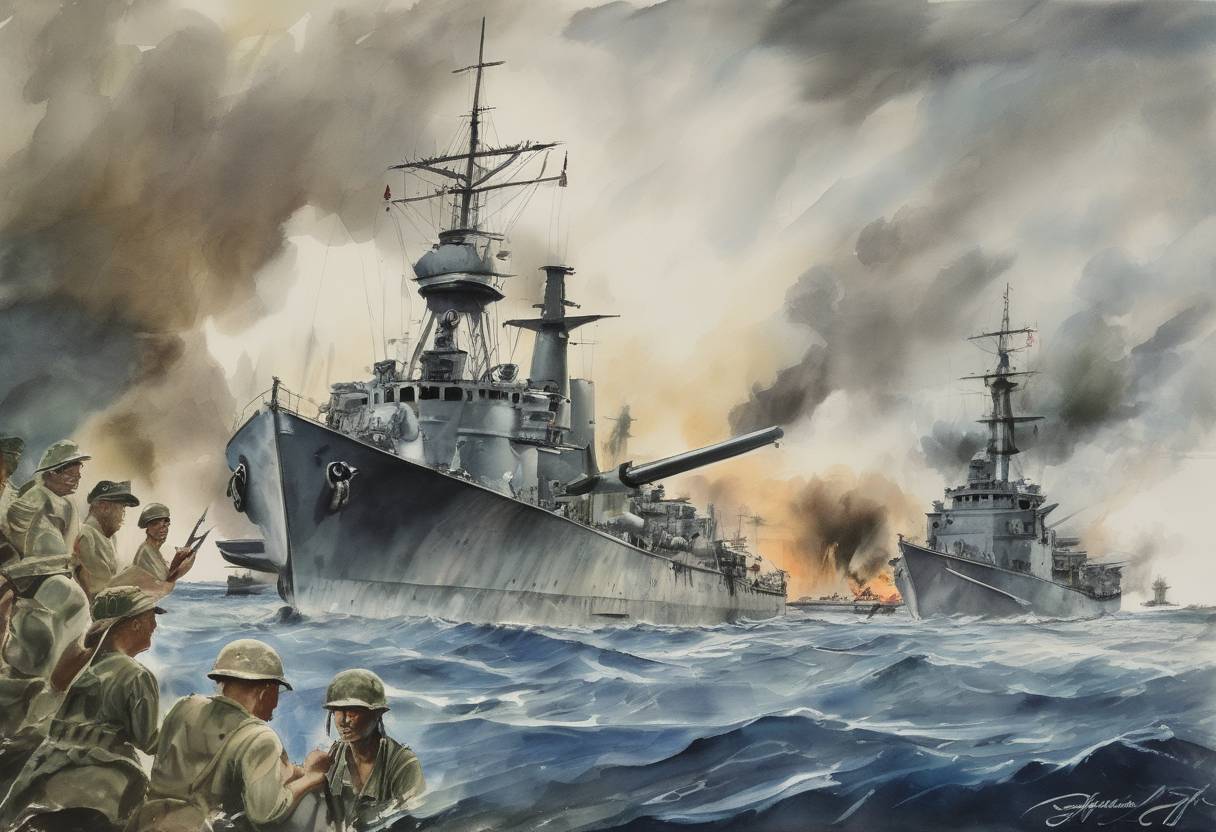
The Naval Battle of Guadalcanal: A Decisive Allied Victory
Overview
The Naval Battle of Guadalcanal, which concluded on November 15, 1942, was a pivotal engagement in the Pacific Theater of World War II. This battle marked a significant turning point in the Allies’ favor against Japanese forces. It was part of the larger Guadalcanal Campaign, which aimed to secure the strategically important island of Guadalcanal in the Solomon Islands.
Context
- Guadalcanal Campaign: Initiated in August 1942, the campaign was the first major offensive by Allied forces against the Empire of Japan. The primary objective was to deny the Japanese the use of the island as a base to threaten supply routes between the United States, Australia, and New Zealand.
- Strategic Importance: Control of Guadalcanal and its airfield, Henderson Field, was crucial for both sides. For the Allies, it provided a base to launch further operations in the Pacific. For the Japanese, it was vital to maintain their defensive perimeter and protect their southern flank.
Key Events Leading Up to the Battle
- Initial Landings: The U.S. Marines landed on Guadalcanal on August 7, 1942, capturing the airfield and establishing a foothold.
- Japanese Counterattacks: Over the following months, Japanese forces launched several counterattacks by land, sea, and air to retake the island and its airfield.
- Prelude to the Naval Battle: By November, both sides were heavily committed to controlling Guadalcanal. The Japanese planned a major offensive to reinforce their troops and retake Henderson Field.
The Naval Battle
- Dates: The battle occurred from November 12 to November 15, 1942.
- Engagements: The battle consisted of several naval engagements, including night battles characterized by chaotic and close-range combat.
- Forces Involved: The U.S. Navy, under the command of Admirals William Halsey and Richmond K. Turner, faced off against the Imperial Japanese Navy, led by Admirals Isoroku Yamamoto and Nobutake Kondō.
Key Engagements
First Naval Battle (November 13): A fierce night battle where both sides suffered heavy losses. The U.S. lost two cruisers and four destroyers, but the Japanese also incurred significant damage, including the loss of the battleship Hiei.
Second Naval Battle (November 14-15): The climax of the battle saw the U.S. battleships USS Washington and USS South Dakota engage Japanese battleships Kirishima and other vessels. The Japanese battleship Kirishima was sunk, marking a decisive victory for the Allies.
Aftermath and Significance
- Japanese Withdrawal: The defeat forced the Japanese to abandon their efforts to retake Guadalcanal, marking the beginning of a strategic withdrawal in the Pacific.
- Allied Momentum: The victory at Guadalcanal shifted the balance of power in the Pacific, allowing the Allies to transition from defensive operations to offensive strategies.
- Strategic Impact: The battle demonstrated the effectiveness of Allied naval power and marked the first significant check on Japanese expansion in the Pacific.
Conclusion
The Naval Battle of Guadalcanal was a crucial victory for the Allies, significantly impacting the course of the Pacific War. It underscored the importance of air and naval power in modern warfare and set the stage for further Allied advances in the Pacific, ultimately contributing to the eventual defeat of Japan in 1945.