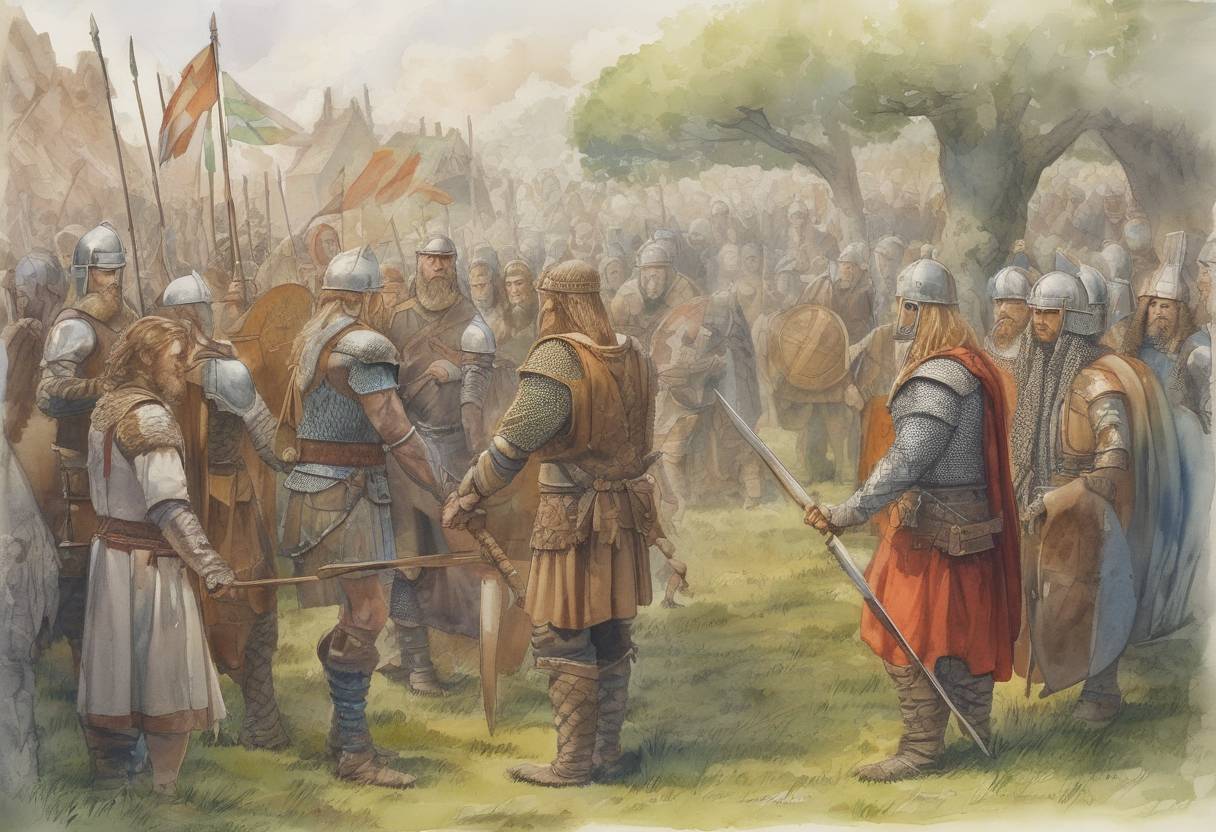
The Treaty of Wedmore: Establishing the Danelaw
The Treaty of Wedmore, traditionally dated to 878, marks a significant turning point in the history of England, as it effectively ended a series of Viking invasions and established the Danelaw. This agreement followed the pivotal Battle of Edington, where King Alfred the Great of Wessex defeated the Viking Great Heathen Army led by Guthrum.
Context Leading to the Treaty
- Viking Invasions: The 9th century saw numerous Viking incursions into England, with the Great Heathen Army arriving in 865. These Norse warriors sought to conquer and settle rather than merely raid.
- Alfred the Great: Ascending to the throne of Wessex in 871, Alfred faced the formidable challenge of defending his kingdom against the Vikings. His leadership was crucial in resisting Viking advances.
- Battle of Edington: In May 878, Alfred achieved a decisive victory against Guthrum’s forces at Edington. This battle was critical in shifting the balance of power in favor of the Anglo-Saxons.
The Treaty of Wedmore
- Terms of the Treaty: The treaty’s exact details are not fully documented, but it is understood to have included the baptism of Guthrum and his followers, symbolizing their acceptance of Christianity. Guthrum took the Christian name Athelstan.
- Establishment of the Danelaw: The treaty delineated boundaries between Alfred’s kingdom and the territories under Viking control, known as the Danelaw. This area included parts of modern-day northern and eastern England.
- Peace and Coexistence: The agreement allowed for a period of relative peace and coexistence between the Anglo-Saxons and the Vikings, facilitating cultural and economic exchanges.
Aftermath and Historical Significance
- Alfred’s Legacy: Alfred the Great is celebrated for his military acumen and efforts to unify England. His reign laid the groundwork for the eventual unification of England under a single monarch.
- Cultural Integration: The Danelaw became a region where Norse and Anglo-Saxon cultures intermingled, influencing language, law, and customs.
- Long-term Impact: The treaty and subsequent peace allowed for the stabilization of England, setting the stage for future consolidation and resistance against further Viking incursions.
The Treaty of Wedmore is a landmark in English history, symbolizing the resilience of the Anglo-Saxons and the beginning of a new era of cultural integration and political stability.