Abel Tasman Sights New Zealand - December 13, 1642
1642 · New Zealand, New Zealand
Abel Tasman becomes the first European to sight New Zealand.
December 18, 1642
Abel Tasman, a Dutch navigator, becomes the first European to sight New Zealand.
New Zealand (offshore), New Zealand | Dutch East India Company
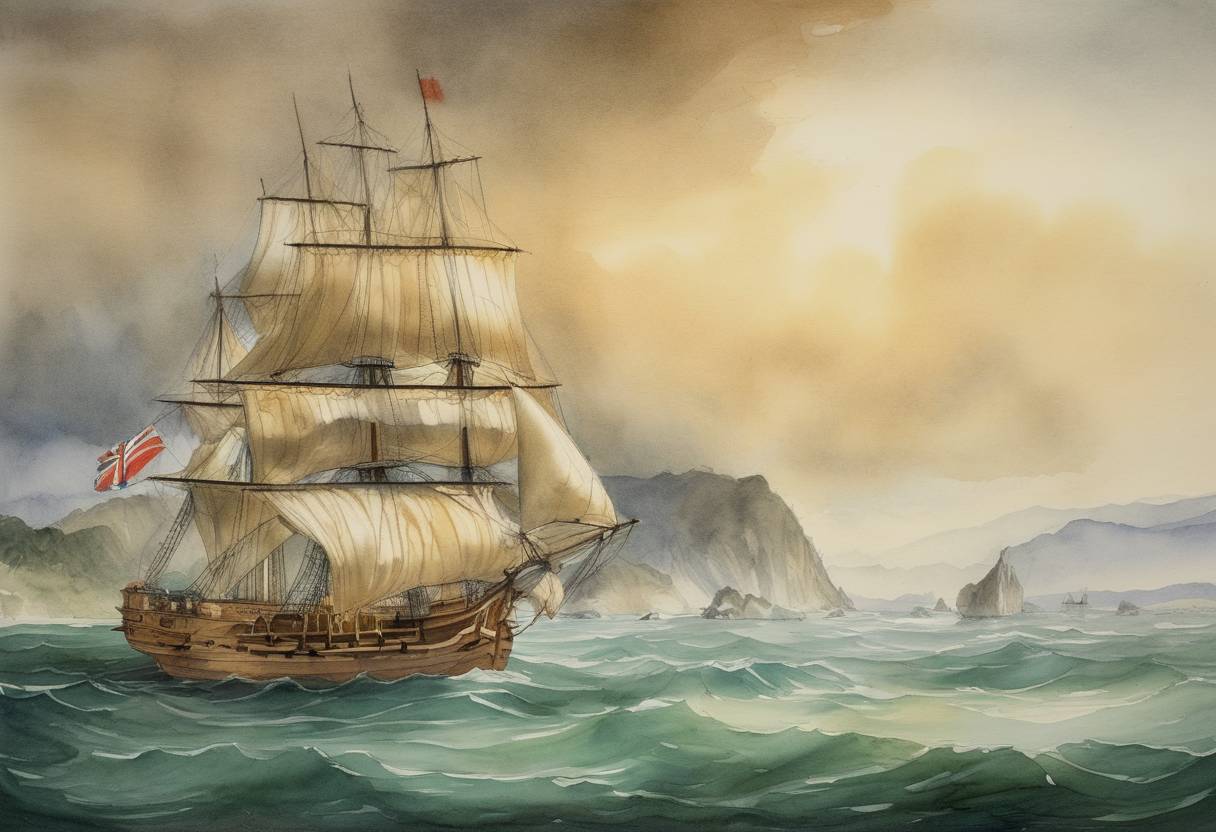
On December 18, 1642, Abel Tasman, a Dutch explorer and navigator, became the first European known to have sighted New Zealand. This marked a significant moment in the age of exploration, expanding European understanding of the Southern Hemisphere.
Abel Tasman: He was employed by the Dutch East India Company (VOC), which was a major commercial enterprise seeking new trade routes and opportunities. Born in 1603 in Lutjegast, Netherlands, Tasman was an experienced seafarer engaged in several exploratory voyages.
VOC’s Objectives: The VOC was keen to discover and map unknown lands in the South Pacific to augment Dutch maritime supremacy and economic interests. This was during a period of intense competition between European powers for territorial expansion and trade opportunities.
Mission Start: Tasman’s voyage was part of his broader expedition to explore the “Great South Land,” now known as Australia. He set sail from Batavia (modern-day Jakarta, Indonesia) in August 1642, commanding two ships, the Heemskerck and the Zeehaen.
Route: After reaching Tasmania earlier in December, Tasman’s ships sailed further eastward, crossing the Tasman Sea. His navigation relied on rudimentary maps and the guidance of wind and current patterns.
First Sighting: On December 13, 1642, Tasman’s crew spotted the mountain ranges of what is now the west coast of New Zealand’s South Island. Continuing along the coast, Tasman eventually anchored at what is today known as Golden Bay (then named Murderers’ Bay by the Dutch due to subsequent events).
Initial Encounter: On December 18, 1642, the Dutch encountered the Ngāti Tumatakokiri, an indigenous Māori tribe, upon entering a bay. This was their first known contact with the Māori people.
Conflict: The initial meeting did not go peacefully. Misunderstandings led to a skirmish in which several Māori and four of Tasman’s men were killed. This led Tasman to name the bay “Murderers’ Bay.”
Exploration Halted: Due to the hostile encounter and challenges in communication, Tasman decided against further inland exploration and continued mapping the coastline from a distance.
Legacy: Abel Tasman’s discovery of New Zealand marked a foundational moment in European exploration of the Pacific. Despite the voyage not resulting in immediate colonization or trade, it laid the groundwork for future European interests in the region.
Mapping: Tasman’s charts and logs provided the first European documentation of New Zealand and parts of Australia, proving vital for later voyages.
Continued Exploration: The sighting fueled further curiosity and exploration, eventually leading to Britain’s colonization under Captain James Cook’s voyages in the 18th century.
Tasman’s endeavors significantly contributed to the geographic and cultural mapping of the world during this period, despite the fraught nature of early cross-cultural encounters.
Source: en.wikipedia.org