Soviet Troops Enter Hungary to Crush the Hungarian Revolution: November 4, 1956
1956 · Budapest, Hungary
Soviet troops enter Hungary to crush the Hungarian Revolution, resulting in a significant loss of life.
October 6, 1849
The execution of 13 Martyrs of Arad was carried out by the Austrian Empire. These Hungarian generals were executed for their roles in the Hungarian Revolution of 1848.
Arad, Hungary | Austrian Empire
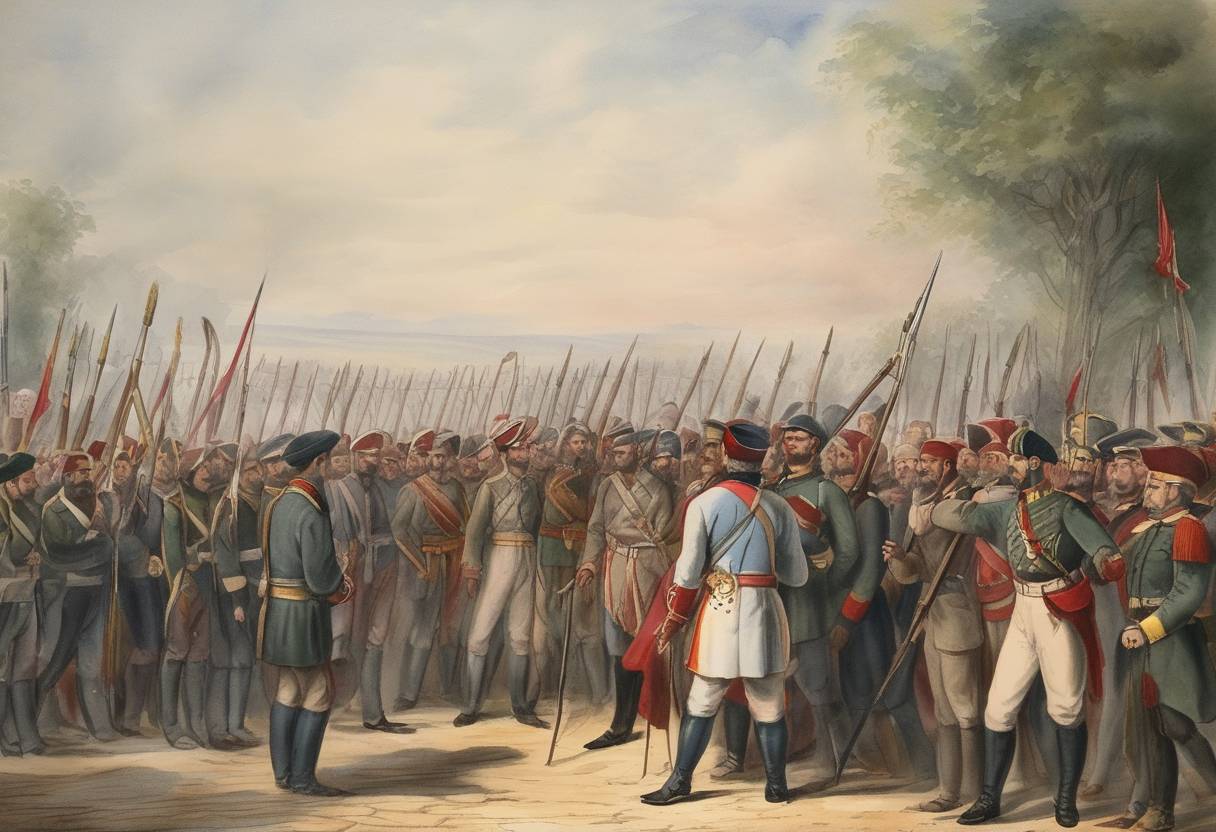
On October 6, 1849, the Austrian Empire executed thirteen Hungarian military leaders in Arad, which, at the time, was part of the Kingdom of Hungary within the Austrian Empire (now Romania). These executions were a grim conclusion to the Hungarian Revolution of 1848–1849, a failed effort for Hungarian independence from Habsburg rule.
The Hungarian Revolution of 1848 was part of a series of interconnected revolutionary events across Europe that year. In Hungary, the revolution had a dual nature: a struggle for national independence and a fight for internal social and political reforms. On March 15, 1848, the revolution initially appeared successful, leading to significant concessions from the Habsburgs, including the establishment of a Hungarian government. However, by 1849, the movement faced internal and external pressures, notably from the Austrian monarchy, which was determined to regain control over its dominions.
After the defeat of the Hungarian revolutionaries in August 1849, reprisals were swift and harsh. The Austrian Empire, with aid from Russian forces, sought to suppress any further insurrections decisively. Austrian General Julius Jacob von Haynau, known for his severity, was appointed to oversee the military tribunals of captured Hungarian leaders.
The 13 Hungarian generals were tried and sentenced for treason by an Austrian military court in Arad. They were accused of leading and inciting a rebellion against the Austrian Emperor and thus were deemed responsible for the failure of the revolution and subsequent war effort.
The executions were carried out by hanging and by firing squad, meant to serve as both punishment and a warning to other potential dissenters within the Austrian Empire.
The following is a list of the executed generals:
These men were revered for their roles in the defense of Hungarian liberty, and their execution became emblematic of the cost of the struggle for national independence.
The executions at Arad became a symbol of martyrdom and sacrifice in the Hungarian national consciousness, emphasizing the harsh measures of the Habsburg reaction. This day, October 6, is now commemorated annually in Hungary as a day of remembrance for those who sacrificed their lives for the country’s independence. The events solidified Hungarian resolve against Habsburg dominance, influencing future generations and contributing to the eventual emergence of a more autonomous Hungary within the Austro-Hungarian Compromise of 1867.
Source: en.wikipedia.org