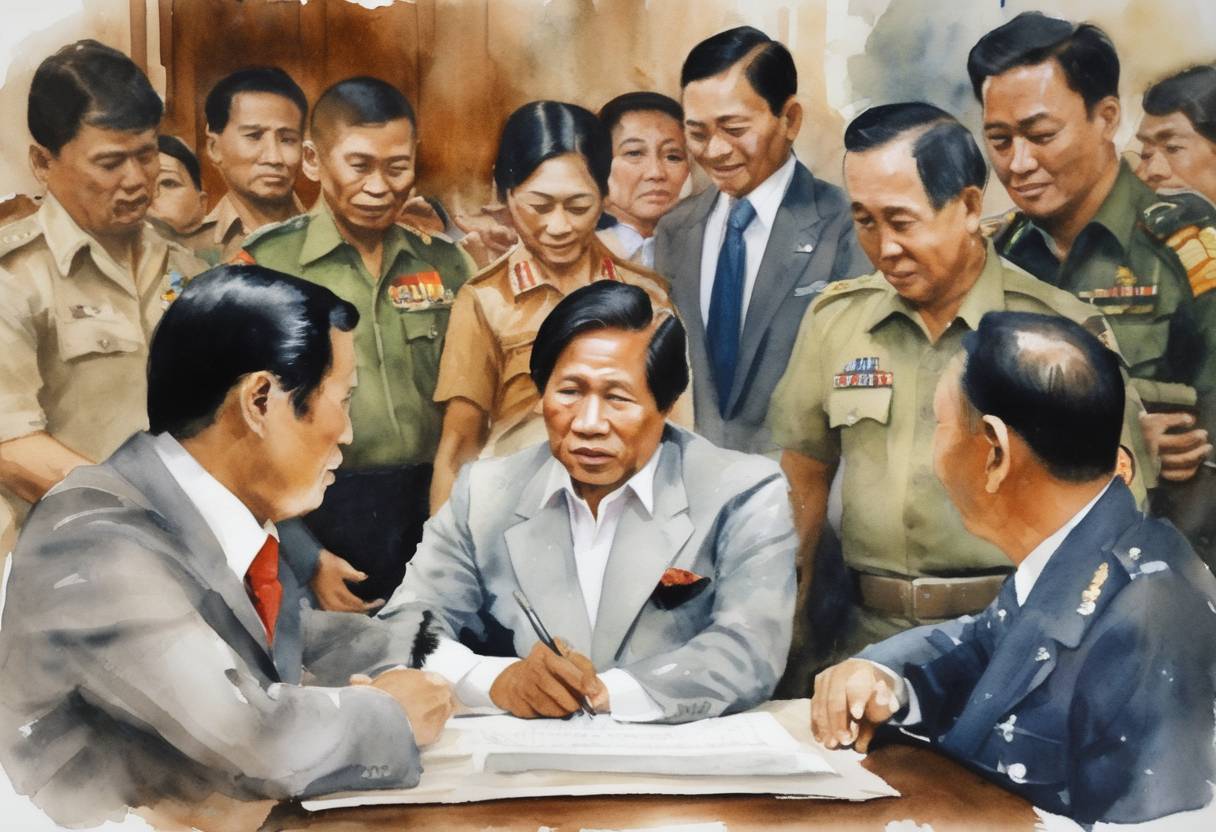
Declaration of Martial Law in the Philippines: September 21, 1972
On September 21, 1972, Philippine President Ferdinand Marcos signed Proclamation No. 1081, placing the entire nation under martial law. This event marked a pivotal turning point in the country’s history, fundamentally altering its political landscape and governance.
Context and Prelude
Leading up to the proclamation, the Philippines was facing significant political and civil unrest. There were growing concerns over national security due to increasing acts of violence, including bombings in Manila and alleged threats from communist insurgents and political opponents. The socio-political environment was marked by significant opposition to Marcos’s administration, widespread protests, and economic challenges.
Ferdinand Marcos, having been elected president in 1965 and re-elected in 1969, faced constitutional limitations that would bar him from seeking a third term. However, tensions and crises provided a pretext to consolidate power.
Proclamation No. 1081
Proclamation No. 1081 was ostensibly justified as a means to restore order, eliminate threats from leftist insurgents, and combat widespread corruption and lawlessness. However, it effectively dissolved civil liberties, allowing the president to rule by decree, control the media, and suppress political opposition.
Under martial law, thousands of political opponents, journalists, and activists were arrested and detained without charges. Critical government entities, including the legislative assembly, were closed down or brought under the direct control of the president.
Significance and Impact
- Extended Rule: Martial law enabled Marcos to extend his rule indefinitely, as elections were manipulated and democratic institutions were weakened.
- Human Rights Abuses: The period was characterized by numerous reports of human rights abuses, censorship, and the stifling of dissent. Torture, unjust incarcerations, and enforced disappearances became prevalent.
- Economic Policies: While some infrastructure developments and economic reforms took place during this period, they were often overshadowed by cronyism, corruption, and debt accumulation.
- Constitutional Changes: Eventually, a new constitution was drafted in 1973, which cemented the president’s powers and changed the political structure, exacerbating the authoritarian governance.
Aftermath
Although Proclamation No. 1081 was dated September 21, it was formally announced to the public on September 23, 1972. Martial law continued for nearly a decade, formally lifted on January 17, 1981, but many of its effects and policies persisted.
The end of martial law did not herald a return to democracy, as Marcos retained significant control until his eventual ouster during the People Power Revolution of 1986. This non-violent uprising marked the restoration of democratic governance in the Philippines and was a pivotal chapter in the country’s history, illustrating the eventual resilience and determination of its people against dictatorship.