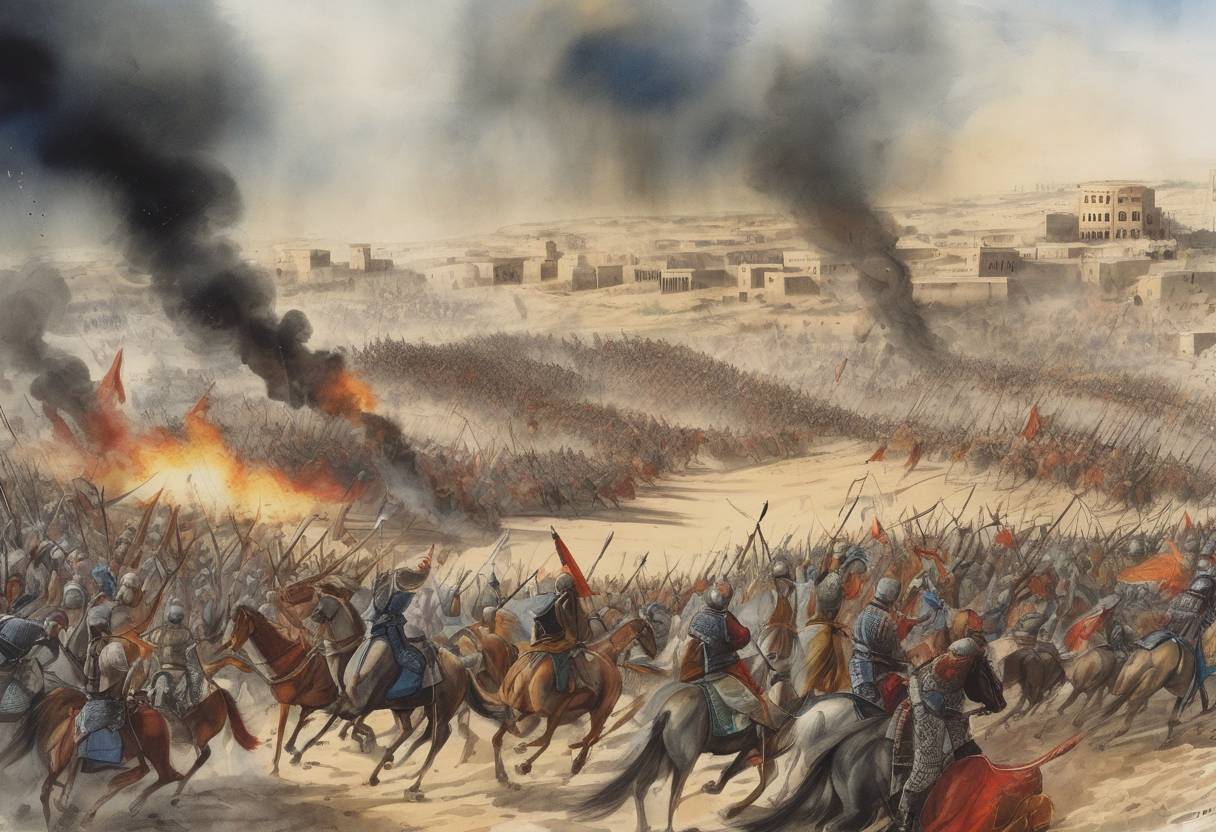
The Battle of Siffin
The Battle of Siffin, a pivotal conflict in early Islamic history, took place from July 26 to July 28, 657 CE. This battle was a significant event during the First Fitna, the first major civil war within the Islamic community, which arose due to political and religious disputes following the assassination of the third caliph, Uthman ibn Affan, in 656 CE.
Background
The First Fitna: The First Fitna was a period of internal strife and civil war within the early Islamic community. It was primarily a struggle for leadership and legitimacy following the murder of Caliph Uthman. The conflict pitted various factions against each other, with Ali ibn Abi Talib, the cousin and son-in-law of the Prophet Muhammad, being chosen as the fourth caliph by a faction in Medina.
Opposition to Ali: Ali’s caliphate was contested by several groups, most notably by Muawiya ibn Abi Sufyan, the powerful governor of Syria and a relative of the slain Uthman. Muawiya demanded justice for Uthman’s murder and refused to acknowledge Ali’s authority until the perpetrators were punished.
The Battle
Location: The battle took place near Siffin, a location along the Euphrates River in present-day Syria. This strategic location was chosen as it was near the border of Muawiya’s power base in Syria.
Forces: Ali’s forces were primarily composed of supporters from Iraq, while Muawiya’s troops were drawn from Syria. Both sides were well-matched in terms of numbers and military capability.
Course of the Battle: The battle was characterized by a series of skirmishes and engagements over several days. It was marked by intense fighting and significant casualties on both sides. The conflict reached a stalemate, with neither side able to secure a decisive victory.
The Arbitration: The battle concluded with an agreement to arbitration, a controversial decision that aimed to resolve the conflict through negotiation rather than continued warfare. This decision was influenced by the exhaustion of both armies and the desire to avoid further bloodshed.
Aftermath and Significance
Arbitration Outcome: The arbitration process ultimately failed to resolve the dispute and instead deepened divisions within the Islamic community. It led to further fragmentation and the eventual establishment of the Umayyad Caliphate under Muawiya.
Impact on Ali’s Leadership: The decision to agree to arbitration weakened Ali’s position and led to dissent among his supporters, particularly the Kharijites, who opposed the arbitration and later rebelled against him.
Long-term Consequences: The Battle of Siffin and the First Fitna had lasting impacts on Islamic history, contributing to the Sunni-Shia split and shaping the political landscape of the Muslim world for centuries to come.
The Battle of Siffin remains a significant event in Islamic history, illustrating the complex interplay of political, religious, and social factors that influenced the early Islamic community.