Gundobad and the Proclamation of Glycerius as Emperor
473 · Ravenna, Italy
Gundobad, a prominent Roman general of the Western Roman Empire, proclaimed Glycerius as emperor in Ravenna.
July 11, 0472
After a siege, the Roman general Ricimer captures Rome and installs Olybrius as the Western Roman Emperor.
Rome, Italy | Western Roman Empire
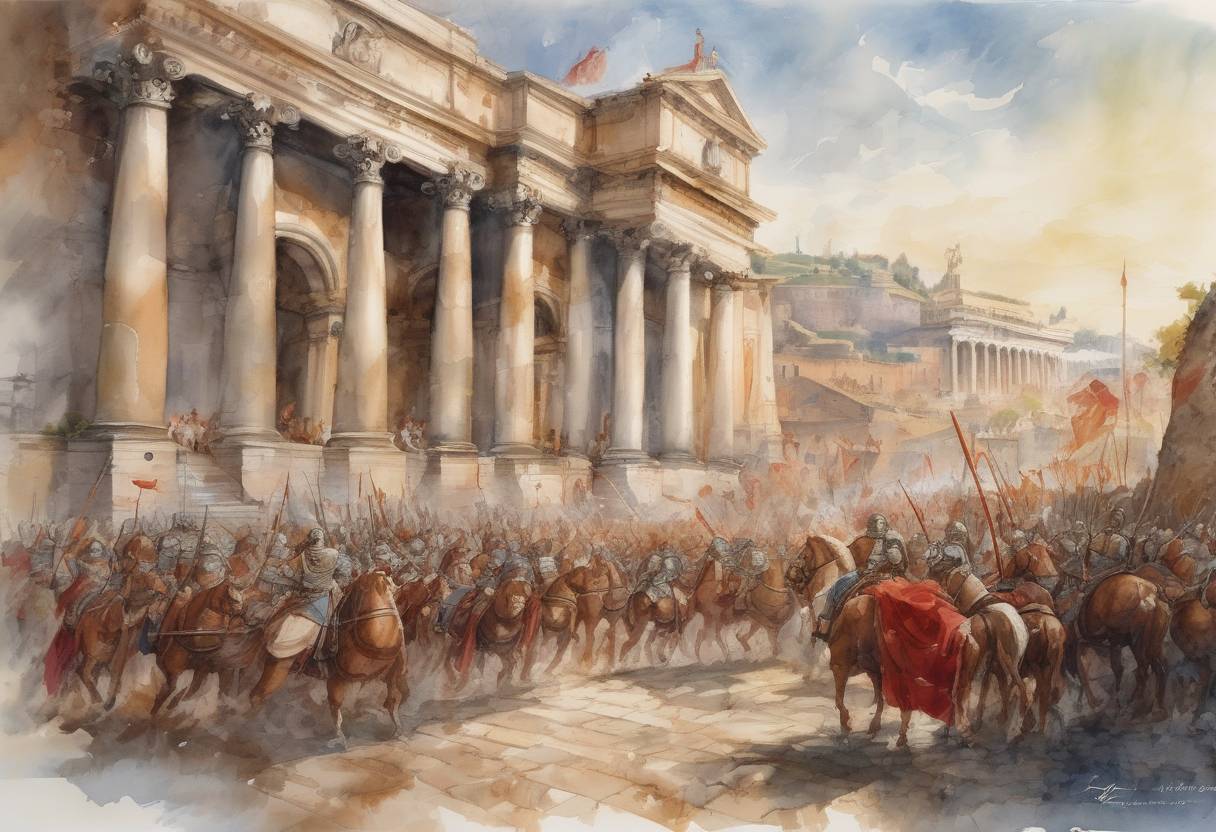
On July 11, 472, a significant event unfolded in the waning days of the Western Roman Empire: the capture of Rome by the Roman general Ricimer, who subsequently installed Olybrius as the Western Roman Emperor. This event is a notable episode in the turbulent history of the late Western Roman Empire, characterized by political instability and power struggles.
The Western Roman Empire, by the 5th century, was in a state of decline, plagued by internal strife, economic troubles, and external pressures from barbarian invasions. The political landscape was marked by frequent changes in leadership and the influence of powerful military leaders who often acted as kingmakers.
Ricimer, a Roman general of Germanic descent, was one such influential figure. He wielded considerable power behind the scenes, often determining who would sit on the imperial throne. Before the events of July 472, Ricimer had already played a crucial role in the rise and fall of several emperors.
The events leading up to the siege of Rome were rooted in the conflict between Ricimer and the then-reigning Western Roman Emperor, Anthemius. Anthemius, who had been installed as emperor in 467 with the support of the Eastern Roman Empire, eventually fell out of favor with Ricimer. Their relationship deteriorated into open hostility, culminating in Ricimer laying siege to Rome in 472.
The siege was a brutal affair, reflecting the chaotic and violent nature of the period. Ricimer’s forces eventually breached the city’s defenses, leading to the capture of Rome. Anthemius was captured and executed, marking the end of his reign.
Following the capture of Rome, Ricimer installed Olybrius as the new Western Roman Emperor. Olybrius was a member of the Roman aristocracy and had connections to the Eastern Roman Empire through marriage. His appointment was likely influenced by these connections, as well as his perceived malleability, which suited Ricimer’s interests.
Olybrius’s reign, however, was short-lived. He ruled for only a few months, from July to November 472, before his death. His tenure as emperor did little to stabilize the Western Roman Empire, which continued its decline.
The installation of Olybrius as emperor was one of the last acts of Ricimer, who himself died shortly after in August 472. The power vacuum left by Ricimer’s death further destabilized the Western Roman Empire, which would ultimately fall in 476 with the abdication of the last emperor, Romulus Augustulus.
This period highlights the fragmentation and weakening of imperial authority in the West, as military leaders and external forces increasingly dictated the fate of the empire. The events of July 11, 472, underscore the complex interplay of power, politics, and military might that characterized the final years of the Western Roman Empire.
Source: en.wikipedia.org