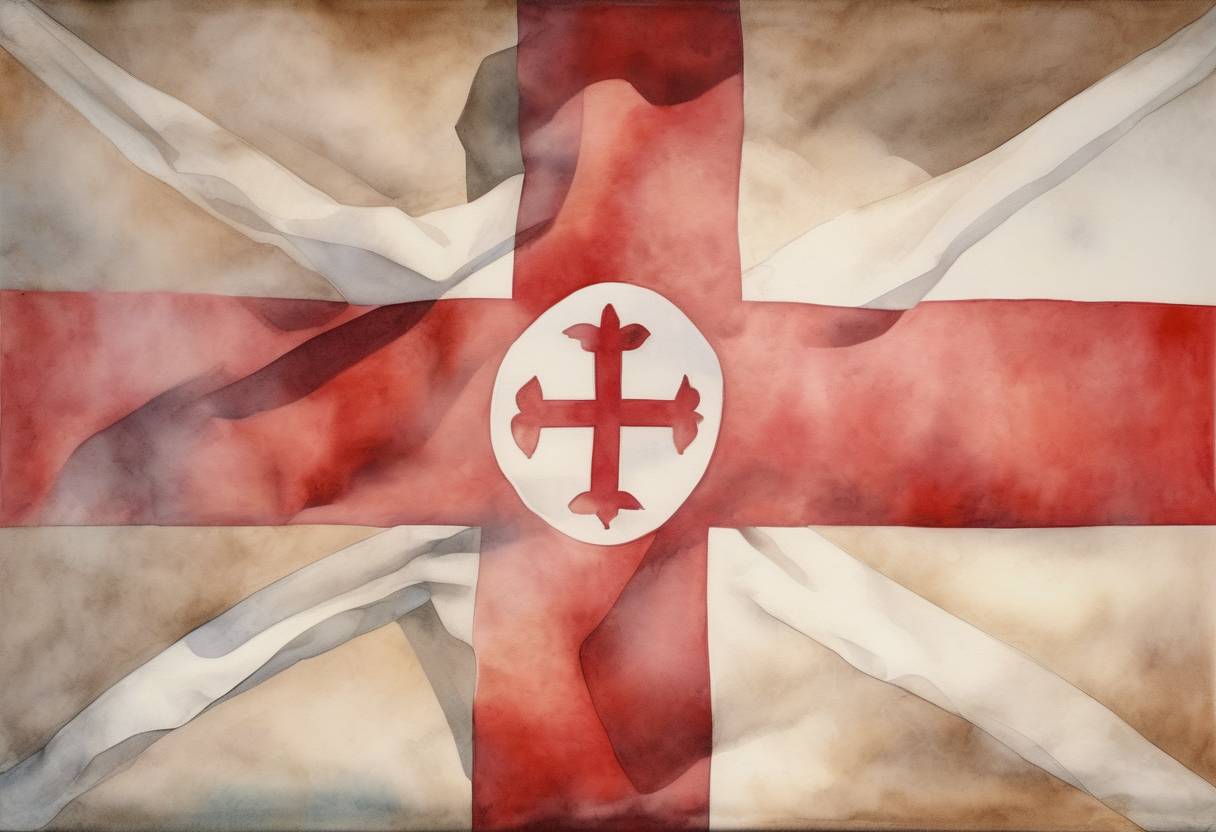
Restoration of the Five Cross Flag of Georgia
On January 14, 2004, the national flag of Georgia, known as the “Five Cross Flag,” was officially restored to use after a hiatus of over 500 years. This event marked a significant moment in Georgia’s history, symbolizing a return to national traditions and a reassertion of cultural identity.
Historical Context
The Five Cross Flag, also known as the “Georgian Cross Flag,” has deep historical roots in Georgia. It is believed to have been used during the medieval period, particularly associated with the Kingdom of Georgia under the reign of King George V in the 14th century. The flag features a large cross in the center with four smaller crosses in each quadrant, all in red on a white field. This design is thought to symbolize the Christian heritage of Georgia, with the central cross representing Jesus Christ and the four smaller crosses symbolizing the Four Evangelists.
Events Leading to the Restoration
The restoration of the Five Cross Flag was part of a broader movement in Georgia to reclaim national symbols and assert independence following the dissolution of the Soviet Union in 1991. During the Soviet era, Georgia, like other Soviet republics, used a flag that incorporated Soviet symbols. After gaining independence, there was a strong desire to revive historical symbols that reflected Georgia’s unique cultural and historical identity.
The push for the restoration of the Five Cross Flag gained momentum in the early 2000s, particularly with the rise of the United National Movement, led by Mikheil Saakashvili. The movement advocated for reforms and a pro-Western orientation for Georgia, and the adoption of the historical flag was seen as a step towards embracing Georgia’s past while looking to the future.
The Restoration
On January 14, 2004, the Georgian parliament officially adopted the Five Cross Flag as the national flag of Georgia. This decision was part of a series of reforms implemented by the newly elected government following the Rose Revolution in late 2003, which brought Saakashvili to power. The restoration of the flag was widely supported by the Georgian public and was seen as a symbol of national unity and pride.
Significance and Aftermath
The restoration of the Five Cross Flag was more than a mere change of symbols; it represented a broader cultural and political shift in Georgia. It signified a break from the Soviet past and a reaffirmation of Georgia’s historical and cultural roots. The flag has since become a powerful symbol of Georgian identity and sovereignty.
In the years following its restoration, the Five Cross Flag has been prominently displayed in national and international contexts, reinforcing Georgia’s aspirations for integration with Western institutions such as the European Union and NATO. The flag continues to be a source of national pride and a reminder of Georgia’s rich history and enduring spirit.
Overall, the restoration of the Five Cross Flag on January 14, 2004, was a pivotal moment in Georgia’s modern history, reflecting the country’s journey towards reclaiming its heritage and asserting its place on the global stage.