Christopher Columbus' Fourth and Final Voyage
1502 · Cadiz, Spain
Christopher Columbus embarked on his fourth and final voyage to the New World, aiming to find a passage to Asia.
May 11, 1502
Christopher Columbus departs on his fourth and final voyage to the Americas.
Cadiz, Spain | Spanish Crown
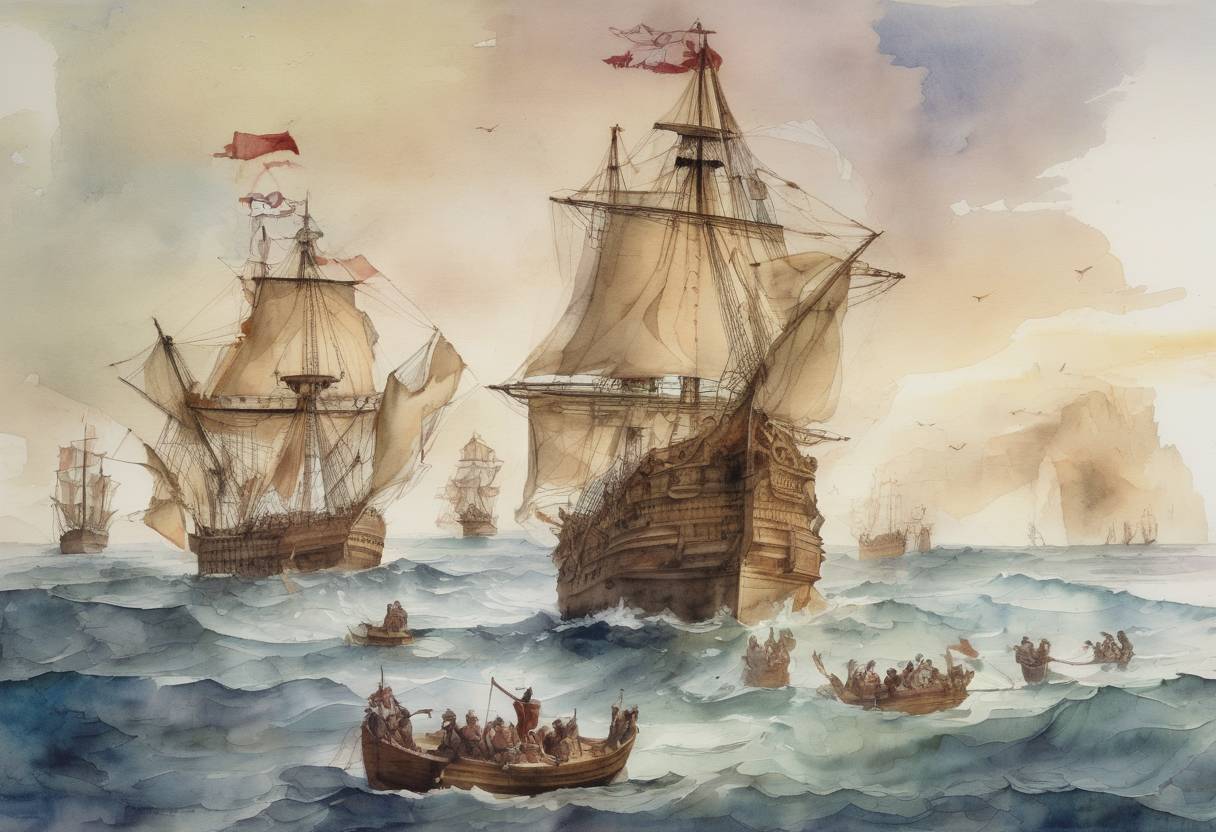
On May 11, 1502, Christopher Columbus embarked on his fourth and final voyage to the Americas. This expedition was marked by a series of challenges and was intended to find a westward passage to the Indian Ocean, further exploring the territories he had previously encountered.
By 1502, Columbus had already completed three voyages across the Atlantic, which had resulted in the European discovery of the Caribbean islands and parts of Central and South America. Despite these achievements, Columbus faced criticism and political challenges upon his return to Spain. His governance of the territories he discovered was questioned, and he was eventually removed from his position as governor of the Indies.
Despite these setbacks, Columbus was granted permission by King Ferdinand and Queen Isabella of Spain to undertake a fourth voyage. The primary goal was to find a strait or passage that would lead to the Indian Ocean, allowing Spain to establish a direct trade route to Asia.
Columbus set sail from Cádiz, Spain, with a fleet of four ships: the Capitana, the Gallega, the Vizcaína, and the Santiago de Palos. He was accompanied by his brother Bartholomew and his 13-year-old son, Ferdinand. The fleet carried approximately 150 men.
Exploration of Central America: Columbus explored the coasts of present-day Honduras, Nicaragua, Costa Rica, and Panama. He was the first European to set foot on these lands, encountering various indigenous peoples and documenting the rich biodiversity of the region.
Search for a Passage: Despite his efforts, Columbus did not find the anticipated passage to the Indian Ocean. His exploration was hindered by adverse weather conditions and the complex geography of the Central American coastline.
Shipwreck and Struggles: The voyage was fraught with difficulties, including shipwrecks and hostile encounters with indigenous groups. In June 1503, Columbus and his crew were stranded on the island of Jamaica after two of his ships became unseaworthy.
Rescue and Return: Columbus and his men were marooned on Jamaica for over a year. They were eventually rescued in June 1504, after sending messages to Hispaniola requesting aid. Columbus returned to Spain in November 1504.
Columbus’s fourth voyage did not achieve its primary objective of finding a westward passage to Asia. However, it contributed to the European understanding of the geography of Central America and the Caribbean. The voyage marked the end of Columbus’s explorations, as he returned to Spain in poor health and without the favor he once enjoyed at court.
Columbus’s explorations had a profound impact on world history, initiating widespread contact between Europe and the Americas. This era of exploration led to significant cultural exchanges and the eventual colonization of the Americas, shaping the course of global history.
Despite the controversies surrounding his governance and treatment of indigenous peoples, Columbus remains a pivotal figure in the Age of Exploration, symbolizing the spirit of discovery and the complex legacy of European expansion.
Source: en.wikipedia.org