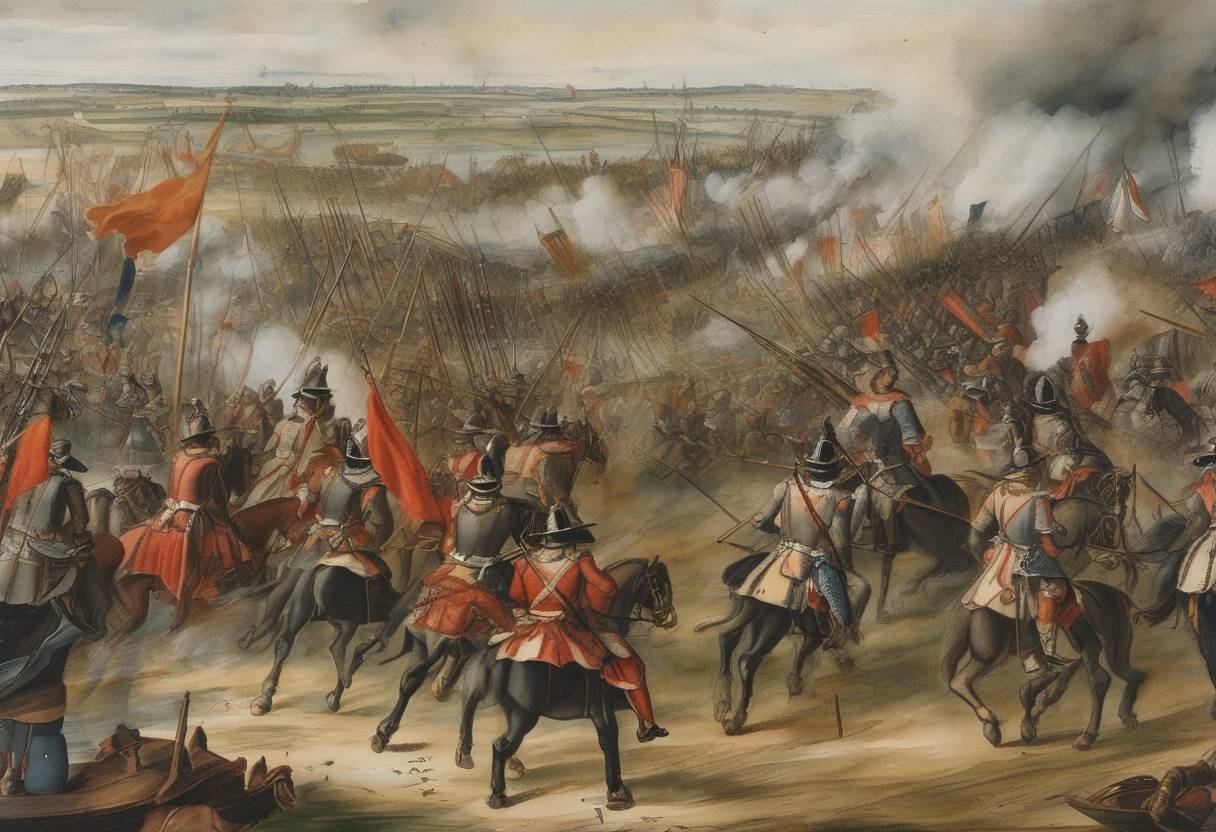
The Battle of Nieuwpoort: Prelude, May 31, 1600
On May 31, 1600, the Dutch-English army under the command of Maurice of Nassau began assembling in anticipation of the Battle of Nieuwpoort, a pivotal event during the Eighty Years’ War. This conflict was part of the broader struggle between the Spanish Habsburgs and the emerging Dutch Republic, which sought independence from Spanish rule.
Strategic Context
Eighty Years’ War: This prolonged conflict (1568–1648) was essentially a revolt of the Dutch provinces against the Spanish Empire, driven by religious, political, and economic tensions.
Maurice of Nassau’s Leadership: As the stadtholder and military leader of the Dutch Republic, Maurice was known for his innovative military tactics and strategic acumen. His leadership was crucial in the recent successes of the Dutch forces.
Prelude to the Battle
In the spring of 1600, Maurice received orders from the States-General to launch an offensive against the Spanish-occupied Flanders region. The aim was to seize key coastal positions, which would cripple Spanish logistics and provide the Dutch with a strong position for further incursions.
Assembling Forces: On May 31, Maurice’s forces began gathering near the coast, consisting of a well-disciplined contingent of roughly 12,000 foot soldiers and 2,000 cavalry, including English troops led by Sir Francis Vere.
Strategic Objectives: The campaign’s immediate objective was the capture of the port town of Nieuwpoort, a strategic stronghold providing access to the North Sea.
Significance
The preparations and eventual Battle of Nieuwpoort marked critical points in the Thirty Years’ continuation of warfare. Maurice’s decision reflected both the ambitions of the Dutch Republic to expand its influence and the evolving tactics of warfare during this period.
Maurice’s army, known for its drilled infantry and innovative deployment strategies, set the stage for a direct confrontation with the Spanish forces. As preparations concluded, the advancing Dutch-English alliance sought to capitalize on their new offensive strategy that promised a high-stakes challenge to the Spanish hold over the region.
The battle that ensued in early July, following these preparations, would be a testing ground for Maurice’s military innovations and have profound implications for the subsequent stages of the Eighty Years’ War.