Jacques Cartier Lands in Canada - July 24, 1534
1534 · Gaspé, Canada
French explorer Jacques Cartier lands in Canada, claiming it for France.
July 7, 1534
Jacques Cartier makes contact with indigenous peoples of the Gaspé Peninsula in present-day Quebec and claims the territory for France.
Gaspé Peninsula, Canada | Kingdom of France
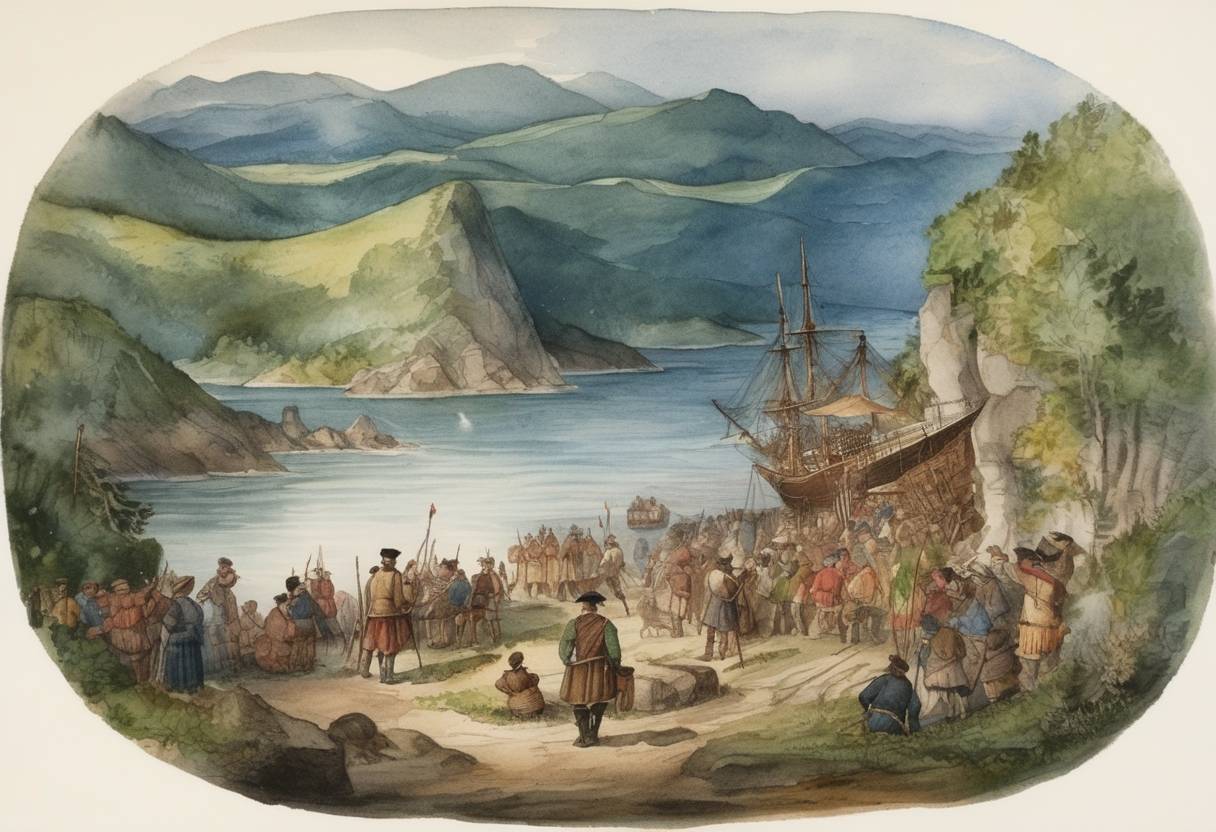
On July 7, 1534, the French explorer Jacques Cartier made a significant contact with the St. Lawrence Iroquoian peoples on the Gaspé Peninsula, an event pivotal in the history of French exploration in the Americas. This encounter occurred during Cartier’s first voyage to what is now Canada, an expedition sponsored by King Francis I of France, aiming to discover a western passage to Asia and to claim new lands for France.
Jacques Cartier departed from Saint-Malo, France, on April 20, 1534, with two ships and a crew of about 61 men. After crossing the Atlantic, he navigated through what is today Newfoundland and into the Gulf of St. Lawrence. His exploration eventually brought him to the Gaspé Peninsula, located in the present-day Canadian province of Quebec.
On July 7, Cartier and his crew landed on the Gaspé Peninsula where they were met by a group of St. Lawrence Iroquoians, known for their farming and established villages in the fertile St. Lawrence Valley. Initial interactions between Cartier and the indigenous group were cautious but friendly.
In a symbolic act mirrored by many European explorers of the time, Cartier and his men planted a 30-foot wooden cross on the shores of the peninsula, inscribed with the words “Vive le Roi de France” (“Long live the King of France”). This cross served as a territorial claim on behalf of King Francis I, marking the land as French territory. The act was intended to assert French sovereignty over the new lands, despite the presence of its indigenous inhabitants who had called it home long before Cartier’s arrival.
While Cartier’s planting of the cross was intended as a peaceful assertion of French presence, it sowed seeds of future tensions as indigenous perspectives on land, ownership, and sovereignty were dramatically different from the European view. This land claim was one of the first acts in what would become a long history of European colonization in North America.
Cartier’s voyages laid the foundation for subsequent French explorations and settlements, notably leading to Samuel de Champlain’s establishment of Quebec City in 1608. The interactions between Europeans and indigenous populations that followed were varied, often resulting in both cooperative alliances and destructive conflicts.
In summary, Jacques Cartier’s encounter with the indigenous peoples of the Gaspé Peninsula and his claim of the territory for France on July 7, 1534, marks a critical point in the history of French colonial ambitions in North America. It underscores the beginning of significant cultural exchanges and the often tumultuous interactions between European explorers and Native American societies.
Source: www.history.com