The Fall of Manila: August 13, 1898
1898 · Manila, Philippines
The Spanish-American War effectively ends with the fall of Manila to American forces, although the formal peace treaty is signed later.
February 4, 1899
The Philippine-American War begins with the Battle of Manila as hostilities break out between Filipino and American forces.
Manila, Philippines | United States military
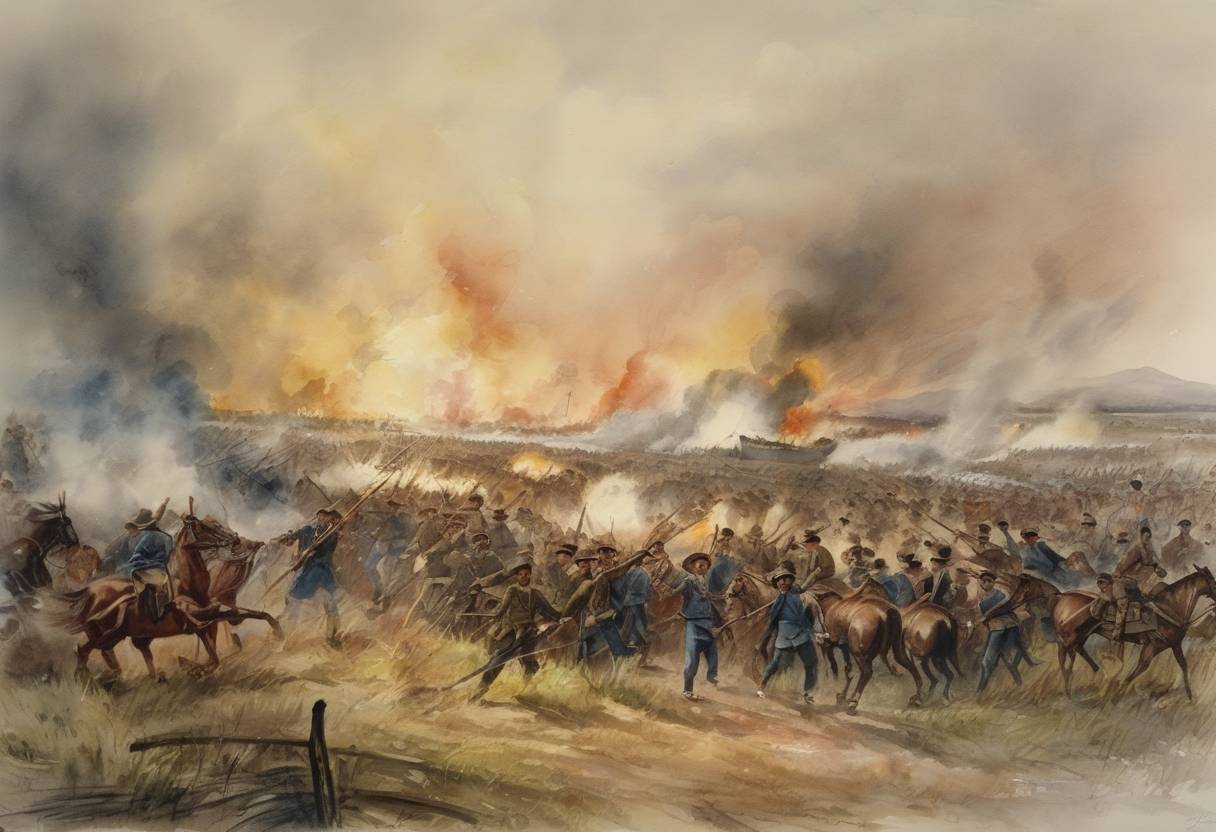
On February 4, 1899, the Battle of Manila marked the outbreak of the Philippine-American War. This conflict arose from the complex geopolitical interactions following the Spanish-American War, during which the United States acquired sovereignty over the Philippines from Spain under the 1898 Treaty of Paris.
After the Spanish-American War ended in December 1898 with the signing of the Treaty of Paris, the United States’ acquisition of the Philippines was met with resistance by Filipino nationalists. The Filipino forces, led by Emilio Aguinaldo, had been fighting for independence from Spanish colonial rule and expected to achieve sovereignty following the Spanish retreat. Tensions mounted as the United States asserted control over the archipelago without recognizing the aspirations of the newly declared First Philippine Republic.
The initial clash at the Battle of Manila occurred when an American sentry, located near San Juan del Monte Bridge just outside Manila, fired upon a group of Filipino soldiers patrolling the area between their respective lines. This skirmish swiftly escalated into a full-scale engagement as both sides mobilized forces. The American forces, under the command of General Elwell S. Otis, quickly organized a defense and retaliatory operations to secure strategic positions in and around Manila.
The fighting around Manila continued intensely for the following days, resulting in significant casualties on both sides. The Americans, with superior firepower and reinforcements, managed to push back the Filipino forces. This engagement marked the beginning of hostilities, leading to an expanded military conflict throughout the Philippine archipelago.
Despite initial successes, the United States faced protracted guerrilla warfare led by Aguinaldo and other Filipino insurgents. The conflict, which lasted until 1902, saw numerous battles and skirmishes, with Filipino resistance rooted in a desire for true independence rather than subjugation to another foreign power.
The Philippine-American War highlighted the contradictions of American imperialism during an era of purported progressivism and democracy. It spurred debates and divisions within the United States over the ethics and implications of colonial rule. Internationally, the conflict demonstrated the complexities of post-colonial transitions and the enduring legacy of colonialism in Southeast Asia.
The war ultimately resulted in significant Filipino casualties and hardship. It showcased the resilience of the Filipino nationalist movement, leading to eventual U.S. recognition of Philippine independence decades later, in 1946, after World War II. This conflict remains a pivotal chapter in both Philippine history and the broader narrative of American foreign policy and imperialism at the turn of the 20th century.
Source: www.history.com