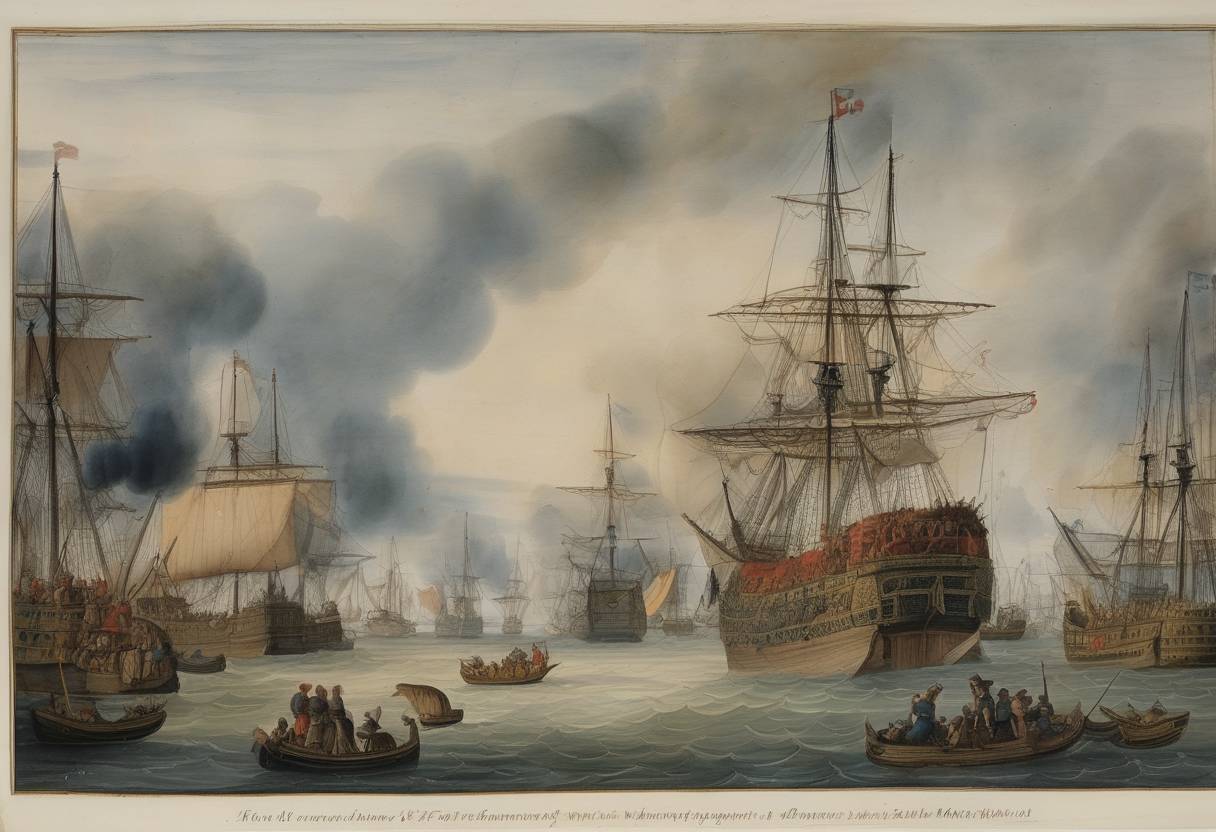
Battle of Deventer: June 23, 1594
The Battle of Deventer, occurring on June 23, 1594, was a significant naval engagement during the Eighty Years’ War, a protracted conflict between the Spanish Empire and the emerging Dutch Republic. This battle marked a crucial triumph for the Dutch forces under the leadership of Maurice of Nassau, as they engaged and defeated a Spanish fleet, further strengthening their naval capabilities and boosting morale in their campaign for independence.
Background
The Eighty Years’ War (1568-1648) was a struggle for independence by the provinces of what is now known as the Netherlands against Spanish Habsburg rule. The conflict was not only a fight for political sovereignty but also had deeply religious undertones, as it was a manifestation of the Protestant Reformation against the Catholic Spanish Crown. Maurice of Nassau, the Prince of Orange, was a key military and political leader for the Dutch.
The Battle
- Location: The battle took place near Deventer, a strategic town in the Province of Overijssel, Netherlands.
- Forces Involved: The Dutch naval forces, commanded by Maurice of Nassau, were pitted against a well-equipped Spanish fleet. The ability of the Dutch to leverage their naval strength was crucial to their approach against the more numerous Spanish forces.
- Tactics: Maurice’s fleet utilized innovative tactics leveraging shallow draft vessels and a high degree of maneuverability, which were crucial in the intricate waterways of the Dutch provinces.
Outcome and Significance
- Dutch Victory: The result was a decisive victory for the Dutch forces, further hampering Spanish sea power and securing vital maritime routes that were essential for Dutch trade and military movements.
- Strategic Impact: This victory enhanced the reputation of Maurice of Nassau as a formidable military strategist and increased the morale of the Dutch insurgent forces. It was instrumental in maintaining control over key positions along the waterways, crucial for maintaining pressure on Spanish fortifications in the region.
- Long-Term Consequence: The battle was part of a broader shift in naval technology and tactics during this period, reflecting a transition from traditional land-based engagements to naval dominance. It underscored the importance of controlling the sea in warfare strategy which would become a staple in European conflicts moving forward.
Maurice of Nassau
Maurice of Nassau played a pivotal role in the eventual independence of the Netherlands. His contributions to military tactics, especially in terms of revolutions in siege warfare and naval engagements, had lasting impacts on military doctrines in Europe.
By securing decisive victories such as the Battle of Deventer, Maurice not only reinforced Dutch aspirations for independence but also demonstrated the evolving nature of military engagements during the early modern period. This battle underscored the importance of innovative approaches and the strategic use of naval power in the broader context of the Eighty Years’ War.