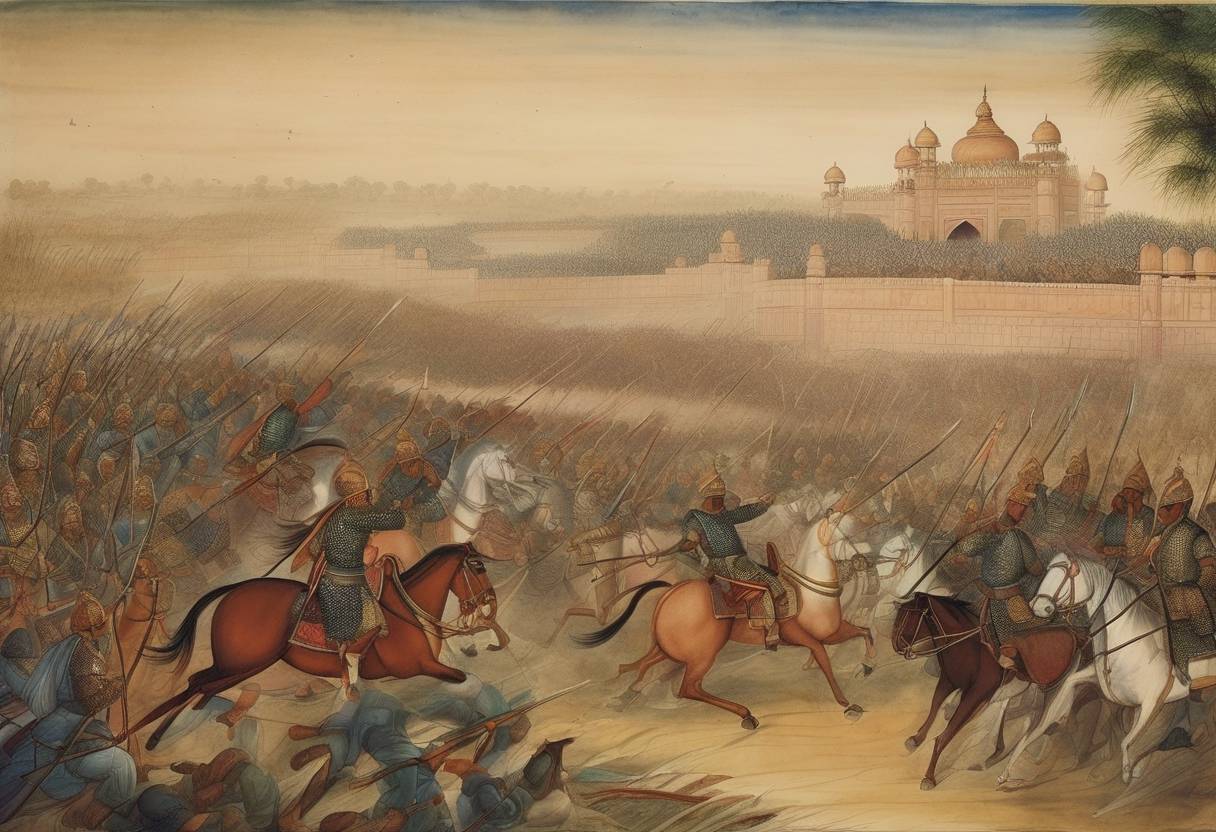
The First Battle of Panipat (April 21, 1526)
The First Battle of Panipat, which occurred on April 21, 1526, was a pivotal moment in Indian history that marked the beginning of the Mughal Empire. The confrontation took place at Panipat, a significant battlefield site in northern India, and resulted in a decisive victory for Zahir-ud-din Muhammad Babur, the founder of the Mughal Empire in India.
Background
- Context: The battle was fought during a period of political fragmentation in northern India following the decline of the Delhi Sultanate. Ibrahim Lodi was the Sultan of Delhi, yet his rule was fraught with dissent and rebellion among the nobility.
- Babur’s Ambitions: Babur, a descendant of Timur and Genghis Khan, aimed to build an empire in India after having established control over Kabul. His aspirations for territorial expansion were fueled by both personal ambition and the need to find new conquest territory after earlier failed attempts in Central Asia.
Key Details
- Forces: Babur’s army consisted of approximately 12,000 troops, including a substantial contingent of cavalry and a few hundred matchlock men. Ibrahim Lodi’s forces were significantly larger, with estimates ranging between 30,000 to 40,000 soldiers, along with 400 war elephants.
- Tactics: Babur employed superior tactics including the use of field artillery — a relatively new introduction to Indian warfare by Babur’s forces — which played a crucial role in neutralizing the threat posed by the elephants. His strategic use of the Tulughma tactic allowed his cavalry to encircle and isolate segments of Lodi’s forces.
The Battle
- Engagement: Early on April 21, Babur’s forces entrenched themselves using a tactic called “Ottoman-style” defensive formations. This arrangement was instrumental in providing a formidable line of defense against the larger army of Lodi.
- Outcome: At the height of battle, Babur’s use of coordinated cavalry assaults and artillery fire caused significant disarray within Lodi’s ranks. The effective use of firearm technology overwhelmed the Lodi forces unfamiliar with such warfare.
- Ibrahim Lodi: Sultan Ibrahim Lodi was killed during the battle, reportedly while making a valiant last stand against Babur’s troops.
Consequences
- Establishment of the Mughal Empire: The defeat marked the fall of the Lodi dynasty and facilitated Babur’s conquest of Delhi. It laid the foundation for over 300 years of Mughal rule in India, profoundly impacting the region’s culture, administration, and society.
- Military Innovations: The battle demonstrated the effectiveness of gunpowder weapons and mobile artillery, impacting subsequent military strategies in the Indian subcontinent.
- Historical Significance: The battle is often heralded as a turning point that transitioned India from medieval Islamic dynasties to the more centralized and impactful Mughal sovereignty, becoming one of the most enduring legacies in the subcontinent’s history.
The First Battle of Panipat remains a cornerstone event in South Asian history, symbolizing the beginning of a new era under the Mughal Empire’s dominion.