Johannes Kepler's Death - November 15, 1630
1630 · Regensburg, Holy Roman Empire (modern-day Germany)
Johannes Kepler, the renowned German mathematician and astronomer best known for his laws of planetary motion, passed away in Regensburg.
November 21, 1555
Georgius Agricola, a German scholar widely known as the 'father of mineralogy,' passed away. Agricola had significantly contributed to the development of mineralogy by authoring the influential work 'De Re Metallica,' which meticulously documented the techniques of ore mining, smelting, and the practical elements of metallurgy.
Chemnitz, Holy Roman Empire
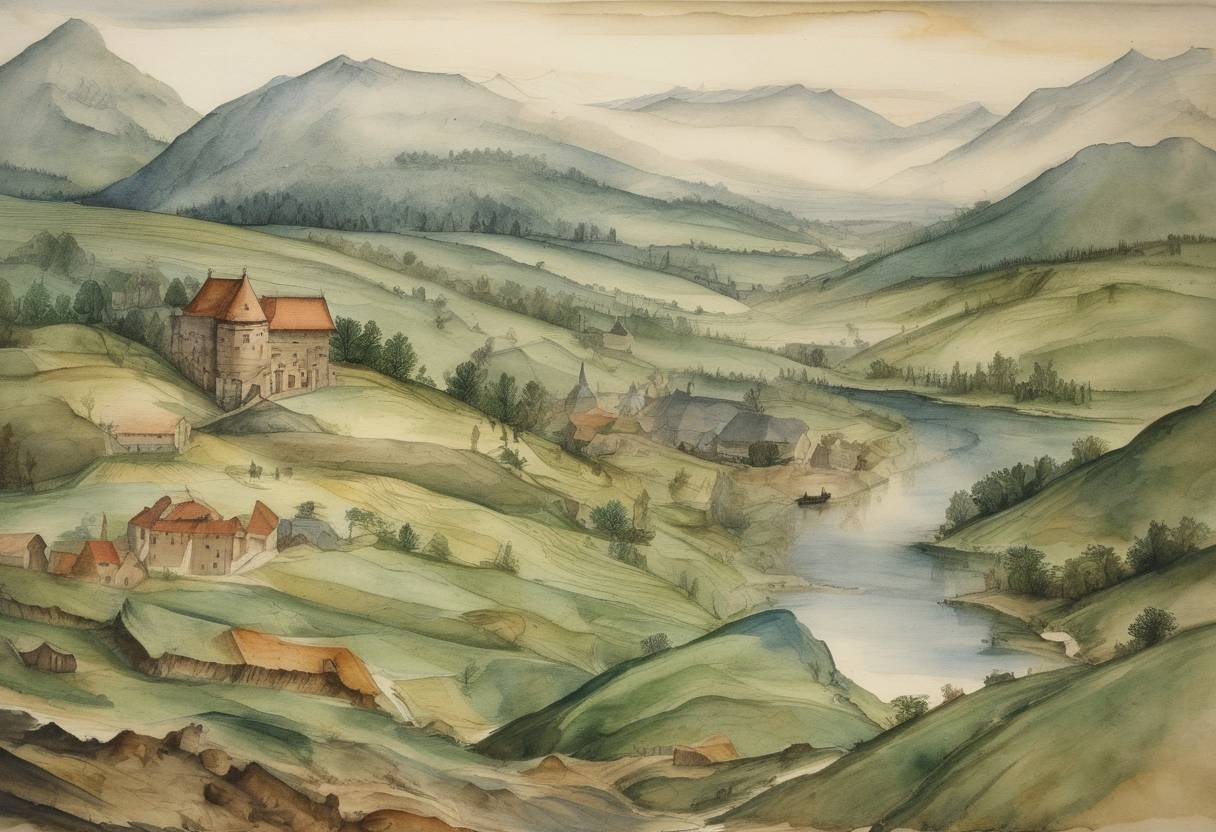
On November 21, 1555, Georgius Agricola, often hailed as the “father of mineralogy,” passed away in Chemnitz, Saxony. Agricola was a pioneering figure in the study of minerals and metallurgy, and his death marked the close of a remarkable career that laid the foundation for modern mineralogy and mining practices.
Agricola’s most significant contribution to science is his seminal work, De Re Metallica, published posthumously in 1556. This comprehensive treatise is a detailed account of the state of mining, refining, and smelting of ores around his time. The work consisted of twelve books, each examining a different aspect of mining or metallurgy, including geology, the use of machinery, the chemistry of metals, and the role of various minerals in medicine.
Technical Depth: De Re Metallica is renowned for its depth of technical knowledge. Agricola described the methods of locating ore deposits, the ore extraction processes, and the equipment used in mines. He detailed everything from the building of smelting furnaces to the treatment of metal.
Illustrations and Language: The book includes numerous woodcut illustrations, offering visual guidance alongside his descriptions, which was crucial for miners and metallurgists of the time. Furthermore, Agricola wrote in Latin, the scholarly language of the period, ensuring that his work could disseminate across Europe.
Influence: The work impacted mining and metallurgy techniques for centuries, remaining a reference point for practitioners and scholars. It set a standard for scientific accuracy and practical guidance in the metallurgical sciences.
Agricola’s scientific approach established mineralogy as a discipline and demonstrated the significance of empirical data and direct observation. His contributions reflect an early manifestation of the transition from medieval alchemical traditions to a more modern scientific perspective rooted in observation and evidence.
Context in History: The period in which Agricola lived was one of transition, moving from the medieval mindset towards the Renaissance. His scholarly rigor in cataloging fabrication and refining processes showcased the era’s broader movement towards scientific exploration and documentation.
Further Influence: Agricolas’ work inspired later scientists, notably the likes of René Descartes and Isaac Newton, who built upon the principles of scientific inquiry and observation.
Georgius Agricola’s life and work were seminal in the history of geology and mining practices. His meticulous documentation and scientific approach made De Re Metallica a cornerstone of mining literature and earned him a lasting reputation as a foundational figure in the evolution of mineral sciences. His death was not merely the end of a career but a reflection of the transformative cultural and scientific advancements of the 16th century.
Source: en.wikipedia.org