Napoleon Bonaparte's Surrender on July 15, 1815
1815 · Rochefort, France
Napoleon Bonaparte surrendered to Captain Frederick Maitland of HMS Bellerophon, marking the end of the Napoleonic Wars.
August 8, 1815
Napoleon Bonaparte sets sail for exile on Saint Helena aboard the British ship HMS Northumberland.
Rochefort, France | British Royal Navy
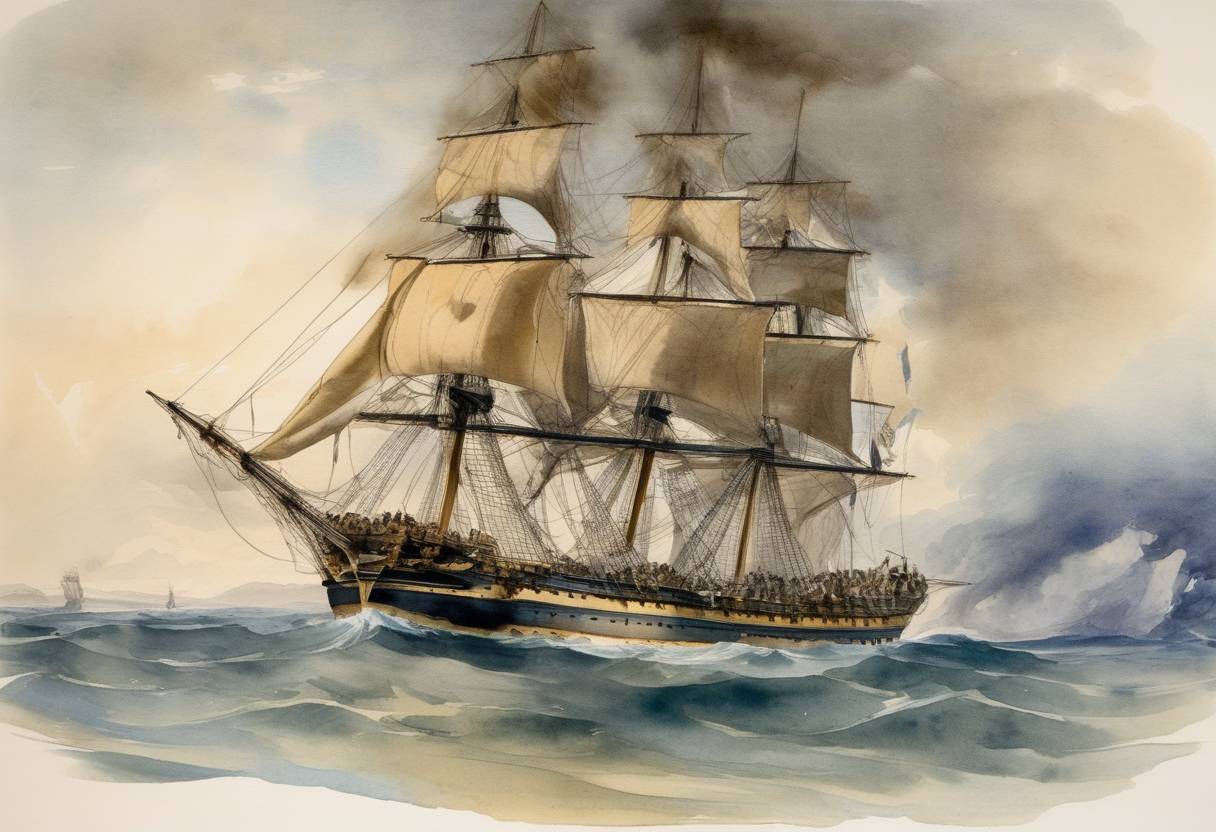
On August 8, 1815, Napoleon Bonaparte, the former Emperor of the French, embarked on a pivotal journey that marked the end of his political and military career. He set sail for exile on the remote island of Saint Helena aboard the British ship HMS Northumberland. This event occurred after his abdication and the defeat at the Battle of Waterloo on June 18, 1815, which resulted in his surrender to the British.
Following his initial abdication on April 6, 1814, Napoleon was exiled to the island of Elba. However, he managed to escape and return to power in France briefly during the period known as the Hundred Days. During this time, he attempted to rekindle the Napoleonic regime, which ultimately led to the confrontation with the Seventh Coalition at Waterloo.
After his definitive defeat, Napoleon sought asylum with the British, hoping for more lenient treatment or perhaps resettlement in the United States. The British government, determined to curtail any possible resurgence of his influence, resolved to exile him to Saint Helena, a choice motivated by the island’s isolation in the South Atlantic.
Napoleon embarked on the HMS Northumberland at the port of Torbay, England. The journey was logistically challenging due to both the distance and Napoleon’s stature. The British were keen to prevent any escape or rescue attempts, given Napoleon’s history and the significance of his previous naval strategies.
Saint Helena was chosen due to its remoteness and difficult accessibility, minimizing the risk of escape or communication with supporters in Europe. This period marked the final chapter of Napoleon’s political life. During his exile, Napoleon engaged in dictating his memoirs, reflecting on his military campaigns, governance, and philosophical views.
The exile of Napoleon Bonaparte served as a symbolic endpoint to the revolutionary Napoleonic Wars that had reshaped Europe in the preceding decades. It allowed European powers to stabilize under the Congress of Vienna’s resolutions and shift focus to internal development and colonial pursuits.
Napoleon remained on Saint Helena under British custody until his death on May 5, 1821. His legacy, however, endured far beyond his life, influencing political ideologies, military tactics, and nationalist movements. His final exile signified the demise of one of history’s most influential and controversial leaders, sealing his legendary status in both European and global history.
Source: www.britannica.com