Galileo Galilei's Arrival in Rome for His Trial
1633 · Rome, Italy
Galileo Galilei arrived in Rome for his trial before the Inquisition.
April 12, 1633
The formal inquisition of Galileo Galilei by the Roman Catholic Church begins, investigating his support of the heliocentric model.
Rome, Italy | Roman Catholic Church
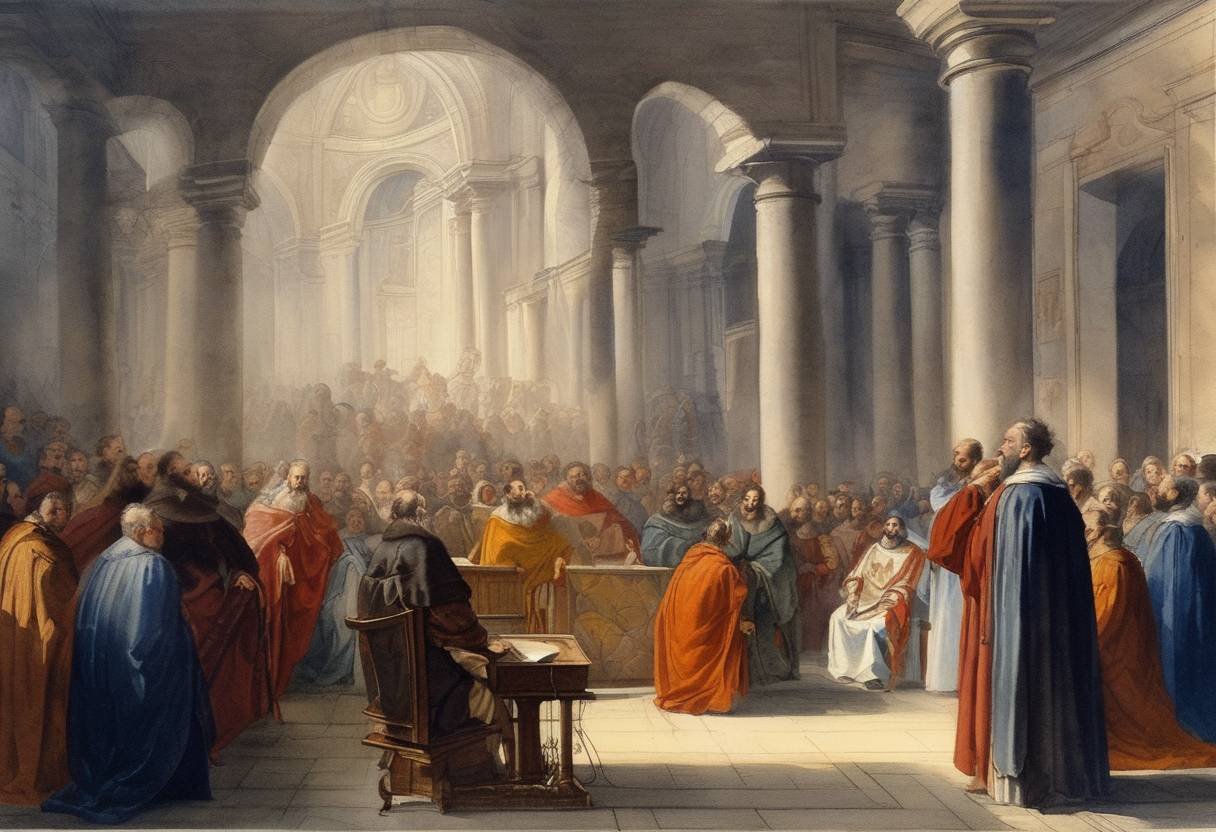
On April 12, 1633, the formal inquisition of Galileo Galilei commenced in Rome by the Roman Catholic Church. This marked a pivotal moment in the history of science and religion, as it was deeply intertwined with the controversies over heliocentrism, inaugurated by Nicolaus Copernicus in the 16th century.
Galileo Galilei, an Italian astronomer, physicist, and polymath, was a prominent figure in the Scientific Revolution. His observations and writings garnered significant attention due to their endorsement of the heliocentric model of the solar system, which posited that the Earth and other planets revolve around the Sun. This model starkly contrasted with the prevailing geocentric model, which positioned the Earth at the center of the universe, in alignment with church doctrine.
In 1616, the Catholic Church had already issued a decree condemning heliocentrism as formally heretical. Galileo was admonished to abandon his support for the heliocentric view. Despite this, he published “Dialogue Concerning the Two Chief World Systems” in 1632, which appeared to advocate for heliocentrism indirectly, exacerbating tensions with the Church authorities.
The investigation initiated on April 12, 1633, was led by the Roman Inquisition, a powerful arm of the Catholic Church responsible for handling cases of heresy. The crux of the inquisitors’ argument focused on whether Galileo had contravened the 1616 injunction by defending heliocentrism explicitly or implicitly in his writings. Galileo faced intense questioning and pressure to recant his views, under the shadow of potential punitive measures.
The inquisition culminated in June 1633 with Galileo being found “vehemently suspect of heresy.” He was required to abjure, curse, and detest his heliocentric views. As a result, Galileo was placed under house arrest for the remainder of his life, during which he continued his scientific work, albeit away from public eye and controversy.
The trial of Galileo Galilei is emblematic of the conflict between scientific inquiry and religious authority during the era. It highlights the challenges faced by early scientists in gaining acceptance for revolutionary ideas that contradicted traditional doctrines. Galileo’s trial left a lasting legacy on the discourse between science and religion and underscored the eventual separation of these spheres in the pursuit of knowledge.
In the broader scope of history, the event is seen as a catalyst for progressive thought, paving the way for future intellectuals and scientists to explore and challenge established paradigms, ultimately advancing the course of human understanding.
Source: www.history.com