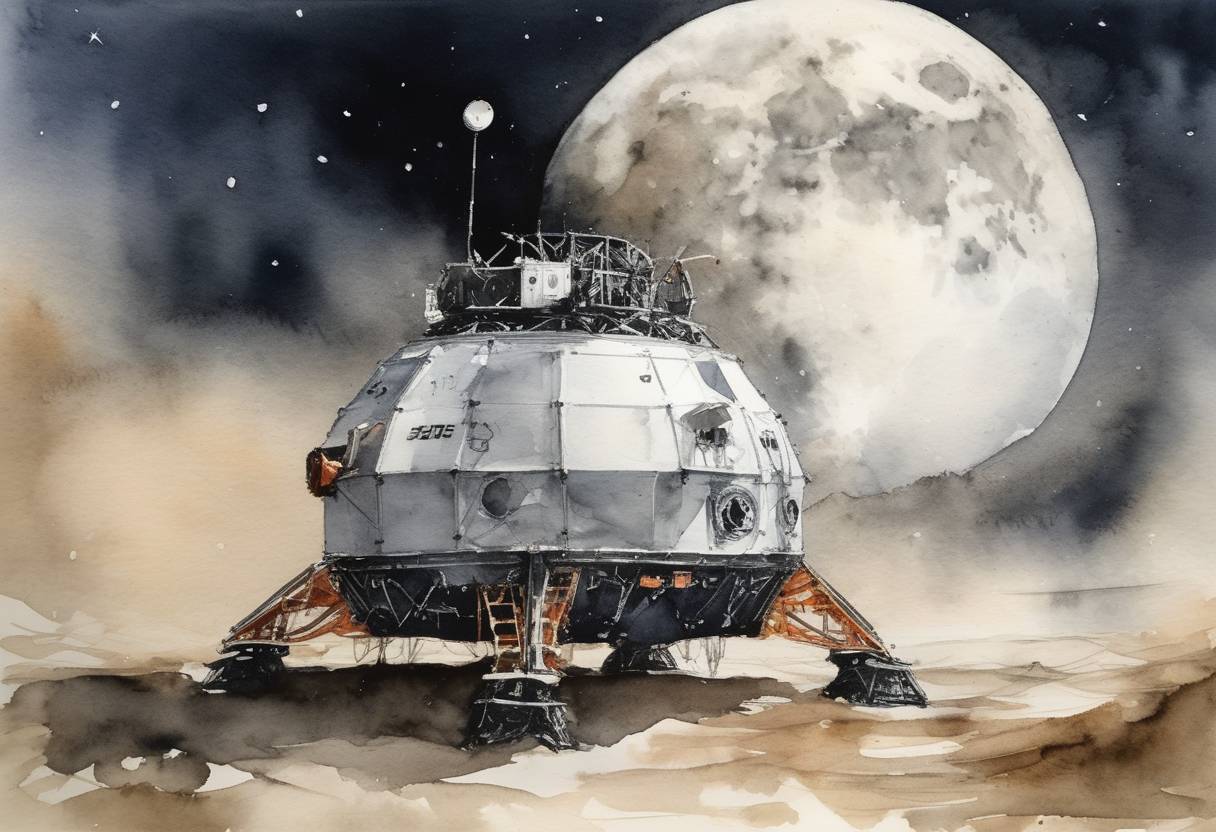
Chang’e 4 Lunar Landing
On January 2, 2019, China’s Chang’e 4 mission achieved a historic milestone by successfully landing on the far side of the moon. This event marked the first time in history that a spacecraft had landed on this unexplored hemisphere, often referred to as the “dark side” of the moon—a term more poetic than accurate, since both lunar hemispheres receive equal amounts of sunlight over time.
Mission Background
Part of China’s ambitious lunar exploration program, Chang’e 4 was launched on December 7, 2018, aboard a Long March 3B rocket from the Xichang Satellite Launch Center. Named after the Chinese moon goddess, Chang’e, the mission consisted of a lander and a rover designed to explore the geology and environment of the moon’s far side.
Landing Site and Objectives
The spacecraft landed in the South Pole-Aitken Basin’s Von Kármán Crater, a scientifically intriguing area due to its potential to offer new insights into the moon’s history, particularly its composition and structure. The primary objectives of the Chang’e 4 mission included:
- Geological Analysis: To study the geological conditions and the composition of minerals on the lunar surface.
- Radio Astronomy Research: To conduct low-frequency radio astronomical observations, taking advantage of the absence of Earth’s radio interference.
- Biological Experimentation: To observe the growth of plants and insects in the lunar environment, part of a mini-biosphere experiment carried aboard the spacecraft.
Instruments and Technologies
The mission utilized advanced technologies, including a relay satellite, Queqiao, positioned at the Earth-Moon L2 point to facilitate communication between the spacecraft and mission control on Earth. Chang’e 4 was equipped with various instruments:
- Visible and Near-Infrared Imaging Spectrometer (VNIS): For mineral identification and geological analysis.
- Lunar Penetrating Radar (LPR): To probe the subsurface structure around the landing site.
- Low Frequency Spectrometer (LFS): For conducting astronomical observations.
Broader Implications
Chang’e 4’s successful operation represented a significant achievement for China’s burgeoning space program, reflecting the nation’s growing capabilities in space exploration. Moreover, this mission paved the way for future explorations, including ambitions for a crewed lunar mission and a potential lunar base.
This historic landing not only advanced scientific understanding of the lunar far side but also underlined the increasing role of China in the global space community. Beyond its scientific goals, the mission exemplified international cooperation, with numerous countries contributing instruments and research inputs.
As the exploration of the moon continues to evolve, Chang’e 4 remains a testament to human ingenuity and the unyielding quest for knowledge beyond our planet.