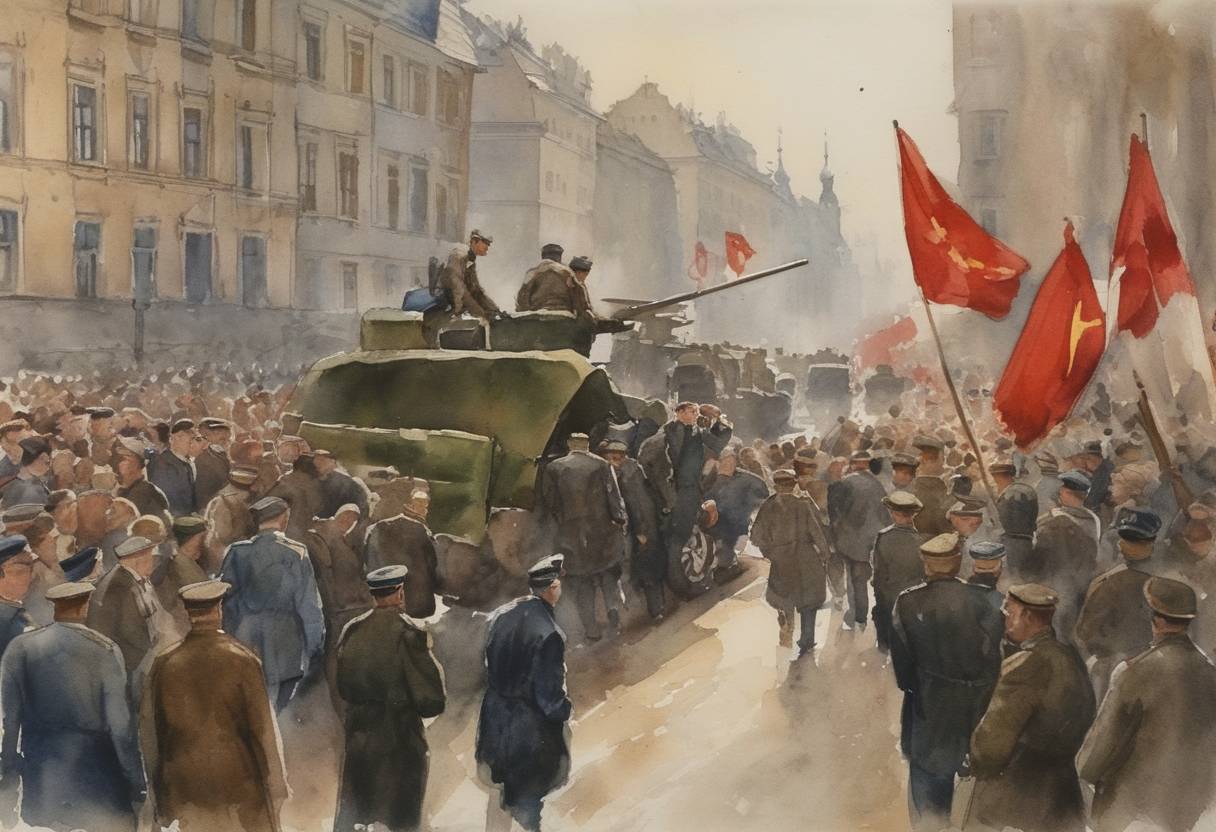
Communist Coup in Czechoslovakia - February 22, 1948
On February 22, 1948, the Communist Party of Czechoslovakia (KSČ), under the leadership of Klement Gottwald, initiated decisive steps that would lead to the party seizing control of the Czechoslovak government. This event marked the beginning of the communist consolidation in Czechoslovakia, influenced heavily by the Soviet Union’s broader strategy in Eastern Europe.
Context
Post-World War II Europe was a landscape of significant political realignment. Czechoslovakia, having been liberated from Nazi occupation, initially maintained a coalition government that included both Communists and non-Communists. This government was structurally fragile and increasingly polarized amidst the rising tensions of the early Cold War period.
Key Events Leading to February 22, 1948
Tensions in the Coalition: By early 1948, internal conflicts in the National Front government were escalating, largely due to divergent visions for the country’s future, amplified by the pressures of the Cold War.
Communist Influence: The KSČ, benefiting from Soviet backing and strategic positioning within the government and state machinery, including the Ministry of Interior, was increasingly assertive.
February 22 and Subsequent Events
Resignations: On February 20, non-Communist ministers resigned in protest against Communist tactics, hoping to force a government reformation. However, this move backfired.
Gottwald’s Response: On February 22, amidst a growing political crisis, Klement Gottwald escalated the situation by refusing the resignations and instead called for pro-Communist demonstrations.
Police Force Control: The Communists had, by this date, effectively seized control of the national police force, an essential tool in enforcing political order and suppressing opposition.
The Aftermath
Februrary 25, 1948 - “Victorious February”: Shortly after February 22, Gottwald and the KSČ, with Soviet support, completed their takeover, often termed the “Victorious February,” where President Edvard Beneš capitulated to Communist demands, effectively installing a single-party communist regime.
Impact on Eastern Europe: This pivotal event signaled a firm entrenchment of Soviet influence in Eastern Europe, contributing to the division of Europe into spheres of influence that defined the early Cold War geopolitical landscape.
Broader Significance
The Communist coup in Czechoslovakia was a critical moment that illustrated the strategic expansion of Soviet influence in Eastern Europe post-World War II. It underscored the fragility of coalitional governments in the face of ideological division and external pressures, shaping the region’s political landscape for decades.