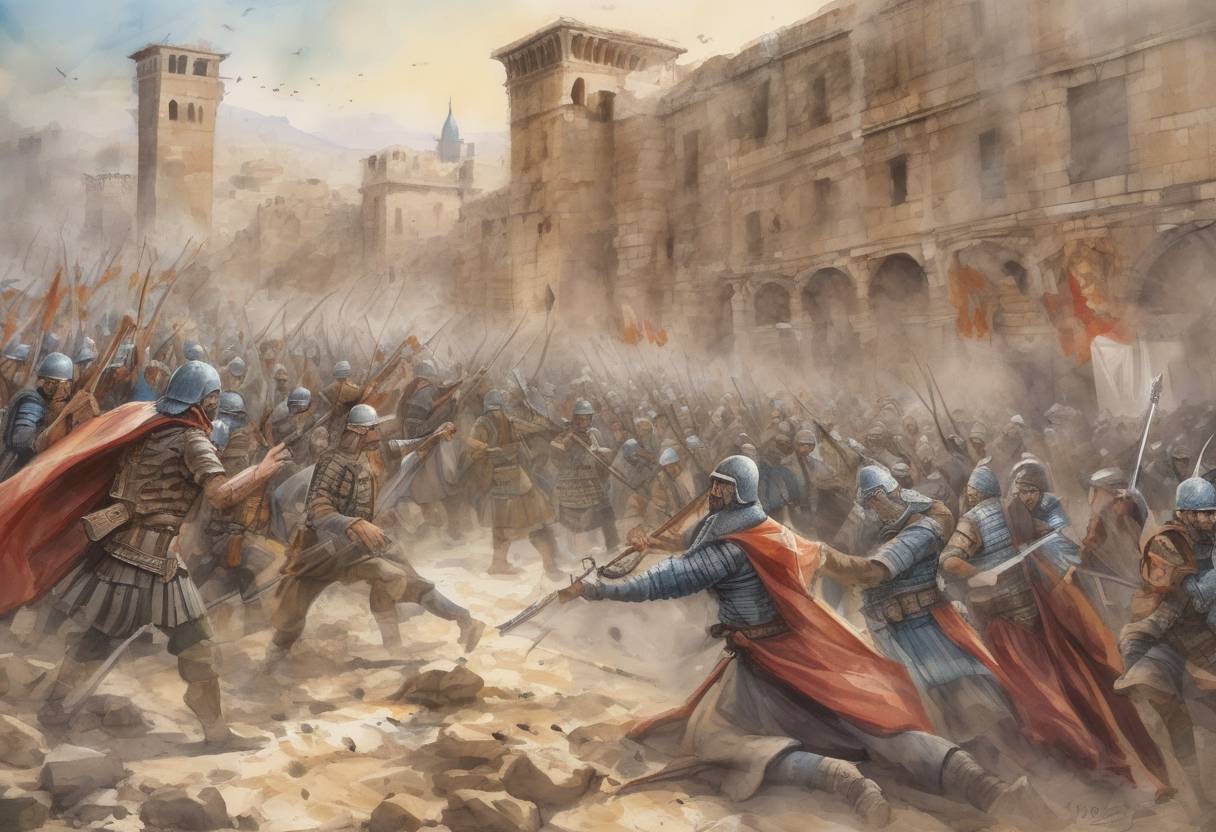
The Battle of Yarmouk: A Decisive Victory
Date and Context
The Battle of Yarmouk concluded on August 21, 636, marking a pivotal moment in the early Islamic conquests. This battle was fought between the forces of the Rashidun Caliphate and the Byzantine Empire, near the Yarmouk River, which is now part of the border region between modern-day Syria and Jordan.
Background
The Byzantine Empire, under Emperor Heraclius, was one of the dominant powers in the region, having recently repelled the Sassanian Persians. However, the empire was weakened by years of warfare and internal strife. Meanwhile, the Rashidun Caliphate, under the leadership of Caliph Umar ibn al-Khattab, sought to expand its territories beyond the Arabian Peninsula.
- Khalid ibn al-Walid: The commander of the Rashidun forces, known for his strategic acumen and military prowess.
- Heraclius: The Byzantine Emperor, who orchestrated the defense of his empire from Antioch.
- Vahan: The Armenian general leading the Byzantine forces on the ground.
The Battle
The battle unfolded over six days, characterized by intense and strategic maneuvers. Khalid ibn al-Walid’s leadership was instrumental in the Rashidun victory. He effectively utilized the mobility and discipline of his troops to counter the larger Byzantine forces. The Rashidun army, though outnumbered, employed tactics such as feigned retreats and flanking maneuvers to disrupt the Byzantine formations.
Outcome
The decisive victory at Yarmouk had significant consequences:
- Control of Syria: The Rashidun Caliphate gained control over Syria, a crucial region for trade and military strategy.
- Byzantine Retreat: The defeat forced the Byzantines to retreat further north, losing their grip on the Levant.
- Expansion of Islam: This victory paved the way for further Islamic expansion into the Byzantine territories, including Egypt and beyond.
Historical Significance
The Battle of Yarmouk is considered one of the most significant military engagements in early Islamic history. It not only marked the decline of Byzantine influence in the region but also facilitated the spread of Islam and the establishment of a new political and cultural order in the Middle East. The battle demonstrated the effectiveness of the Rashidun military strategies and the resilience of its forces, setting a precedent for future conquests.
In summary, the Battle of Yarmouk was a turning point that reshaped the geopolitical landscape of the Middle East, leading to the rise of Islamic power and the decline of Byzantine control in the region.