"My Country, 'Tis of Thee" First Performance
1831 · Boston, United States
Samuel Francis Smith's song "My Country, 'Tis of Thee" is performed for the first time in Boston.
July 4, 1845
Henry David Thoreau began his two-year experiment in simple living at Walden Pond.
Concord, United States | N/A
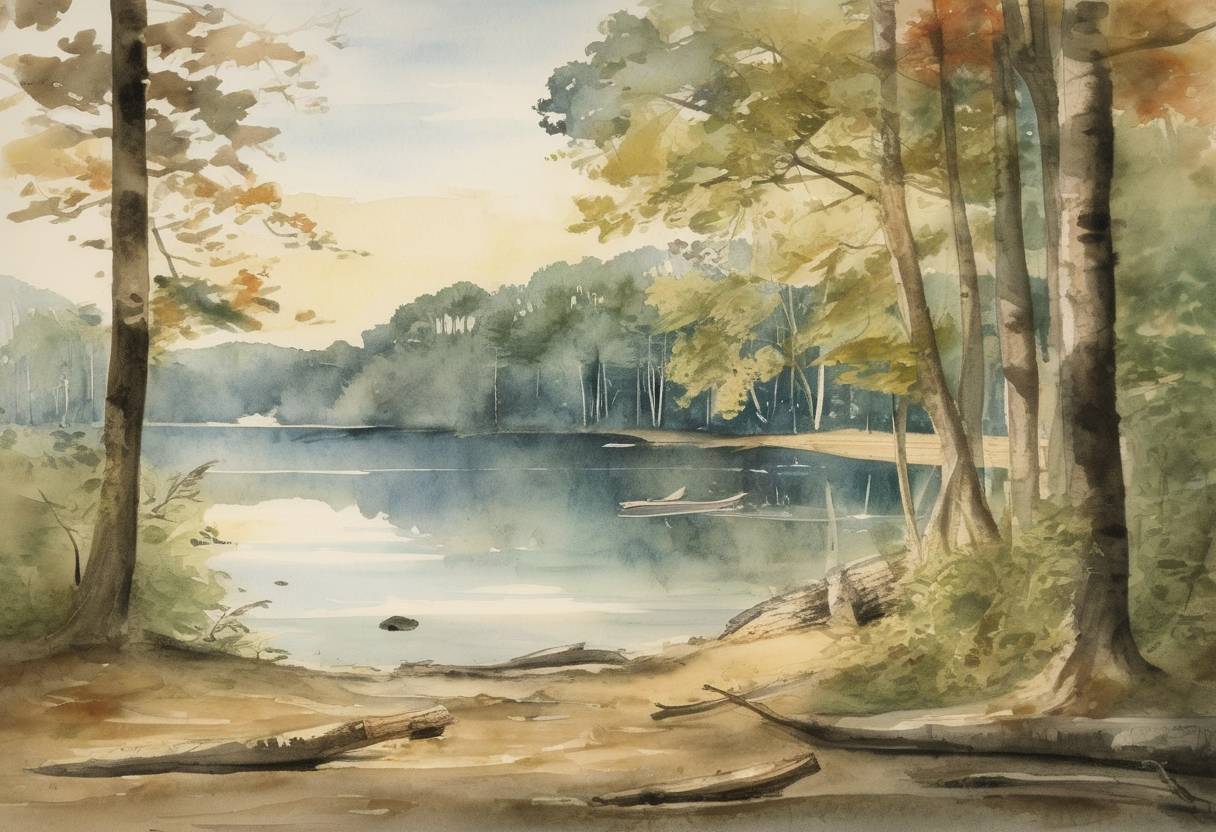
On July 4, 1845, Henry David Thoreau embarked on a transformative experiment in simple living at Walden Pond, near Concord, Massachusetts. This date marks the beginning of a two-year period during which Thoreau sought to explore the essentials of life, away from the complexities of society.
Henry David Thoreau was a prominent American transcendentalist, writer, and philosopher. The transcendentalist movement, which included figures like Ralph Waldo Emerson, emphasized individual intuition and the inherent goodness of people and nature. Thoreau’s decision to live at Walden Pond was influenced by these ideals, as well as his desire to live deliberately and self-sufficiently.
Thoreau constructed a small cabin on land owned by Emerson, where he lived from July 4, 1845, to September 6, 1847. His purpose was to strip life down to its bare essentials and to gain a deeper understanding of himself and the natural world. Thoreau engaged in activities such as reading, writing, farming, and observing nature. He meticulously documented his experiences and reflections, which later formed the basis of his seminal work, “Walden; or, Life in the Woods,” published in 1854.
Simplicity: Thoreau advocated for a life of simplicity, arguing that material possessions and societal expectations often distract from true fulfillment.
Self-Reliance: Living at Walden Pond allowed Thoreau to practice self-reliance, a core tenet of transcendentalism, by growing his own food and constructing his own shelter.
Nature and Solitude: Thoreau’s writings emphasize the importance of nature and solitude in achieving personal growth and understanding.
Civil Disobedience: Although not directly related to his time at Walden, Thoreau’s experience there influenced his later essay, “Civil Disobedience,” which argues for individual resistance to unjust government practices.
Thoreau’s experiment at Walden Pond had a lasting impact on American literature and philosophy. “Walden” is considered a classic of American literature, inspiring countless readers to reflect on their own lives and the society in which they live. Thoreau’s ideas on civil disobedience have influenced notable figures such as Mahatma Gandhi and Martin Luther King Jr.
In summary, Thoreau’s time at Walden Pond was a profound exploration of simplicity, self-reliance, and the human connection to nature. His reflections continue to resonate, encouraging individuals to consider the true necessities of life and the value of introspection.
Source: en.wikipedia.org