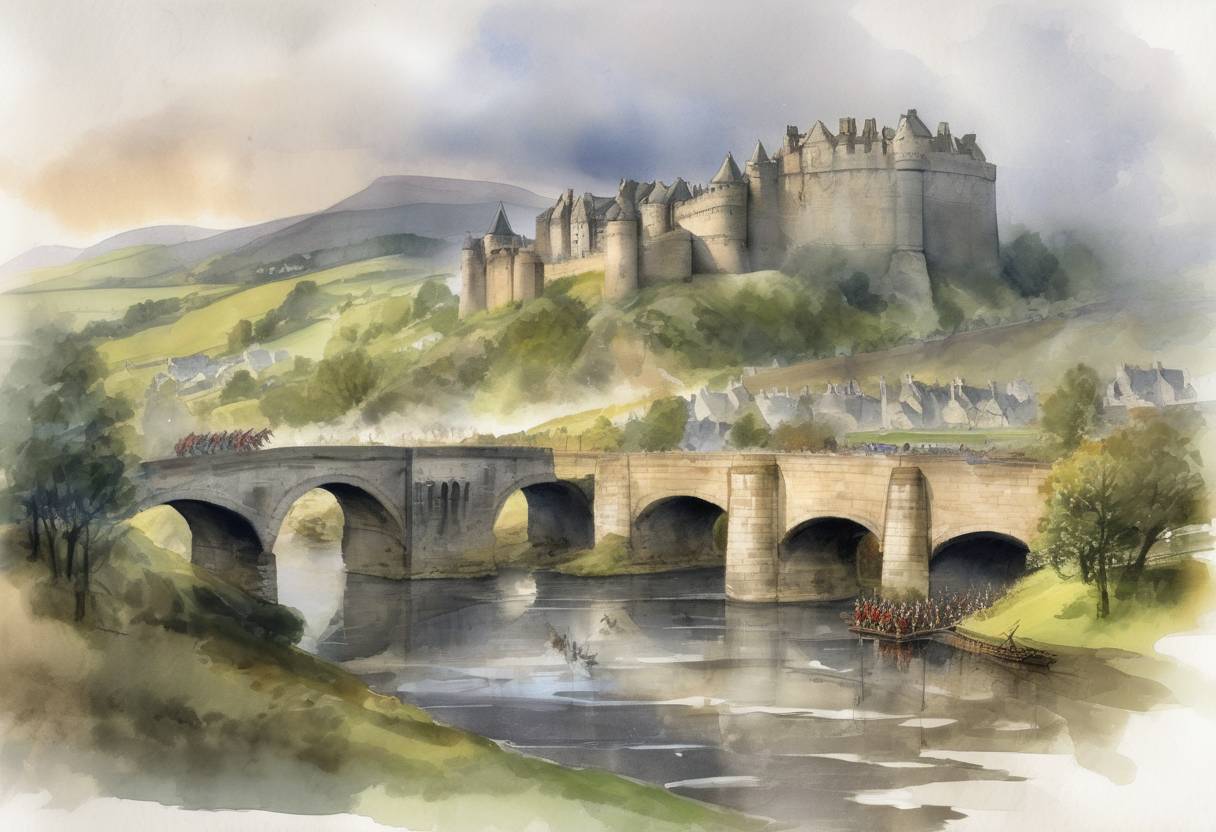
The Battle of Stirling Bridge: September 11, 1297
The Battle of Stirling Bridge was a significant conflict during the First War of Scottish Independence, marking a pivotal victory for the Scottish forces against the English. This battle took place on September 11, 1297, near Stirling, Scotland, and was led by the renowned Scottish leaders William Wallace and Andrew Moray.
Context Leading Up to the Battle
- Background: The late 13th century was a tumultuous period for Scotland, as it struggled for independence from English rule. King Edward I of England had asserted dominance over Scotland, leading to widespread unrest and rebellion.
- Scottish Resistance: In 1297, resistance against English occupation intensified. William Wallace, a minor noble, emerged as a prominent leader of the rebellion, alongside Andrew Moray, who had been leading uprisings in the north.
The Battle
- Location: The battle took place at Stirling Bridge, a strategic crossing over the River Forth. Control of this bridge was crucial for movement and supply lines.
- Scottish Strategy: Wallace and Moray employed a clever strategy, utilizing the narrowness of the bridge to their advantage. They allowed a portion of the English forces to cross before launching a surprise attack, effectively cutting them off from reinforcements.
- English Forces: Led by John de Warenne, the Earl of Surrey, and Hugh de Cressingham, the English army was significantly larger and better equipped. However, their overconfidence and underestimation of the Scottish tactics led to their downfall.
- Outcome: The Scots achieved a decisive victory. The English forces were thrown into disarray, with many soldiers either killed or drowned in the river. Hugh de Cressingham was among those killed, and his death symbolized a significant blow to English morale.
Aftermath and Significance
- Scottish Morale: The victory at Stirling Bridge was a major boost for Scottish morale and a testament to the effectiveness of guerrilla tactics against a larger, more conventional army.
- William Wallace’s Rise: Following the battle, Wallace’s reputation soared, and he was appointed Guardian of Scotland, serving as a symbol of resistance against English oppression.
- Continued Conflict: Despite the victory, the struggle for Scottish independence continued, with further battles and political maneuvering. The conflict would persist until the eventual recognition of Scottish independence in the Treaty of Edinburgh-Northampton in 1328.
The Battle of Stirling Bridge remains a celebrated event in Scottish history, emblematic of the fight for freedom and the strategic brilliance of leaders like Wallace and Moray.