The First Transatlantic Telephone Service: January 7, 1927
1927 · New York City, United States
The first transatlantic telephone service was established between New York City and London, marking a significant milestone in global communications.
October 31, 1926
Harry Houdini, the famous magician and escape artist, dies of peritonitis in Detroit, Michigan.
Detroit, United States
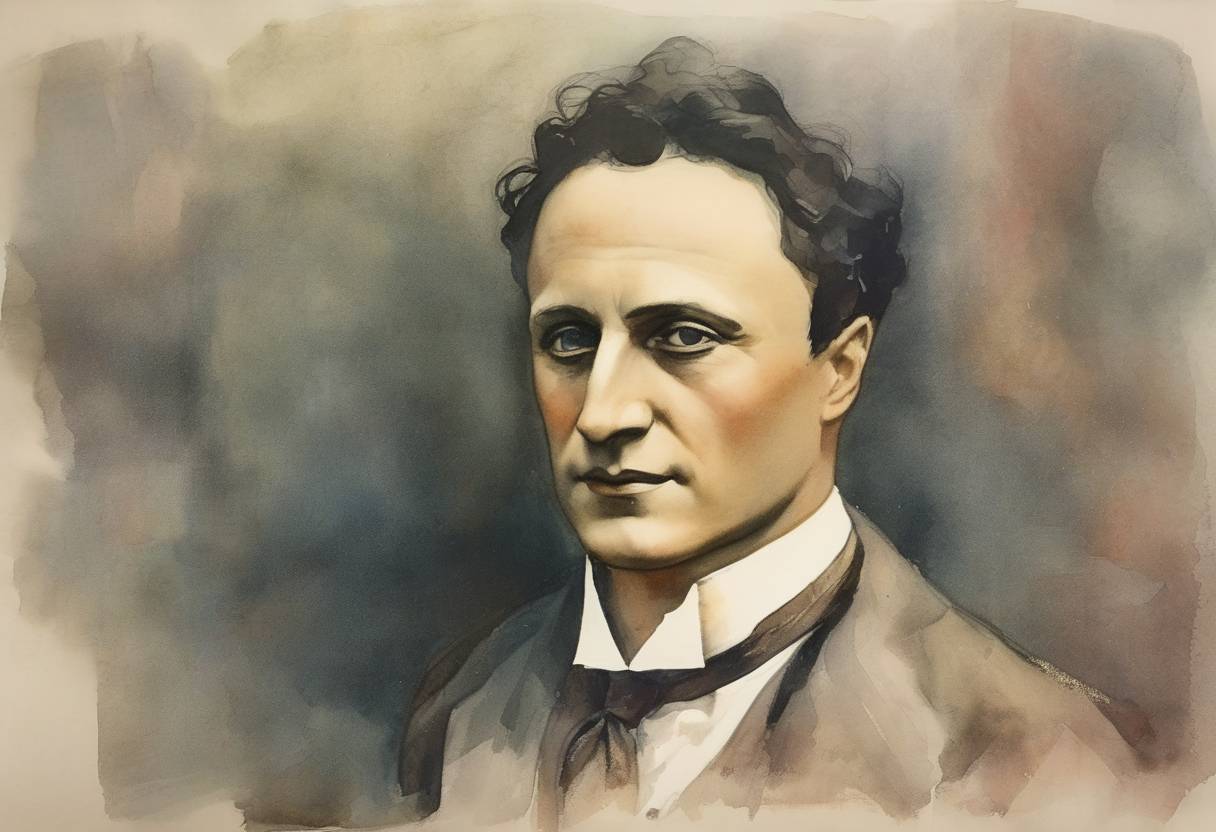
On October 31, 1926, the world-renowned magician and escape artist Harry Houdini passed away in Detroit, Michigan, due to peritonitis, a complication arising from a ruptured appendix. Houdini’s death marked the end of an era for the entertainment world, as he was one of the most celebrated performers of his time.
Harry Houdini, born Erik Weisz on March 24, 1874, in Budapest, Hungary, immigrated to the United States with his family in 1878. He began his career in magic in the late 19th century, eventually gaining fame for his incredible escape acts. Houdini was known for his ability to free himself from handcuffs, straitjackets, and even sealed containers submerged in water. His daring performances captivated audiences worldwide and earned him a legendary status.
In the weeks leading up to his death, Houdini was performing in Montreal, Canada. During a lecture at McGill University on October 22, 1926, a student named J. Gordon Whitehead asked Houdini if it was true that he could withstand any punch to the abdomen. Houdini affirmed this claim, and Whitehead unexpectedly delivered several heavy blows to Houdini’s stomach before he had a chance to brace himself.
Houdini continued to perform despite experiencing severe pain, which he initially dismissed. However, his condition worsened as he traveled to Detroit for a series of performances. On October 24, 1926, he was admitted to Grace Hospital in Detroit, where doctors diagnosed him with acute appendicitis. Despite undergoing surgery, Houdini’s appendix had already ruptured, leading to peritonitis, an inflammation of the abdominal lining.
Houdini died on October 31, 1926, at the age of 52. His death was a significant loss to the world of magic and entertainment. Houdini’s funeral, held in New York City, was attended by thousands, including fellow magicians and admirers. He was buried in Machpelah Cemetery in Queens, New York.
Houdini’s legacy endures through his contributions to the art of magic and his influence on future generations of performers. He is remembered not only for his extraordinary escape acts but also for his efforts to debunk fraudulent spiritualists and mediums, advocating for truth and skepticism.
Houdini’s life and career coincided with a period of great change in the entertainment industry, as vaudeville and live performances were giving way to cinema and radio. His ability to captivate audiences with his daring feats and charismatic personality set a standard for showmanship that continues to inspire entertainers today.
Houdini’s death on Halloween, a day associated with the supernatural, added an eerie element to his already mystical persona. His passing marked the end of an era, but his influence on magic and popular culture remains profound.
Source: en.wikipedia.org