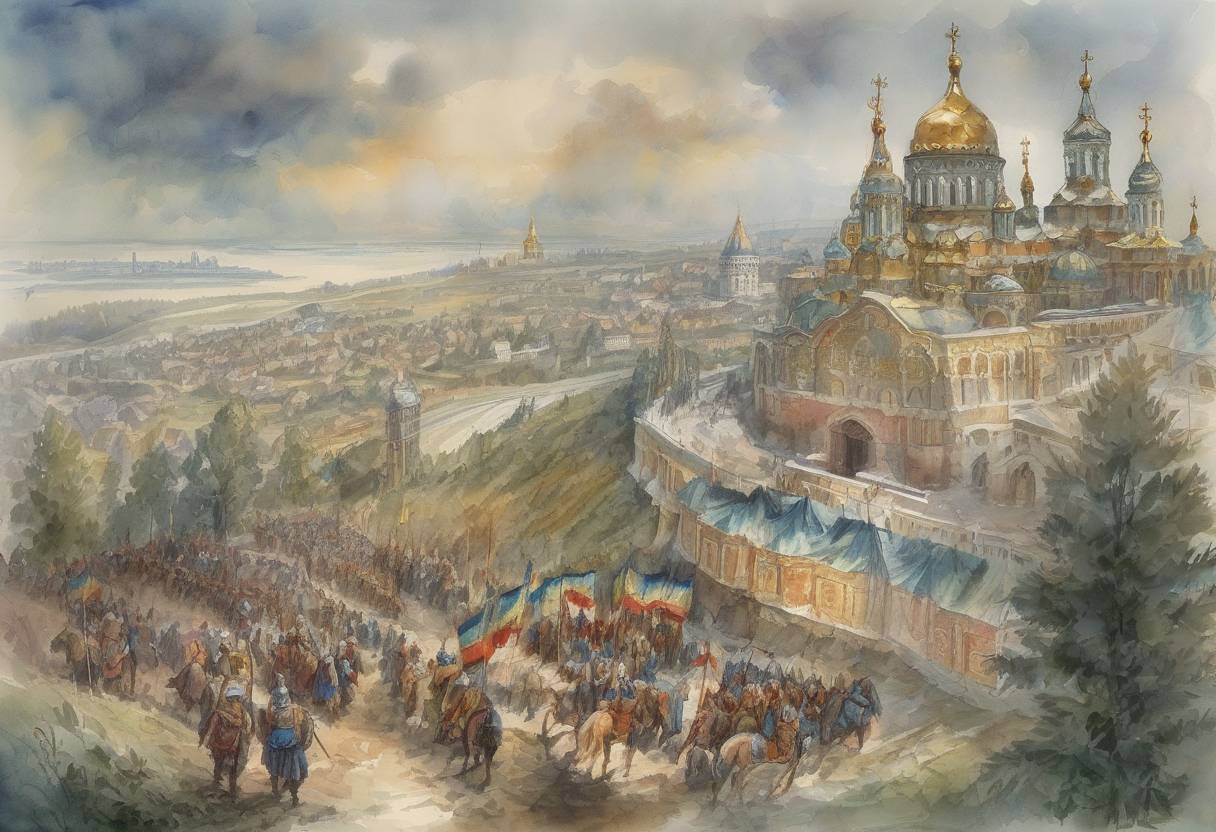
Vladimir the Great Begins His Rule Over Kievan Rus’ - June 11, 980
Background
Vladimir the Great, also known as Vladimir I or Saint Vladimir, was a pivotal figure in the history of Eastern Europe. Born around 958, he was the son of Sviatoslav I of Kiev and a key member of the Rurik dynasty, which played a crucial role in the formation of the Kievan Rus’, a federation of Slavic and Finno-Ugric peoples in Eastern Europe.
Ascension to Power
On June 11, 980, Vladimir began his rule over the Kievan Rus’. His rise to power was marked by a period of internal strife and conflict among the sons of Sviatoslav I. After the death of his father, Vladimir initially fled to Scandinavia to escape his brother Yaropolk, who had seized control of Kiev. With the support of his Viking relatives, Vladimir returned to Kievan Rus’ with a formidable force, eventually defeating Yaropolk and consolidating his power as the Grand Prince of Kiev.
Reign and Achievements
Vladimir’s reign is most noted for the Christianization of Kievan Rus’, a transformative event in the region’s history. Initially a pagan, Vladimir explored various religions, reportedly sending envoys to study Islam, Judaism, and Christianity. Influenced by the Byzantine Empire, he chose to convert to Christianity, a decision that had profound cultural and political implications.
Christianization
- Conversion: In 988, Vladimir was baptized in Chersonesus (present-day Crimea) and subsequently married Anna, the sister of Byzantine Emperor Basil II. This alliance strengthened ties with the Byzantine Empire and facilitated the spread of Christianity.
- Impact: Vladimir’s conversion led to the Christianization of his realm. He ordered the mass baptism of the population in the Dnieper River and began the construction of churches, including the notable Church of the Tithes in Kiev.
Political and Cultural Influence
- Centralization of Power: Vladimir worked to centralize power and expand his territories, incorporating various Slavic tribes into his realm.
- Cultural Development: His reign saw the introduction of Byzantine culture and art, which influenced the development of Kievan Rus’ society.
Legacy
Vladimir the Great’s decision to adopt Christianity had lasting effects on the cultural and religious landscape of Eastern Europe. It laid the foundation for the Russian Orthodox Church and influenced the region’s cultural identity for centuries. Vladimir was canonized as a saint in the Eastern Orthodox Church, and his legacy is celebrated in both religious and historical contexts.
In summary, Vladimir’s rule marked a significant turning point for the Kievan Rus’, transforming it into a major Christian state and leaving an indelible mark on the history of Eastern Europe.