Canberra Officially Named as the Capital of Australia
1913 · Canberra, Australia
Canberra is officially named as the capital of Australia.
February 20, 1913
King O'Malley drives in the first survey peg to mark the commencement of work on Australia's new capital city, Canberra.
Canberra, Australia | Australian government
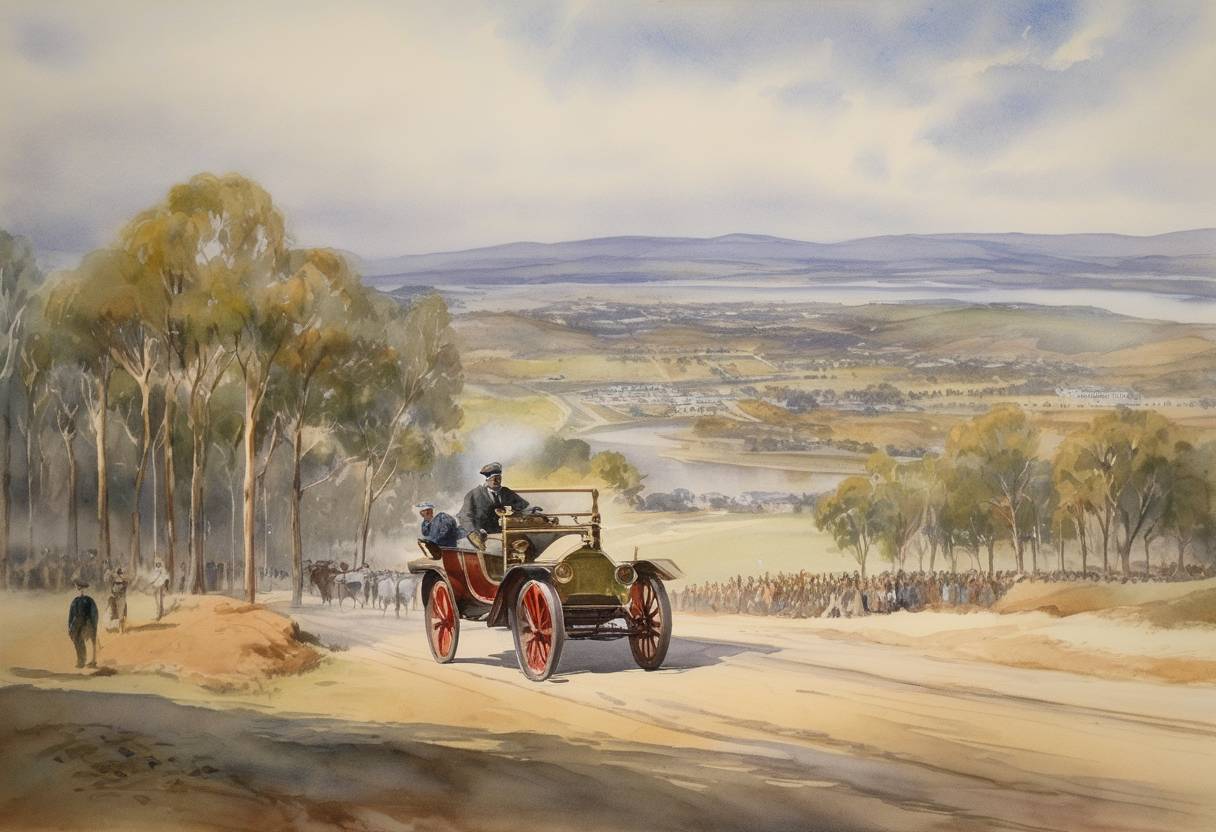
On February 20, 1913, an important milestone in Australian history took place with the driving of the first survey peg for the city’s construction, marking the commencement of work on building Canberra, the nation’s future capital. King O’Malley, the then Minister for Home Affairs, played a pivotal role in choosing the site and authorizing the project’s initiation.
Selection of Canberra: The decision to establish a new capital arose from the need for a neutral location amidst rivalry between Sydney and Melbourne, the two largest Australian cities. Following an extensive search, the federal parliament selected Canberra in 1908 due to its strategic location and climate suitability.
Role of King O’Malley: As Minister for Home Affairs, King O’Malley was instrumental in the early development of Canberra. Although a controversial figure, he was known for his charismatic personality and strong advocacy for the new capital. His contribution was marked by his determination to see the city’s plans materialize.
The Ceremony: The ritual of driving the first survey peg took place in the limestone plains of the Federal Territory. This act symbolized the official beginning of constructing Australia’s purpose-built political center.
Planning of Canberra: The city’s design was influenced by a global competition won by American architect Walter Burley Griffin. O’Malley’s commitment to Griffin’s vision ensured the plan incorporated modern urban design principles and harmonized with the natural landscape.
Development of Canberra: The survey peg ceremony catalyzed the steady development of Canberra, which officially became Australia’s capital in 1927 when the Parliament House was opened.
Urban and Political Symbolism: The creation of Canberra represented Australian independence and the embodiment of a vision for a unified nation. It was designed as a model city reflecting democracy and the ideal of a garden city.
Historical Reflection: Today, Canberra stands as a testament to early 20th-century urban planning and political foresight, continuing to evolve while preserving its founding vision of combining governance with environmental aesthetics.
King O’Malley’s role in the event underscores not only a personal legacy but also the spirit of pioneering progress that marked the nation’s early federal period.
Source: www.nma.gov.au