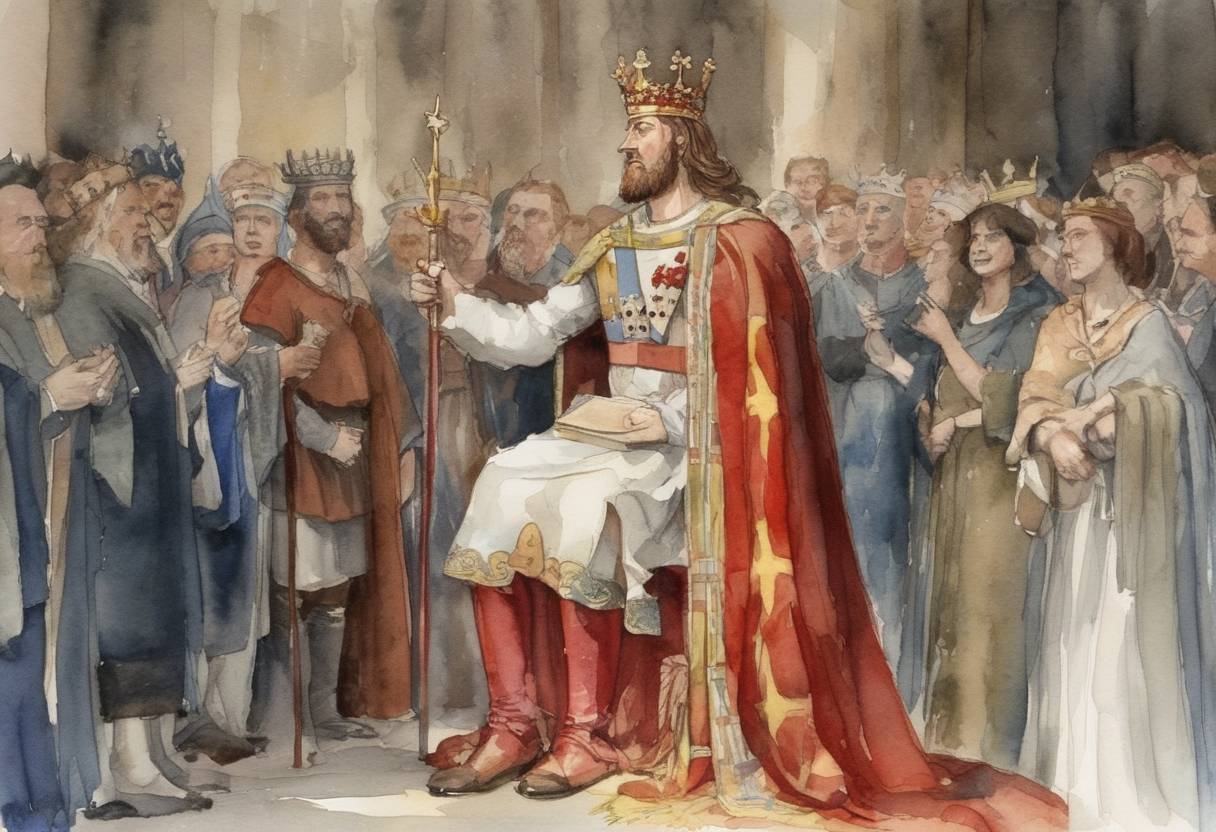
David I Crowned King of Scots on April 27, 1124
David I of Scotland ascended to the throne on April 27, 1124, following the death of his elder brother, Alexander I. His coronation marked the beginning of a transformative era in Scottish history, as he ushered in significant political, religious, and cultural changes that aligned with contemporary European trends.
Background
David was born around 1084, the youngest son of King Malcolm III and Queen Margaret of Scotland. His early years were shaped by the Norman influences in England, where he spent much of his youth at the English court. This period cultivated his understanding and appreciation of Norman governance, which he later infused into his rule over Scotland.
The Path to Kingship
David’s claim to the Scottish throne came after a complex series of events within the Scottish royal family. Although his brother Alexander I was the reigning monarch, David had gradually accrued power, initially ruling over the southern part of Scotland as the Prince of Cumbria. The demise of Alexander I in 1124 left the throne open to David, who succeeded amid some internal disputes and external support from his brother-in-law, King Henry I of England.
David’s reign is noted for initiating the “Davidian Revolution,” characterized by:
Feudal Reorganization: He introduced feudal structures in land distribution, which included establishing a system of baronies held by loyal nobles typically of Anglo-Norman origin.
Ecclesiastical Reform: David was instrumental in reforming the Scottish Church, increasing the number of monastic institutions, and promoting Cluniac and Cistercian orders. These reforms aligned the Scottish Church more closely with Roman practices and extended ecclesiastical influence across Scotland.
Governance and Legal Reforms: He strengthened royal authority, implemented charters that standardized laws, and modernized the judicial system, thereby laying the groundwork for more centralized governance.
Expansion and Legacy
Under David’s rule, the Scottish kingdom expanded its borders significantly. He succeeded in incorporating more regions into his realm, including parts of modern-day England during periods of political turbulence in the more extensive Anglo-Norman world.
David I’s reforms brought about profound changes across Scotland, contributing to the nation’s feudal and ecclesiastical infrastructure. His reign also helped establish the Scottish monarch’s influence and sovereignty during a time of evolving political landscapes in the British Isles.
Conclusion
David I’s coronation and subsequent reign marked a pivotal chapter in Scottish history. His efforts to modernize Scottish institutions, economy, and culture aligned with broader European norms, embedding these innovations deeply into the fabric of the emerging Scottish nation-state. These transformations set precedence for future monarchs and established enduring legacies that persisted long after his death in 1153.