The Battle of Hochkirch (October 14, 1758)
1758 · Hochkirch, Saxony
The Battle of Hochkirch takes place during the Seven Years' War, where Austrian forces under Marshal von Daun defeat the Prussian army led by Frederick the Great.
July 8, 1758
The Battle of Domstadtl takes place during the Seven Years' War as a notable engagement between the Austrian forces and the Prussian army.
Domstadtl, Austrian Empire | Austrian Forces, Prussian Army
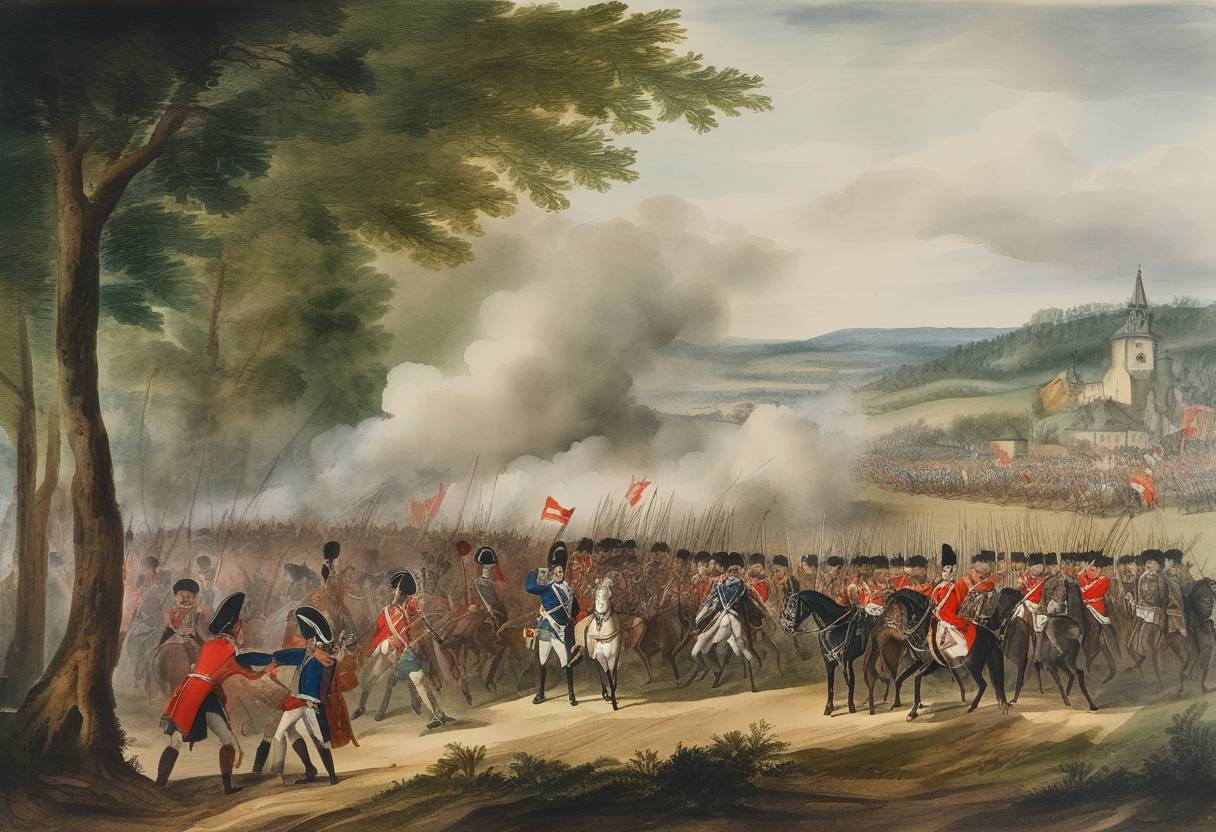
The Battle of Domstadtl, which occurred on July 8, 1758, is a significant event in the larger context of the Seven Years’ War (1756-1763). This global conflict involved most of the great powers of the time and was fought across Europe, North America, Central America, West Africa, India, and the Philippines. The war saw intricate alliances and rivalries, with the Kingdom of Prussia, led by Frederick the Great, facing off against a coalition of Austria, France, Russia, Spain, and other states.
In the broader strategic scope of 1758, Frederick the Great was implementing an aggressive strategy to relieve pressure on Prussian forces by launching offensives into Austrian territories. The Prussian army aimed to maintain control over captured regions and supply their forces effectively.
On July 8, 1758, Austrian forces engaged a Prussian convoy at Domstadtl (modern-day Domašov nad Bystřicí, Czech Republic). The convoy, heavily laden with supplies, was a critical logistical component for the Prussian army’s operations in Moravia. The Austrian army, commanded by General Ernst Gideon Freiherr von Laudon, also supported by General Major von Zedtwitz, seized the opportunity for an attack.
Forces Involved: The Austrian forces were composed of regular troops bolstered by local militia, who were familiar with the terrain. The Prussian convoy was protected by guards, but the element of surprise and the strategic positioning of the Austrian troops played crucial roles in the battle.
Tactics: The Austrians employed effective guerrilla tactics, leveraging the Czech landscape’s challenging terrain to ambush the convoy in a surprise attack, targeting its long, vulnerable line.
Outcome: The Austrians succeeded in disrupting and capturing the majority of the Prussian supply line. They inflicted heavy losses on the Prussian side, with significant Prussian casualties and the capture of vital resources.
The Battle of Domstadtl had noteworthy strategic repercussions. It weakened Prussian efforts in the region by severely limiting their supplies, impacting the sustainment of their military campaign. This setback compelled Frederick the Great to reassess his operations in Moravian territories, as logistical challenges mounted against his forces.
The battle serves as a testament to effective tactical innovation and the impact of logistics in military campaigns. The success of the Austrian forces at Domstadtl helped fortify their defensive posture and underscored the importance of local knowledge and terrain utilisation in warfare. It illustrated the challenges faced by far-reaching military campaigns reliant on secure supply lines, a lesson echoed throughout military history.