The Abdication of Emperor Puyi: The End of the Qing Dynasty
1912 · Beijing, China
The last Emperor of China, Puyi, abdicates the throne, marking the end of the Qing Dynasty and the imperial era in China.
June 13, 1900
China formally declared war on all nations with diplomatic ties to it, including Germany, Japan, and Russia, marking an escalation of hostilities during the Boxer Rebellion.
Beijing, China | Qing Dynasty
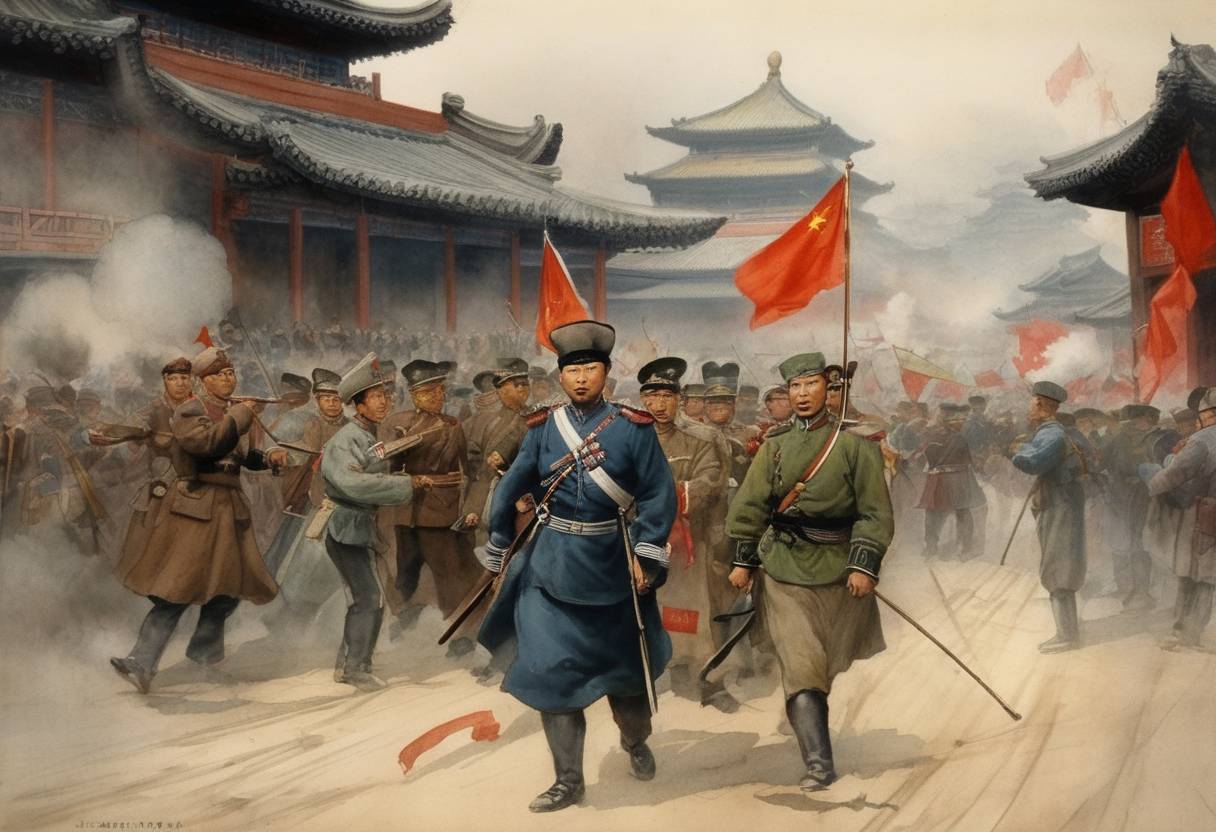
On June 13, 1900, during the Boxer Rebellion, the Qing Dynasty under the rule of Empress Dowager Cixi formally declared war on several foreign powers that had diplomatic relations with China, including Germany, Japan, and Russia. This marked a significant escalation in the hostilities that had been intensifying in the region.
The Boxer Rebellion (1899-1901) was an anti-foreign, anti-colonial uprising in China. The “Boxers” was a colloquial term for the largely peasant-based group known as the “Society of the Righteous and Harmonious Fists.” The Boxers were motivated by opposition to foreign imperialism and Christianity, which they believed threatened Chinese traditions and sovereignty.
Anti-Foreign Sentiments and Boxer Movement: Rising anti-foreign sentiment, exacerbated by natural disasters and economic disruptions, led to widespread support for the Boxer movement. The Boxers targeted foreign nationals, Chinese Christians, and institutions connected to Western influences.
Foreign Concessions and Occupations: By the late 19th century, China had faced numerous humiliating defeats and concessions to Western powers and Japan in conflicts such as the First Sino-Japanese War (1894-1895), emphasizing the Qing Dynasty’s perceived weakness.
Siege of Diplomatic Legations in Beijing: By mid-1900, violence erupted across northern China, culminating in the siege of the foreign legations in Beijing. In response, an Eight-Nation Alliance, composed of Japan, Russia, Britain, France, the United States, Germany, Italy, and Austria-Hungary, mobilized to relieve their besieged nationals.
Responding to increasing pressures from the Boxers and factions within the Chinese court, Empress Dowager Cixi sided with the Boxers, seeing support for them as a means to consolidate power and possibly remove foreign influence. The decision to declare war was viewed as a desperate attempt to maintain dynastic control amid internal and external threats.
International Military Response: The declaration led to a coordinated military intervention by the Eight-Nation Alliance aimed at protecting foreign nationals and interests. This included a series of battles culminating in the capture of Beijing in August 1900.
Boxer Protocol: Following the military defeat, the Boxer Protocol was signed in September 1901, imposing severe penalties on China. It included significant indemnities, the stationing of foreign troops in Beijing, and other measures restricting China’s sovereignty.
Dynastic Decline: This conflict further weakened the Qing Dynasty, contributing to its eventual downfall and the Chinese Revolution of 1911, ending over two millennia of imperial rule.
The events surrounding June 13, 1900, underscore the complex interplay of internal upheaval and external pressures that characterized China’s late Qing era, setting the stage for profound transformations in the nation’s subsequent history.
Source: en.wikipedia.org