The Treaty of Tilsit - July 7, 1807
1807 · Tilsit, Russia
The Treaty of Tilsit is signed between Napoleonic France and Russia, establishing the two powers as allies and reorganizing numerous European territories.
April 3, 1582
A peace treaty was signed between Tsar Ivan IV of Russia and Stephen Báthory of the Polish–Lithuanian Commonwealth, significantly shaping Eastern European politics. This agreement was part of ongoing negotiations to end the Livonian War, where the Russian tsardom sought a truce with the Polish–Lithuanian forces.
Yam-Zapolsky, Russia | Tsardom of Russia, Polish–Lithuanian Commonwealth
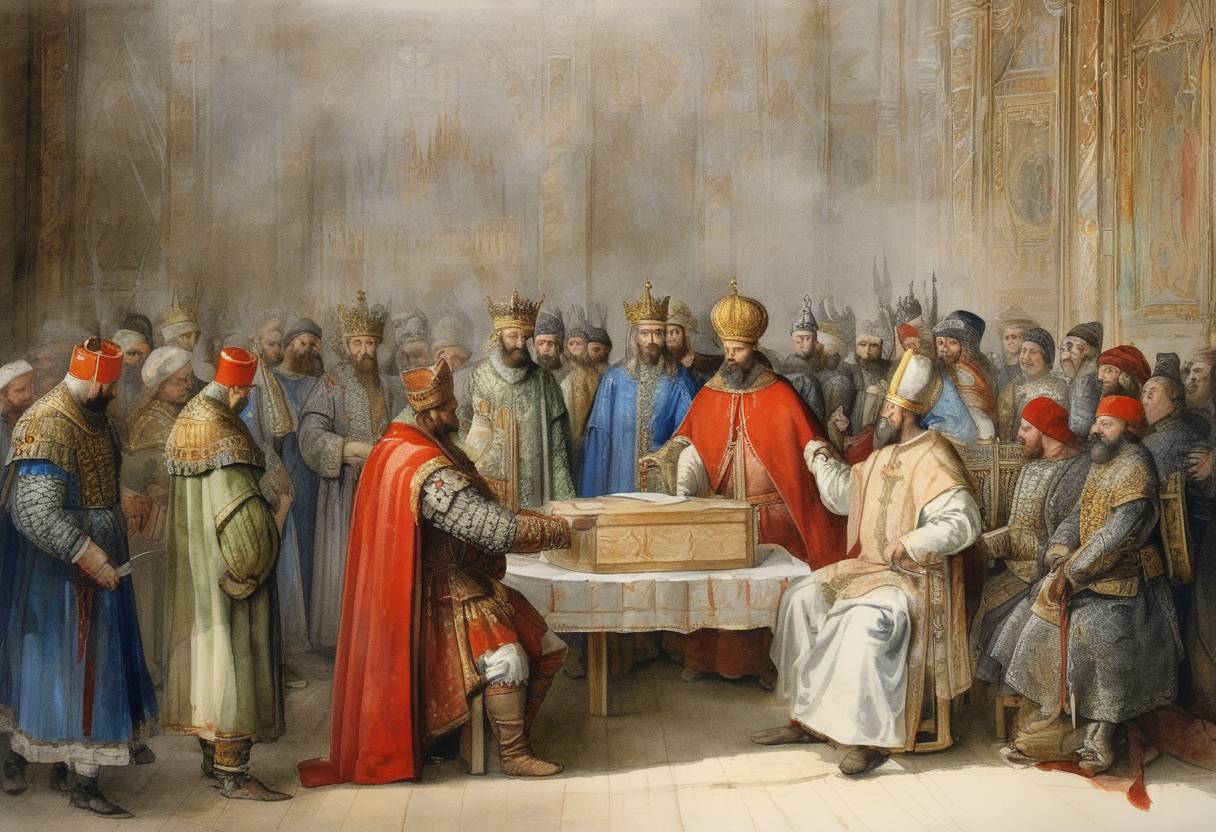
On March 4, 1582, a crucial treaty known as the “Truce of Jam Zapolski” was signed between Tsar Ivan IV (Ivan the Terrible) of Russia and Stephen Báthory, the King of Poland and Grand Duke of Lithuania. This treaty marked a significant moment in Eastern European history by concluding hostilities between the Tsardom of Russia and the Polish–Lithuanian Commonwealth, effectively bringing an end to the Livonian War.
The Livonian War (1558–1583) involved several powers, including Russia, the Polish–Lithuanian Commonwealth, Sweden, and Denmark-Norway, competing for control over the region of Livonia (modern-day Latvia and Estonia). Tsar Ivan IV sought to expand Russian influence by accessing the Baltic Sea, a critical trade route.
As the war progressed, the Polish–Lithuanian Commonwealth emerged as a formidable opponent to Russian ambitions. Stephen Báthory, who ascended to power in the Commonwealth in 1575, was a dynamic military leader committed to resisting Russian expansion.
Following a series of military setbacks for Russia and the strategic need to redirect his attention to domestic issues, Ivan IV sought peace with the Commonwealth. Negotiations were initiated in late 1581, leading to the meeting at Jam Zapolski, a location in the Lithuanian part of the Commonwealth.
The Truce of Jam Zapolski established the following conditions:
The truce was pivotal in reshaping the political landscape of the region:
The Truce of Jam Zapolski illustrates the intricate balance of power in 16th-century Eastern Europe and underscores the importance of diplomacy following protracted warfare.
Source: en.wikipedia.org