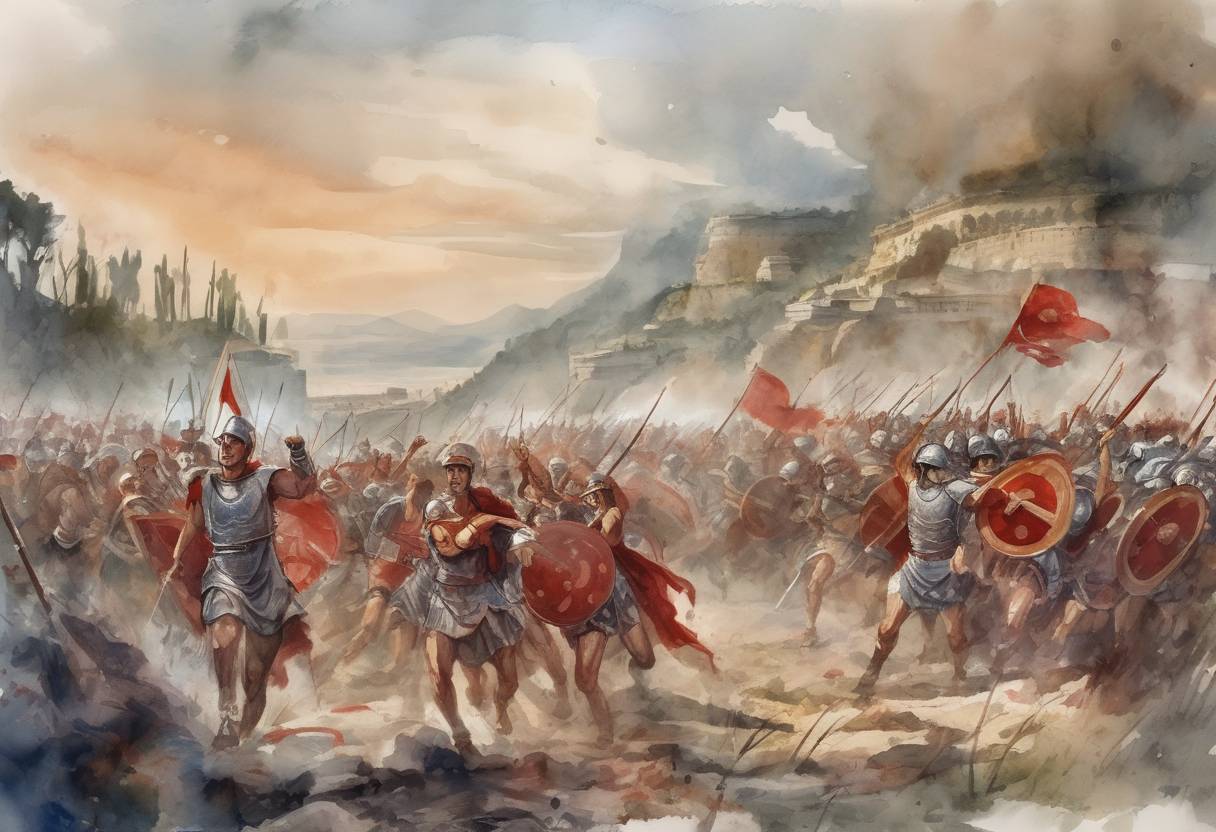
Battle of Dyrrhachium: Caesar’s Civil War
Context
The Battle of Dyrrhachium, fought on July 10, 48 BCE, was a significant engagement during Caesar’s Civil War, a conflict that arose from the power struggle between Julius Caesar and the Roman Senate, led by Pompey the Great. This civil war was a pivotal moment in Roman history, marking the end of the Roman Republic and the rise of the Roman Empire.
Prelude to the Battle
- Background: The conflict began in 49 BCE when Caesar crossed the Rubicon River, defying the Senate’s authority and effectively declaring war. This act was a response to the Senate’s demand that he disband his army and return to Rome as a private citizen.
- Strategic Movements: By 48 BCE, Caesar had pursued Pompey to Greece, where Pompey had consolidated his forces. Dyrrhachium (modern-day Durrës, Albania) was strategically important due to its location and its role as a supply base for Pompey’s forces.
The Battle
- Forces: Caesar’s army was significantly outnumbered, with approximately 15,000 troops compared to Pompey’s 45,000. Despite this, Caesar’s forces were seasoned veterans, known for their discipline and loyalty.
- Tactics: Caesar attempted to encircle Pompey’s forces by constructing a series of fortifications. However, Pompey managed to break through Caesar’s lines, leading to a chaotic and bloody confrontation.
- Outcome: Contrary to the initial prompt, the Battle of Dyrrhachium was actually a tactical defeat for Caesar. Pompey successfully repelled Caesar’s forces, inflicting significant casualties and forcing Caesar to retreat.
Aftermath
- Strategic Withdrawal: Despite the setback at Dyrrhachium, Caesar’s strategic acumen allowed him to regroup and maintain the morale of his troops.
- Subsequent Victory: The defeat at Dyrrhachium was short-lived. Caesar’s forces would later decisively defeat Pompey at the Battle of Pharsalus in August 48 BCE, turning the tide of the civil war in Caesar’s favor.
- Historical Significance: The events surrounding Dyrrhachium and Pharsalus underscored Caesar’s military genius and his ability to recover from setbacks. These battles were crucial in his path to becoming the dictator of Rome, ultimately leading to the end of the Roman Republic.
Conclusion
The Battle of Dyrrhachium was a critical episode in Caesar’s Civil War, demonstrating the volatility and high stakes of the conflict between Caesar and Pompey. While it was a tactical defeat for Caesar, it set the stage for his eventual triumph and the profound transformation of Roman political structures.