Creation of Martin Luther King Jr. Day
1983 · Washington, D.C., United States
U.S. President Ronald Reagan signed a bill creating Martin Luther King Jr. Day, a federal holiday to honor the civil rights leader.
July 2, 1964
U.S. President Lyndon B. Johnson signs the Civil Rights Act of 1964 into law, prohibiting discrimination based on race, color, religion, sex, or national origin.
Washington, D.C., United States | U.S. Government
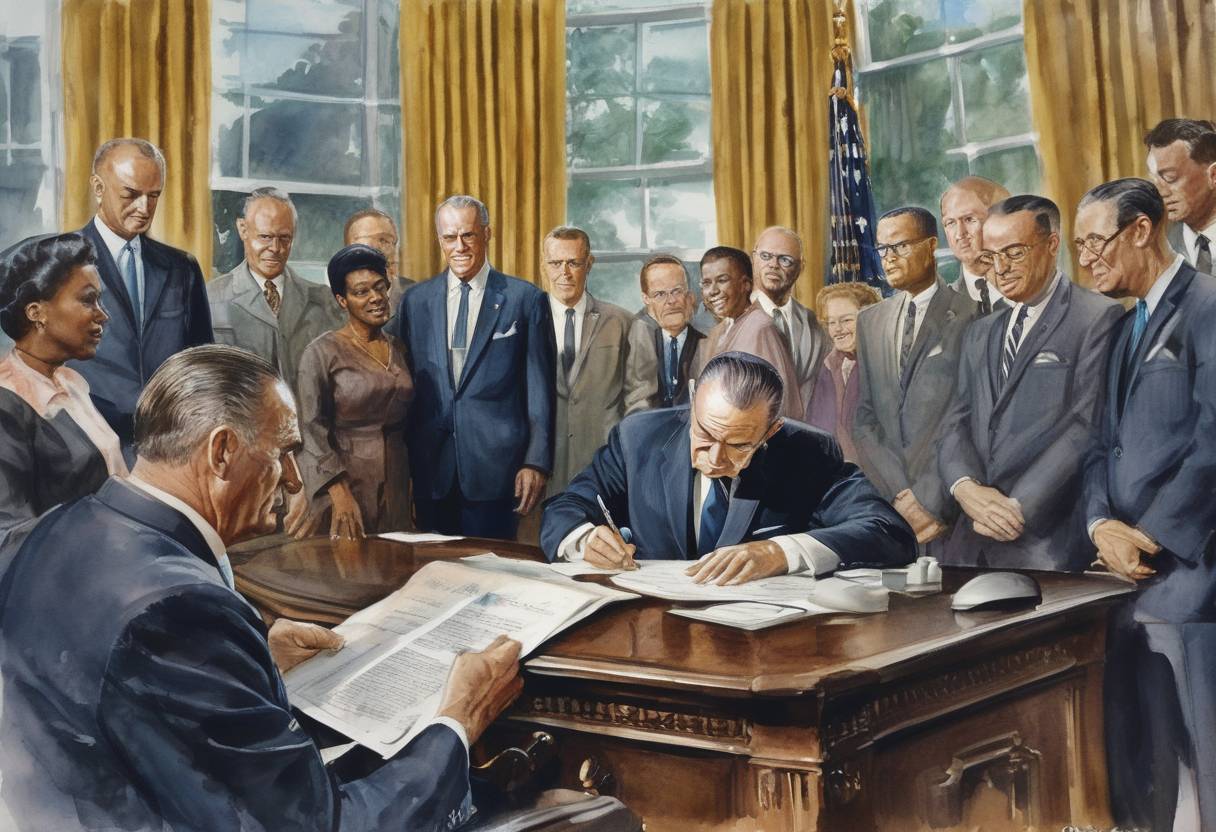
On July 2, 1964, U.S. President Lyndon B. Johnson signed the Civil Rights Act into law, marking a pivotal moment in American history. This landmark legislation aimed to end segregation and discrimination based on race, color, religion, sex, or national origin, fundamentally transforming the social and legal landscape of the United States.
The Civil Rights Act of 1964 was the culmination of years of struggle and activism by civil rights leaders and organizations. The movement gained momentum in the 1950s and early 1960s, with significant events such as the Montgomery Bus Boycott (1955-1956), the Little Rock Nine’s integration of Central High School (1957), and the March on Washington for Jobs and Freedom (1963), where Martin Luther King Jr. delivered his iconic “I Have a Dream” speech.
The assassination of President John F. Kennedy in November 1963 also played a crucial role. Kennedy had proposed civil rights legislation, and his successor, Lyndon B. Johnson, used his legislative acumen and political capital to push the bill through Congress, framing it as a tribute to Kennedy’s legacy.
The Civil Rights Act of 1964 comprised several titles, each addressing different aspects of discrimination:
The signing ceremony took place at the White House, with President Johnson surrounded by key civil rights leaders, members of Congress, and other dignitaries. In his remarks, Johnson emphasized the moral imperative of the legislation, stating, “We believe that all men are created equal, yet many are denied equal treatment.”
The Civil Rights Act of 1964 was a watershed moment in the American civil rights movement. It laid the groundwork for subsequent legislation, including the Voting Rights Act of 1965 and the Fair Housing Act of 1968. The Act also inspired other social movements, including the women’s rights movement and efforts to secure rights for other marginalized groups.
While the Act did not immediately end all forms of discrimination, it provided a powerful legal tool for challenging inequality and set a precedent for future civil rights advancements. Its passage marked a significant step toward achieving the constitutional promise of equality for all Americans.
Source: www.history.com