The Siege of Boston Begins: April 20, 1775
1775 · Boston, United States
The Siege of Boston begins during the American Revolutionary War, following the battles of Lexington and Concord.
April 18, 1775
Paul Revere and William Dawes embarked on their midnight ride to warn the colonial militia of the approaching British forces before the battles of Lexington and Concord, which marked the beginning of the American Revolutionary War.
Boston, United States | Sons of Liberty
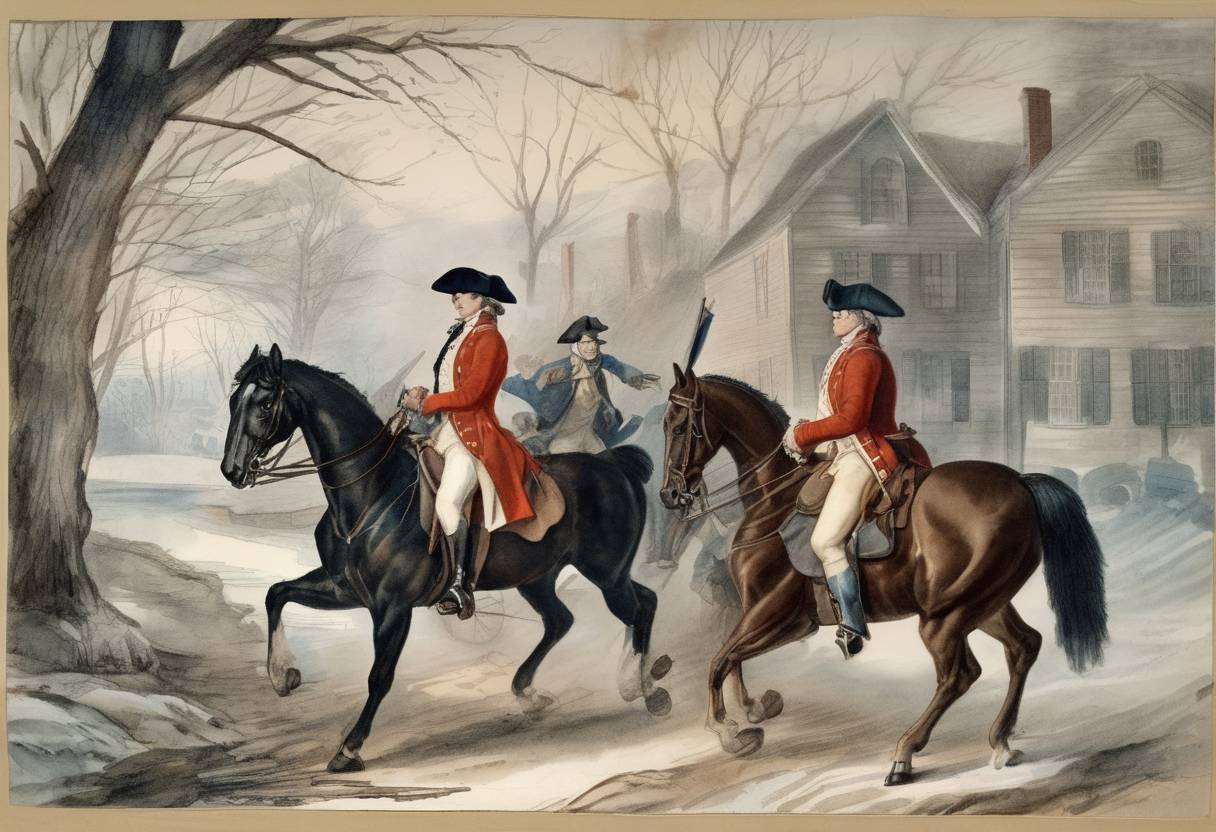
On the night of April 18, 1775, two American patriots, Paul Revere and William Dawes, embarked on a crucial mission that would become a legendary moment in the lead-up to the American Revolutionary War. Their task was to warn the colonial militia of the approaching British forces, an event that played a pivotal role in the battles of Lexington and Concord, marking the beginning of the conflict between Great Britain and its thirteen American colonies.
In the months leading up to April 1775, tensions between the American colonies and the British government had reached a boiling point. The colonies were increasingly frustrated with British taxation and lack of representation in Parliament. In response, the British sought to suppress dissent by seizing colonial military supplies and arresting key leaders of the resistance.
The British planned a secret expedition to Concord, Massachusetts, to capture and destroy military supplies that the colonial militia had stored there. However, the colonists had established a network of spies and informants, allowing them to anticipate British movements.
Paul Revere, a silversmith and a prominent member of the Sons of Liberty, was tasked with alerting the colonial militias of the impending British march. On the evening of April 18, Revere was instructed to ride from Boston to Lexington to warn Samuel Adams and John Hancock, who were staying there and were potential targets for arrest.
Revere arranged for a signal to be sent from the Old North Church in Boston: two lanterns would be hung in the church’s steeple to indicate that the British were advancing by sea across the Charles River, rather than by land. This signal was famously described in the poem by Henry Wadsworth Longfellow, “one if by land, and two if by sea.”
William Dawes, a tanner by trade, was also dispatched to spread the alarm. He took a different route from Boston to Lexington, traveling through the Boston Neck and the towns of Roxbury, Brookline, and Cambridge. This redundancy ensured that the warning would reach its destination even if one rider was captured.
Revere and Dawes successfully reached Lexington, where they warned Adams and Hancock. Afterward, they continued toward Concord, joined by Dr. Samuel Prescott, a local patriot. Along the way, the trio encountered a British patrol. Prescott managed to escape and continued to Concord, while Revere was briefly detained and Dawes was forced to retreat.
The warnings delivered by Revere, Dawes, and Prescott allowed the colonial militias to mobilize and prepare for the British advance. On April 19, 1775, the first shots of the American Revolutionary War were fired at Lexington and Concord, leading to a full-scale conflict that would eventually result in American independence.
The midnight ride of Paul Revere and William Dawes became a symbol of American patriotism and resistance. While Revere’s ride is more widely remembered, largely due to Longfellow’s poem, both men played critical roles in alerting the colonies and setting the stage for the Revolutionary War.
Their actions exemplified the spirit of cooperation and determination that characterized the American struggle for independence, and their legacy endures as a testament to the power of communication and preparedness in times of crisis.
Source: en.wikipedia.org