Spain's General Election on November 20, 2011
2011 · Madrid, Spain
Spain's general election results in the People's Party, led by Mariano Rajoy, winning a majority, which leads to a conservative government amid the eurozone crisis.
October 28, 1982
Spanish Socialist Workers' Party wins the general election, leading to the first socialist government in Spain since the Spanish Civil War.
Madrid, Spain | Spanish Socialist Workers' Party
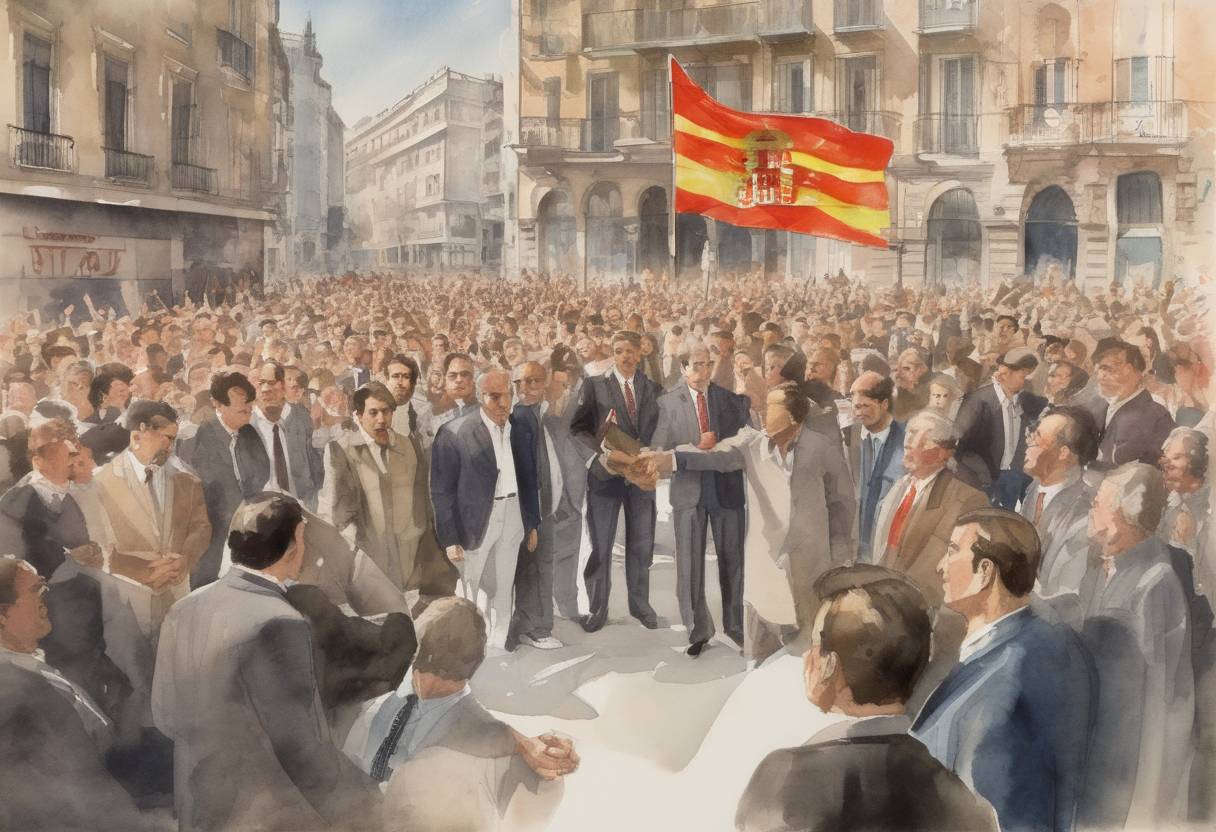
On October 28, 1982, Spain witnessed a pivotal moment in its political history when the Spanish Socialist Workers’ Party (Partido Socialista Obrero Español, PSOE) won the general election. This victory marked the establishment of the first socialist government in Spain since the Spanish Civil War, a significant shift in the nation’s political landscape.
Post-Franco Transition: Spain was undergoing a transition to democracy following the death of dictator Francisco Franco in 1975. The country had been under Franco’s authoritarian rule since the end of the Spanish Civil War in 1939.
Constitutional Framework: The Spanish Constitution of 1978 laid the groundwork for a democratic government, establishing a parliamentary monarchy and guaranteeing civil liberties.
Political Climate: The early 1980s in Spain were marked by economic challenges, including high unemployment and inflation, as well as political instability. The ruling party before the election, the Union of the Democratic Centre (UCD), was struggling with internal divisions and declining public support.
PSOE’s Campaign: Led by Felipe González, the PSOE campaigned on a platform of modernization, economic reform, and social justice. The party promised to address the economic issues and further consolidate Spain’s democratic institutions.
Election Results: The PSOE won a landslide victory, securing 202 out of 350 seats in the Congress of Deputies, the lower house of Spain’s parliament. This overwhelming majority allowed them to form a government without the need for coalition partners.
First Socialist Government Since Civil War: The election marked the first time a socialist government had taken power in Spain since the end of the Spanish Civil War, symbolizing a significant ideological shift.
Felipe González as Prime Minister: At the age of 40, Felipe González became the youngest prime minister in modern Spanish history. His leadership was characterized by efforts to modernize the Spanish economy, integrate Spain into the European Economic Community (EEC), and strengthen democratic institutions.
Economic and Social Reforms: The PSOE government implemented various reforms, including labor market changes, educational improvements, and healthcare expansions. These reforms aimed to align Spain more closely with its European neighbors.
European Integration: Under González’s leadership, Spain joined the EEC in 1986, marking a significant step in its integration into the European community and boosting economic development.
Political Stability: The PSOE’s tenure contributed to political stability in Spain, helping to solidify the country’s democratic transition and paving the way for future democratic governance.
Legacy: The 1982 election is often seen as a turning point in Spanish history, representing the consolidation of democracy and the end of the political isolation that had characterized the Franco era.
The victory of the Spanish Socialist Workers’ Party in 1982 was not just a political triumph but a milestone in Spain’s journey towards a modern, democratic society.
Source: www.britannica.com