The First Convening of the Supreme Court of the United States
1790 · New York City, United States
The Supreme Court of the United States convenes for the first time.
September 24, 1789
The United States Congress passed the Judiciary Act of 1789, establishing the federal judiciary and the Supreme Court.
New York City, United States | United States Congress
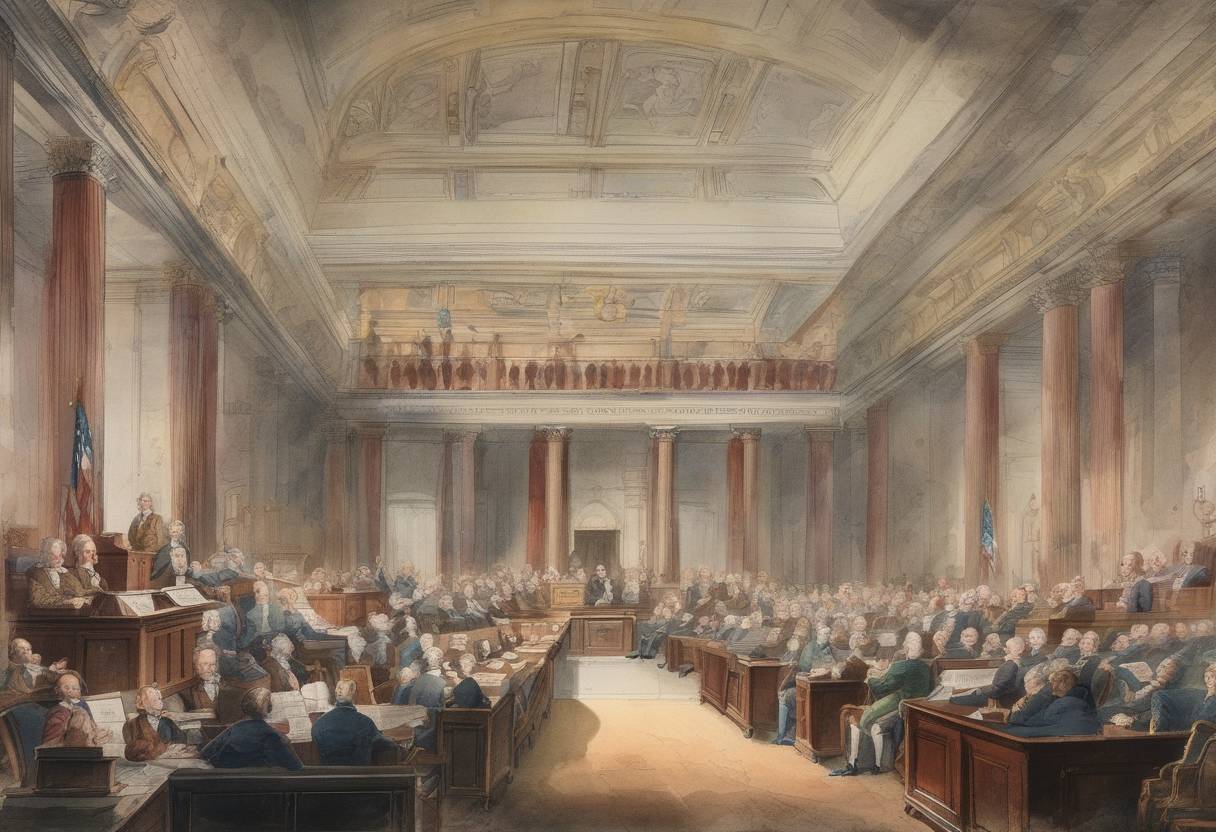
On September 24, 1789, the United States Congress passed the Judiciary Act of 1789, a pivotal piece of legislation that established the federal judiciary of the United States. This act laid the foundation for the judicial branch of the government as outlined in Article III of the U.S. Constitution.
Following the ratification of the U.S. Constitution in 1788, there was a pressing need to create a federal judiciary system to interpret and apply the laws of the new nation. The Constitution provided for a Supreme Court but left the specifics of its structure and the lower courts to be determined by Congress.
The Judiciary Act of 1789 was comprehensive in scope and included several key provisions:
Establishment of the Supreme Court: The Act established the Supreme Court, consisting of one Chief Justice and five Associate Justices. This structure provided the highest court in the land with the authority to resolve disputes involving federal law and the Constitution.
Creation of Lower Courts: It created 13 district courts and three circuit courts. Each state had at least one district court, which served as the trial courts of the federal system. The circuit courts, which were intermediate appellate courts, were organized into three circuits.
Jurisdiction: The Act defined the jurisdiction of the federal courts, including the Supreme Court’s appellate jurisdiction and the original jurisdiction over certain cases, such as those involving ambassadors and states.
Writ of Mandamus: The Act authorized the Supreme Court to issue writs of mandamus, a power that would later become significant in the landmark case of Marbury v. Madison (1803).
Office of the Attorney General: It established the office of the Attorney General, who was responsible for representing the United States in legal matters.
The Judiciary Act of 1789 was crucial in shaping the American legal system. It provided a structured and coherent framework for the federal judiciary, ensuring that the judicial branch could function effectively alongside the executive and legislative branches. The Act also reinforced the principle of judicial review, which would become a cornerstone of American constitutional law.
The Judiciary Act of 1789 has had a lasting impact on the U.S. legal system. It set the precedent for the organization and operation of the federal courts, a structure that has evolved but remains fundamentally intact. The Act’s establishment of the Supreme Court as the ultimate arbiter of constitutional issues has been instrumental in shaping American law and governance.
Overall, the Judiciary Act of 1789 was a foundational moment in U.S. history, ensuring that the judiciary would play a vital role in maintaining the balance of power within the federal government.
Source: www.history.com