Assassination of President James A. Garfield
1881 · Washington, D.C., United States
U.S. President James A. Garfield is shot by Charles J. Guiteau at the Baltimore and Potomac Railroad Station in Washington, D.C.
September 14, 1901
U.S. President William McKinley dies after being shot by an assassin on September 6, and Theodore Roosevelt is sworn in as the 26th President of the United States.
Buffalo, United States | U.S. Government
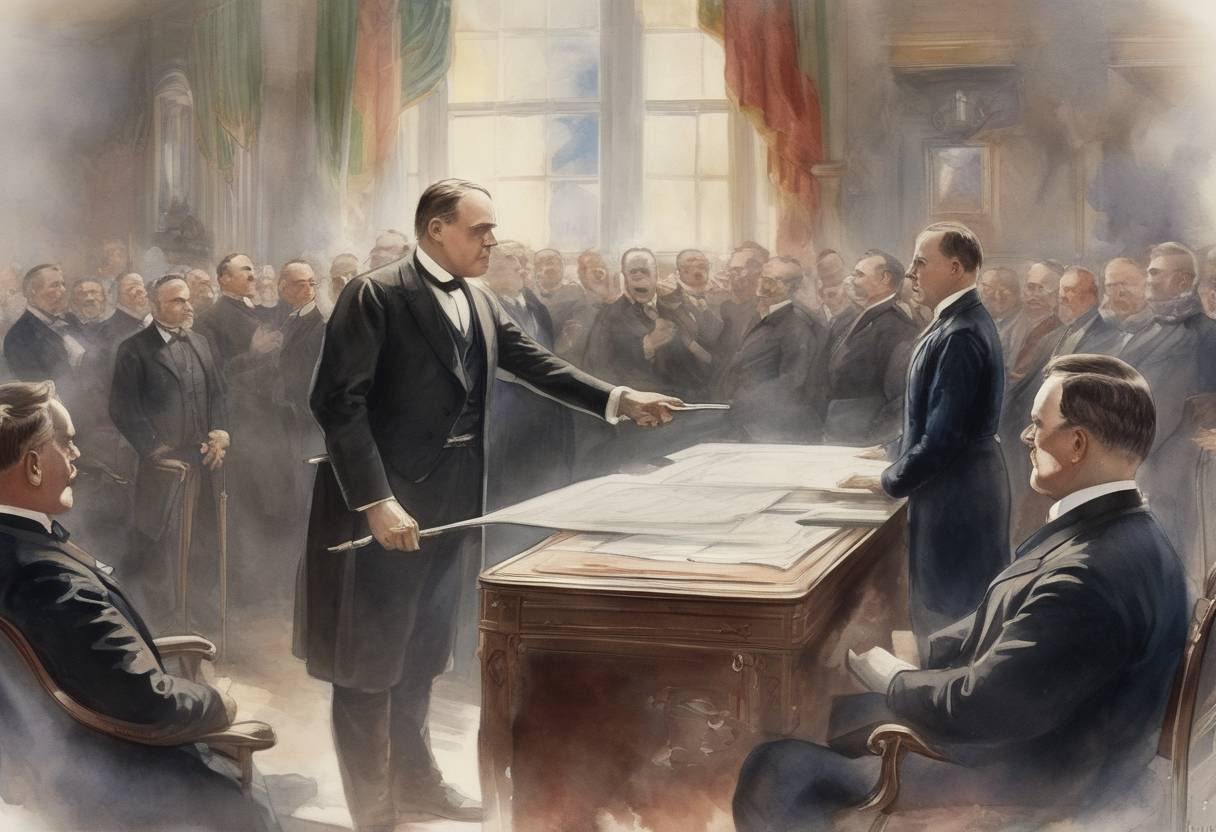
William McKinley, the 25th President of the United States, was serving his second term when he was shot on September 6, 1901. McKinley was attending the Pan-American Exposition in Buffalo, New York, a world’s fair that showcased the latest innovations and fostered international cooperation. His presidency had been marked by significant events, including the Spanish-American War and the subsequent expansion of American influence overseas.
On September 6, 1901, President McKinley was greeting the public at the Temple of Music on the exposition grounds. Leon Czolgosz, an anarchist who opposed McKinley’s policies and the government, approached the president under the guise of shaking his hand. Concealing a revolver in a handkerchief, Czolgosz shot McKinley twice in the abdomen.
Despite initial optimism about his recovery, McKinley’s condition deteriorated due to gangrene that developed around his wounds. After several days of fluctuating health, McKinley succumbed to his injuries on September 14, 1901.
Following McKinley’s death, Vice President Theodore Roosevelt was sworn in as the 26th President of the United States. Roosevelt, known for his robust personality and progressive policies, was vacationing in the Adirondack Mountains when he received news of McKinley’s worsening condition. He rushed to Buffalo, where he took the oath of office at the home of Ansley Wilcox.
The assassination of McKinley marked a pivotal moment in U.S. history, as it led to the presidency of Theodore Roosevelt, who would become one of the most dynamic and influential leaders in American history. Roosevelt’s presidency ushered in an era of progressive reforms, including trust-busting, the establishment of national parks, and significant foreign policy initiatives such as the construction of the Panama Canal.
The event also highlighted the vulnerabilities of public figures and led to increased security measures for U.S. presidents. McKinley’s assassination was a catalyst for change, both in terms of domestic policy and the role of the United States on the world stage.
The transition of power from McKinley to Roosevelt was smooth, reflecting the stability of the U.S. political system even in times of crisis. Roosevelt’s presidency would go on to shape the early 20th century, leaving a lasting legacy on both the domestic and international fronts.
In summary, the assassination of William McKinley and the subsequent rise of Theodore Roosevelt to the presidency marked a significant turning point in American history, setting the stage for the progressive era and expanding the influence of the United States globally.
Source: www.whitehouse.gov