Sinking of the German Battleship Scharnhorst
1943 · North Cape, Norway
The German battleship Scharnhorst was sunk by the Royal Navy during the Battle of the North Cape in World War II.
December 17, 1939
World War II: The German pocket battleship Admiral Graf Spee was scuttled by its crew off Montevideo, Uruguay.
Montevideo, Uruguay | Kriegsmarine
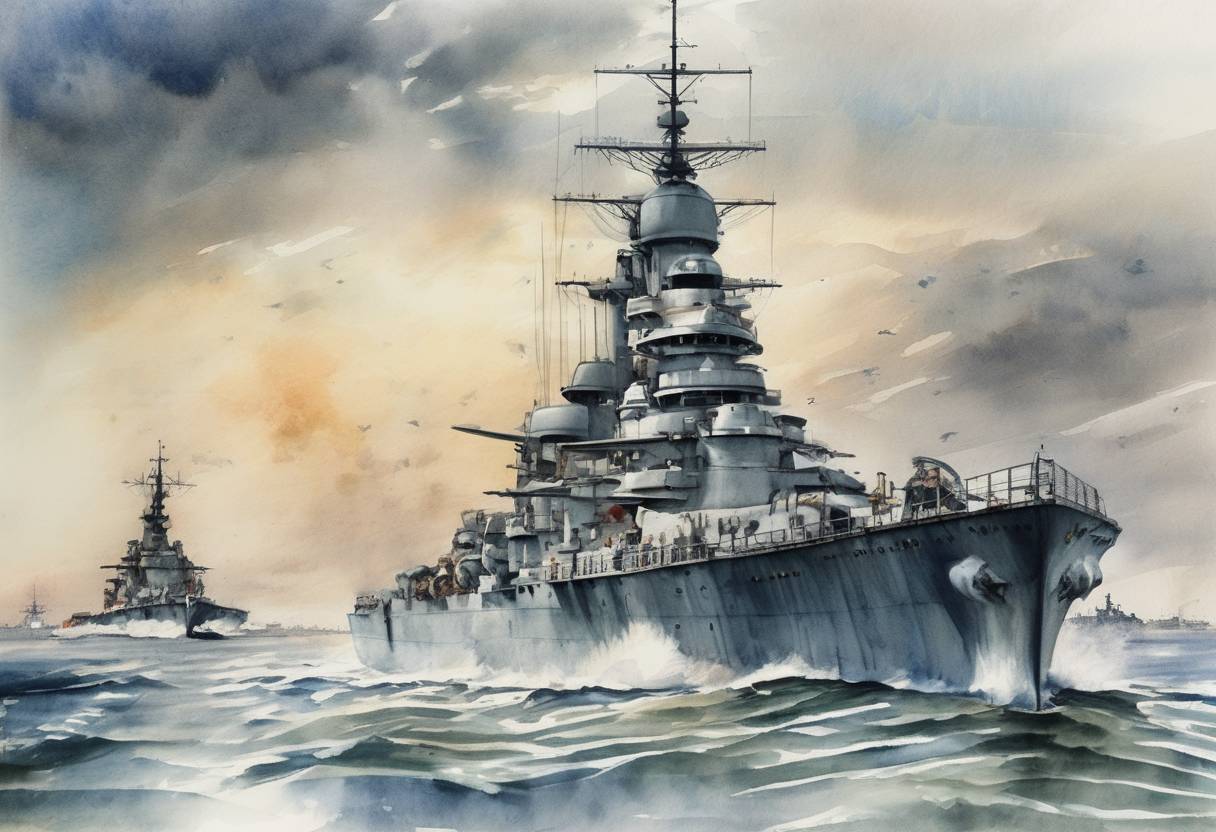
On December 17, 1939, during the early months of World War II, the German pocket battleship Admiral Graf Spee was scuttled by its crew off the coast of Montevideo, Uruguay. This event marked a significant moment in the naval warfare of the Second World War.
The Admiral Graf Spee was a Deutschland-class cruiser, often referred to as a “pocket battleship” due to its heavy armament relative to its size. Commanded by Captain Hans Langsdorff, the ship was part of Germany’s strategy to disrupt Allied shipping routes in the South Atlantic and Indian Oceans.
Prior to its scuttling, the Admiral Graf Spee had engaged in the Battle of the River Plate on December 13, 1939. This was the first major naval battle of World War II. The German ship faced off against three British cruisers: HMS Exeter, HMS Ajax, and HMS Achilles. Although the Graf Spee inflicted significant damage on the British ships, it also sustained damage and was forced to seek refuge in the neutral port of Montevideo.
Under international law, a belligerent ship could only remain in a neutral port for a limited time. Facing the prospect of renewed engagement with superior British naval forces waiting outside the harbor, Captain Langsdorff made the difficult decision to scuttle the Admiral Graf Spee to prevent its capture.
On December 17, 1939, the crew set explosive charges, and the ship was scuttled in the River Plate estuary. The decision was influenced by misinformation suggesting that a larger British force was assembling to confront the Graf Spee.
Captain Langsdorff: Following the scuttling, Captain Langsdorff and his crew were interned in Argentina. Tragically, Langsdorff took his own life on December 20, 1939, adhering to the tradition of a captain going down with his ship, albeit symbolically.
Strategic Impact: The scuttling of the Admiral Graf Spee was a morale boost for the Allies early in the war. It demonstrated the effectiveness of Allied naval coordination and the challenges faced by German surface raiders.
Legacy: The event highlighted the strategic importance of naval power and the complexities of international law during wartime. The wreck of the Admiral Graf Spee remains a point of historical interest and has been the subject of various salvage operations.
The scuttling of the Admiral Graf Spee is remembered as a dramatic episode in naval history, illustrating the tactical decisions and human elements involved in warfare.
Source: en.wikipedia.org