Operation Starvation: March 27, 1945
1945 · Pacific Ocean, Japan
The United States Army Air Forces began Operation Starvation, an aerial mining campaign to blockade Japanese shipping routes during World War II.
March 10, 1945
The U.S. Army Air Forces firebomb Tokyo, resulting in the deaths of an estimated 100,000 people.
Tokyo, Japan | United States Army Air Forces
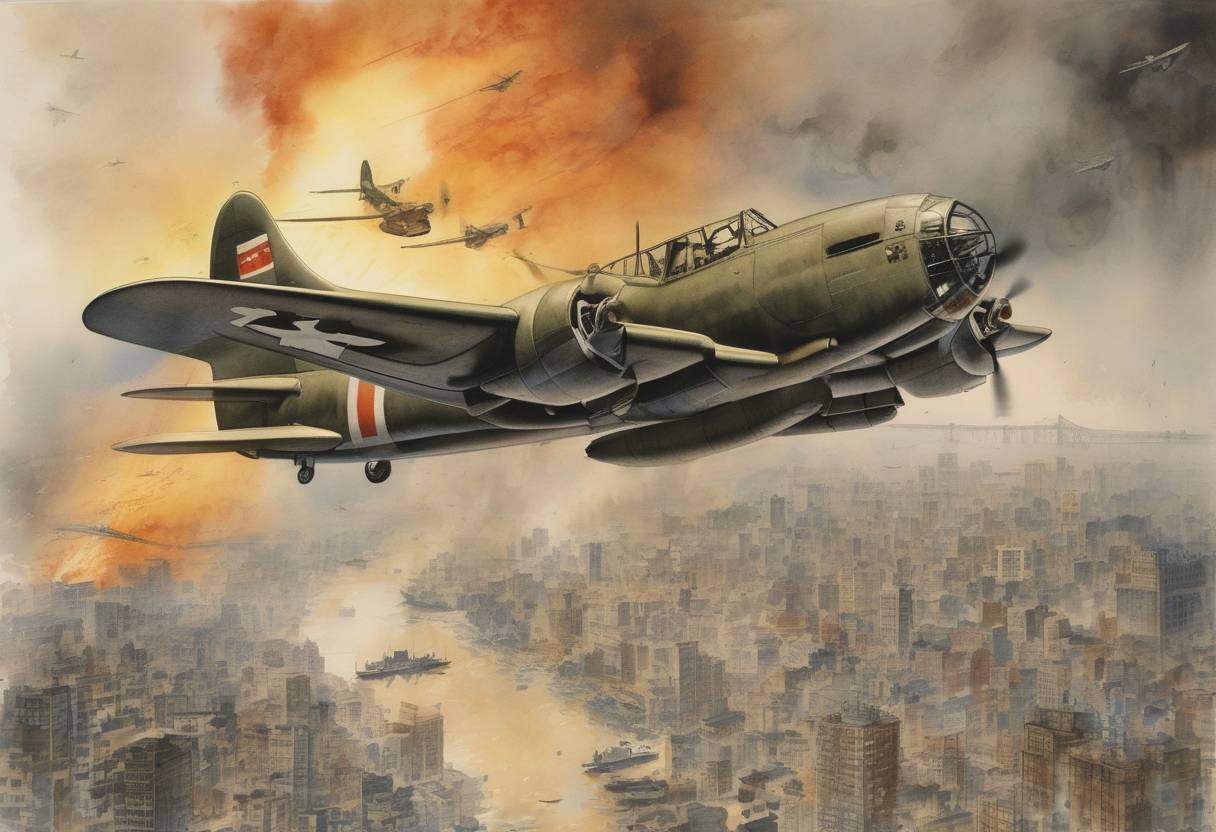
On March 10, 1945, the United States Army Air Forces (USAAF) conducted a devastating firebombing raid on Tokyo, Japan, marking one of the deadliest air raids in history. This operation, known as Operation Meetinghouse, resulted in the deaths of an estimated 100,000 people and left over a million residents homeless. The raid was a pivotal moment in the Pacific theater of World War II, showcasing the destructive power of strategic bombing and its profound impact on civilian populations.
Strategic Bombing Campaign: By 1945, the USAAF had shifted its focus to strategic bombing campaigns aimed at crippling Japan’s war production capabilities and breaking the morale of its civilian population. The B-29 Superfortress, a long-range bomber, was central to these efforts.
Previous Raids: Prior to the Tokyo firebombing, the USAAF had conducted several high-altitude precision bombing raids over Japan. However, these had limited success due to weather conditions and the dispersed nature of Japanese industry.
Change in Tactics: Recognizing the limitations of precision bombing, General Curtis LeMay, commander of the XXI Bomber Command, decided to employ low-altitude incendiary bombing. This tactic aimed to exploit the flammable nature of Japanese cities, which were largely constructed of wood and paper.
Execution: On the night of March 9-10, 1945, 334 B-29 bombers took off from bases in the Mariana Islands. They flew at altitudes as low as 5,000 to 9,000 feet to maximize the effectiveness of their incendiary bombs.
Bombing Strategy: The bombers dropped a mix of M69 incendiary bombs, which were designed to ignite upon impact and spread fire rapidly. The attack targeted a densely populated area of Tokyo, covering approximately 16 square miles.
Destruction: The resulting conflagration created a firestorm, with temperatures reaching up to 1,800 degrees Fahrenheit. The intense heat and winds caused widespread destruction, obliterating entire neighborhoods and overwhelming firefighting efforts.
Casualties and Damage: The raid killed an estimated 100,000 people, injured many more, and left over a million residents homeless. It destroyed approximately 267,000 buildings, including factories and homes.
Impact on Japan: The firebombing of Tokyo was a psychological blow to Japan, highlighting the vulnerability of its cities to air attacks. It also underscored the challenges Japan faced in defending against such raids.
Strategic Implications: The success of the Tokyo raid led to similar firebombing campaigns against other Japanese cities, contributing to the eventual weakening of Japan’s ability to sustain the war effort.
Moral and Ethical Debate: The raid sparked significant debate over the morality of targeting civilian populations in warfare. It raised questions about the ethical implications of strategic bombing and its role in achieving military objectives.
The firebombing of Tokyo remains a significant event in the history of warfare, illustrating the devastating impact of air power on civilian populations. It also foreshadowed the use of atomic weapons later in 1945, as the United States sought to bring a swift end to World War II. The raid is remembered for its human cost and its role in shaping post-war discussions on the conduct of war and the protection of civilians.
Source: en.wikipedia.org