1864 · Atlanta, United States
The Battle of Ezra Church took place during the American Civil War, resulting in a Union victory under Major General William T. Sherman.
November 24, 1863
The Battle of Lookout Mountain during the American Civil War begins. Union forces fight Confederate troops in Tennessee, a prelude to the larger Battle of Chattanooga.
Lookout Mountain, United States | Union Army
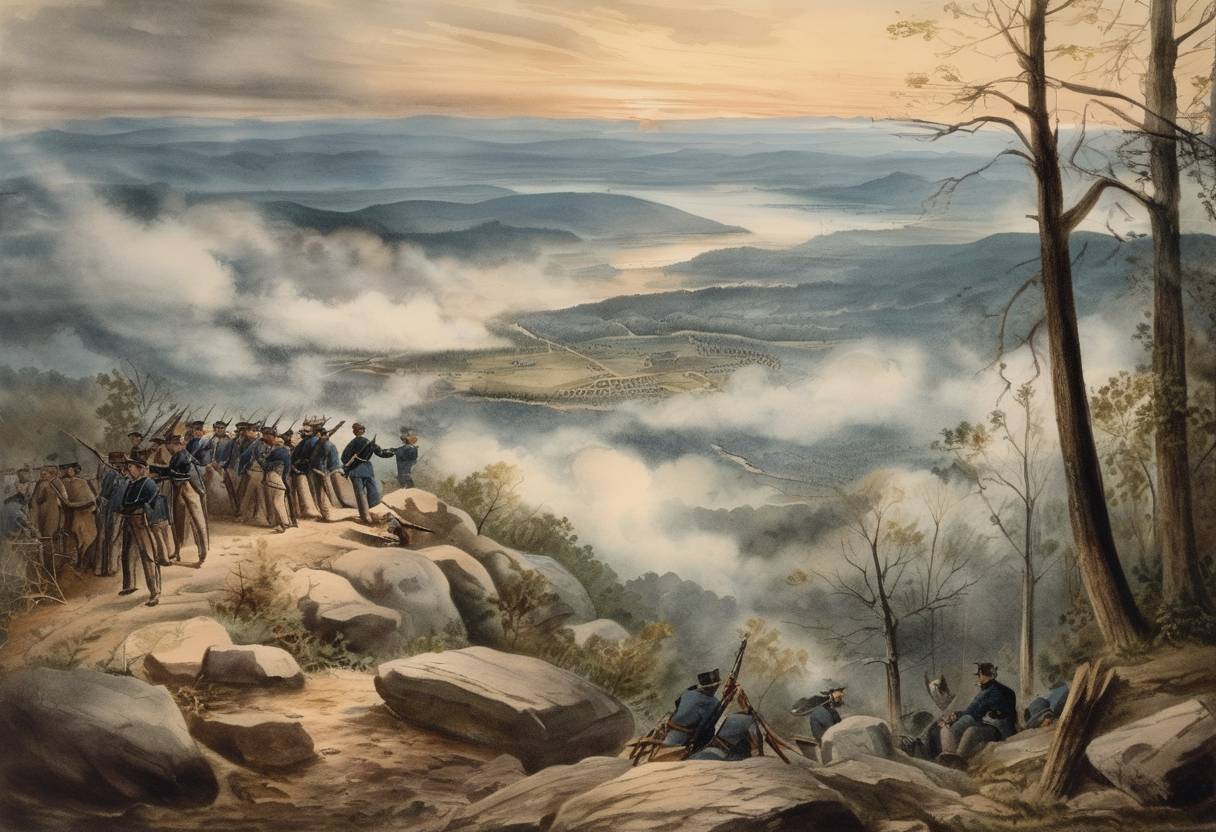
On November 24, 1863, the Battle of Lookout Mountain, often referred to as the “Battle Above the Clouds,” commenced as part of the larger Chattanooga Campaign during the American Civil War. This engagement saw Union forces under Major General Joseph Hooker taking on Confederate troops commanded by Major General Carter L. Stevenson on the slopes of Lookout Mountain in Tennessee. This battle was a prelude to the more extensive Battle of Chattanooga.
Chattanooga was a critical transportation hub for the Confederacy, and its control was vital for both Union and Confederate forces. Following the Union defeat at the Battle of Chickamauga in September 1863, Confederate forces, led by General Braxton Bragg, laid siege to the Union army trapped in Chattanooga. In response, the Union sought to break the siege and secure control over Chattanooga.
The Union army, reinforced by troops from the Army of the Potomac and led by General Ulysses S. Grant, devised a plan to lift the siege. One of the key components was the attack on Lookout Mountain, a strategic position held by the Confederates that dominated the approaches to Chattanooga from the south.
By the afternoon of November 24, Union forces effectively pushed the Confederates off Lookout Mountain. This victory was pivotal, as it paved the way for the Union to lift the siege of Chattanooga in the subsequent engagements on Missionary Ridge.
The Battle of Lookout Mountain had several significant consequences:
By effectively leveraging the terrain and employing coordinated assaults, the Union’s victory at Lookout Mountain marked a turning point in the Western campaigns of the Civil War and underscored the strategic acumen of Union military leadership.
Source: en.wikipedia.org