1170 · Legnano, Italy
The Lombard League, an alliance of northern Italian cities, defeated Holy Roman Emperor Frederick I Barbarossa at the Battle of Legnano.
May 29, 1176
The Battle of Legnano was fought between the forces of the Holy Roman Empire, led by Emperor Frederick I Barbarossa, and the Lombard League, a coalition of northern Italian city-states. The Lombard League emerged victorious.
Legnano, Italy | Lombard League
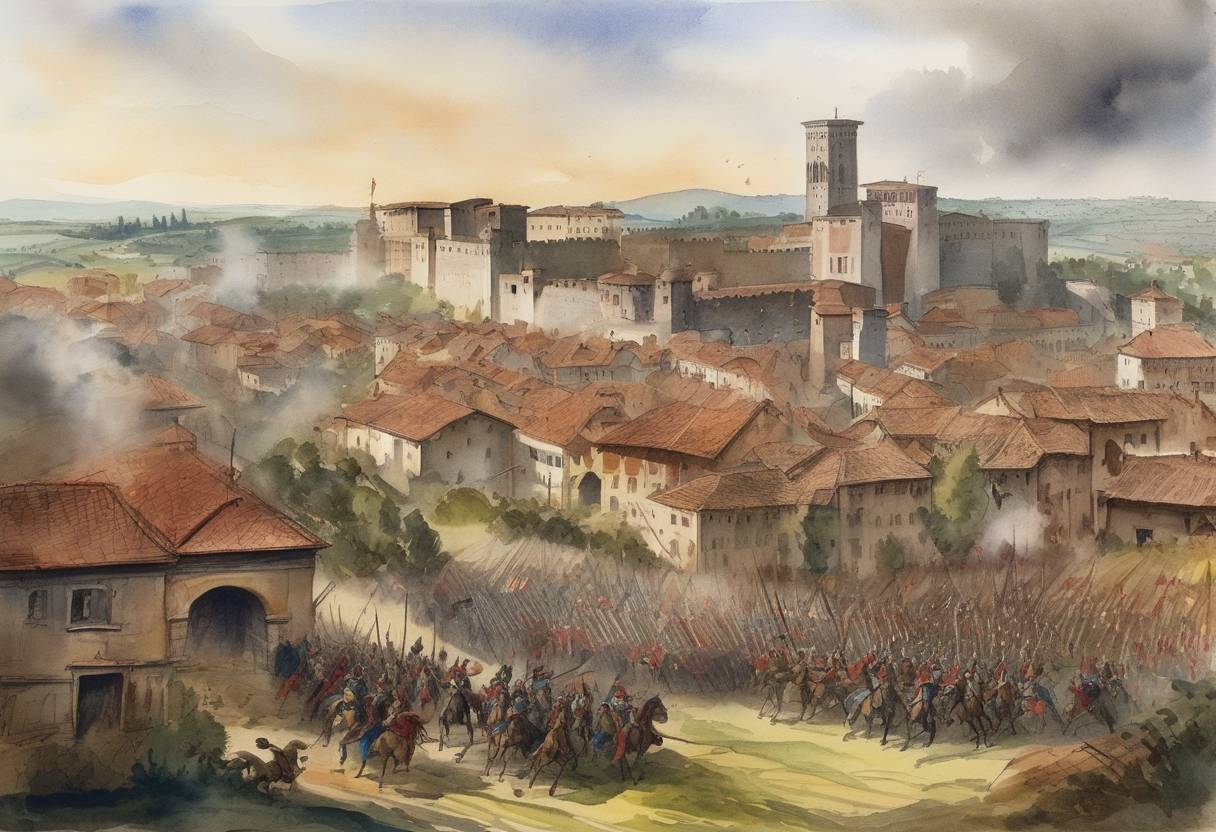
On May 29, 1176, the Battle of Legnano took place, marking a significant turning point in the conflict between the Holy Roman Empire and the Lombard League. This confrontation occurred near the town of Legnano, in present-day northern Italy.
The battle was part of a prolonged struggle for power and autonomy between the Holy Roman Emperor Frederick I Barbarossa and the northern Italian city-states. By this time, Frederick sought to assert imperial control over the increasingly independent cities in northern Italy, which resisted such dominance. The contest for control had been ongoing since Frederick’s first Italian campaign in 1154 and included multiple military engagements.
The Lombard League, founded in 1167, was a coalition of city-states, including Milan, Venice, and Bologna, which banded together to resist Frederick’s encroachments. Supported by the Papacy, the League sought to protect their communal liberties and economic interests.
Frederick I Barbarossa led the imperial forces in an attempt to crush the Lombard League and restore his authority. The battle commenced on the Carroccio, the sacred symbol of Milanese liberty, positioned on a hill overlooking the battlefield. The Lombard League, commanded by forces under the Milanese, rallied around this symbol and organized a robust defense.
Despite being less organized and numerically inferior, the Lombard League demonstrated remarkable resolve and used their intimate knowledge of the local terrain to their advantage. The engagement saw fierce combat, with high casualties on both sides.
The Lombard League achieved a decisive and symbolic victory at Legnano. This triumph weakened Frederick Barbarossa’s military prowess and compelled him to reconsider his strategy in Italy. The defeat significantly undermined his campaign and marked the first notable instance of an Italian coalition successfully resisting imperial intervention.
The outcome of the Battle of Legnano paved the way for the eventual Peace of Constance in 1183, where Frederick was forced to recognize the autonomy and liberties of the Italian communes, while they, in turn, acknowledged the nominal overlordship of the emperor.
The Lombard League’s victory at Legnano is celebrated as a crucial milestone in Italy’s medieval history. It symbolized the ability of smaller, fragmented city-states to unite and successfully stand against a more significant power, contributing to the development of communal independence and the eventual decline of feudalism in the region.
Source: en.wikipedia.org