Norman Thagard's Historic Spaceflight on March 15, 1995
1995 · Baikonur, Kazakhstan
Norman Thagard became the first American astronaut to ride to space on a Russian launch vehicle, marking a thaw in U.S.-Russian space collaboration post-Cold War.
January 8, 1994
Russian cosmonaut Valeri Polyakov begins his journey on the Soyuz TM-18 to the Mir space station, aiming to set a record for the longest continuous human stay in space.
Baikonur, Kazakhstan | Russian State Corporation for Space Activities
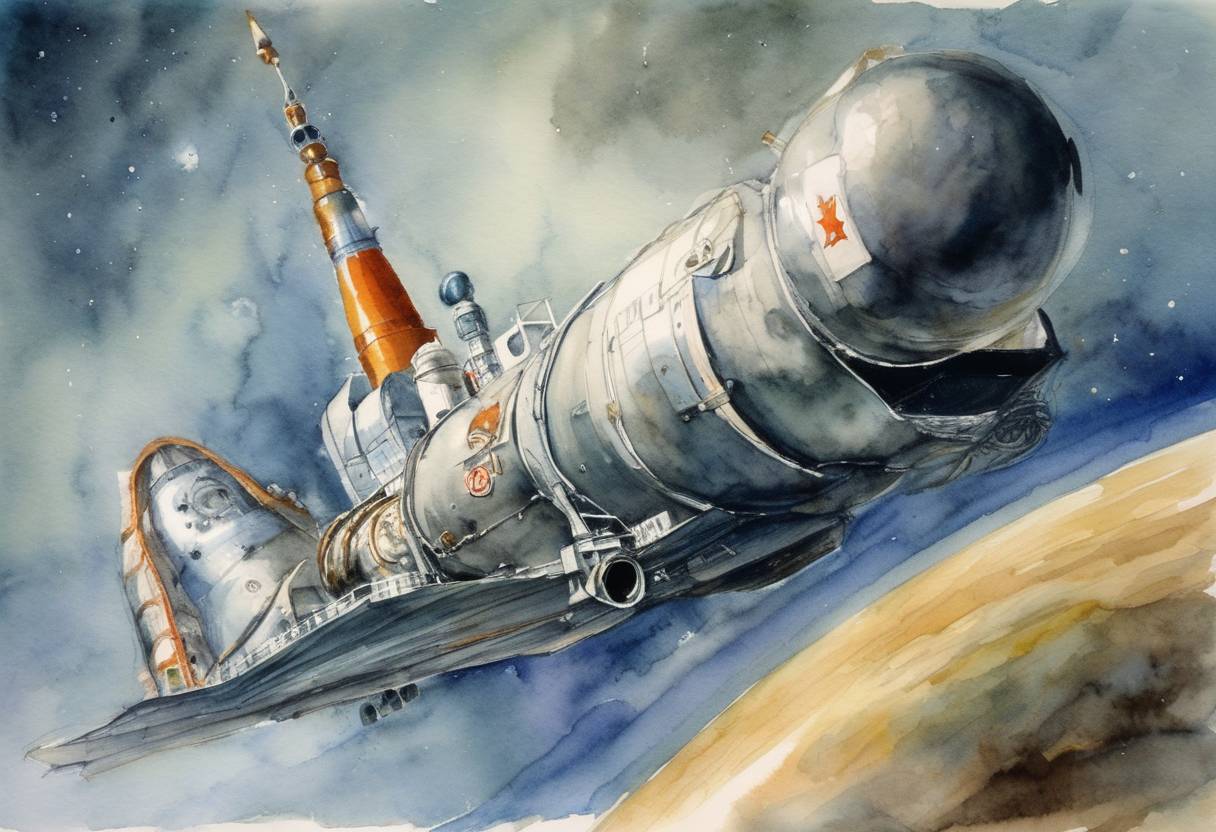
On January 8, 1994, Russian cosmonaut Valeri Polyakov embarked on a groundbreaking mission aboard the Soyuz TM-18 spacecraft, with the intent of setting a world record for the longest continuous spaceflight. His voyage was directed toward the Mir space station, where he aimed to remain for an extended period to study the effects of prolonged space travel on the human body.
Valeri Polyakov, born on April 27, 1942, in Tula, Russia, was not just any cosmonaut; he was also a physician specializing in space medicine. His medical background made him an ideal candidate for this mission, as understanding the physiological changes during long-duration spaceflight was critical for future deep-space missions, including potential human travel to Mars.
The Soyuz TM-18 was launched from Baikonur Cosmodrome in Kazakhstan, a pivotal site for Soviet and Russian space exploration. Accompanying Polyakov were fellow cosmonauts Viktor Afanasyev and Yury Usachov. This mission aimed to transport the crew to the Mir space station to carry out a range of scientific experiments and maintain the station’s operational status.
Upon arriving at Mir, Polyakov began his historic stay, closely monitoring his own health and conducting a variety of medical and technological experiments. His research covered areas such as bone density loss, muscle atrophy, and the psychological effects of isolation and confinement.
Polyakov’s mission was crucial for understanding how the human body copes with the conditions of microgravity over extended periods. His observations were invaluable for planning future long-term space missions. Successfully enduring the psychological and physical strains, Polyakov demonstrated that humans could live and work in space for longer durations than previously believed possible.
Valeri Polyakov remained aboard the Mir space station for 437 days, concluding his mission on March 22, 1995. This achievement set the record for the longest uninterrupted human stay in space, a record that stood firm for decades. Polyakov’s mission highlighted both the challenges and the potential for human endurance in space, providing key insights that continue to influence space travel and exploration strategies.
Source: en.wikipedia.org