Inauguration of William McKinley as the 25th President of the United States
1897 · Washington, D.C., United States
William McKinley was inaugurated as the 25th President of the United States.
November 3, 1896
William McKinley defeated William Jennings Bryan in the United States presidential election, becoming the 25th President.
Washington, D.C., United States | United States Government
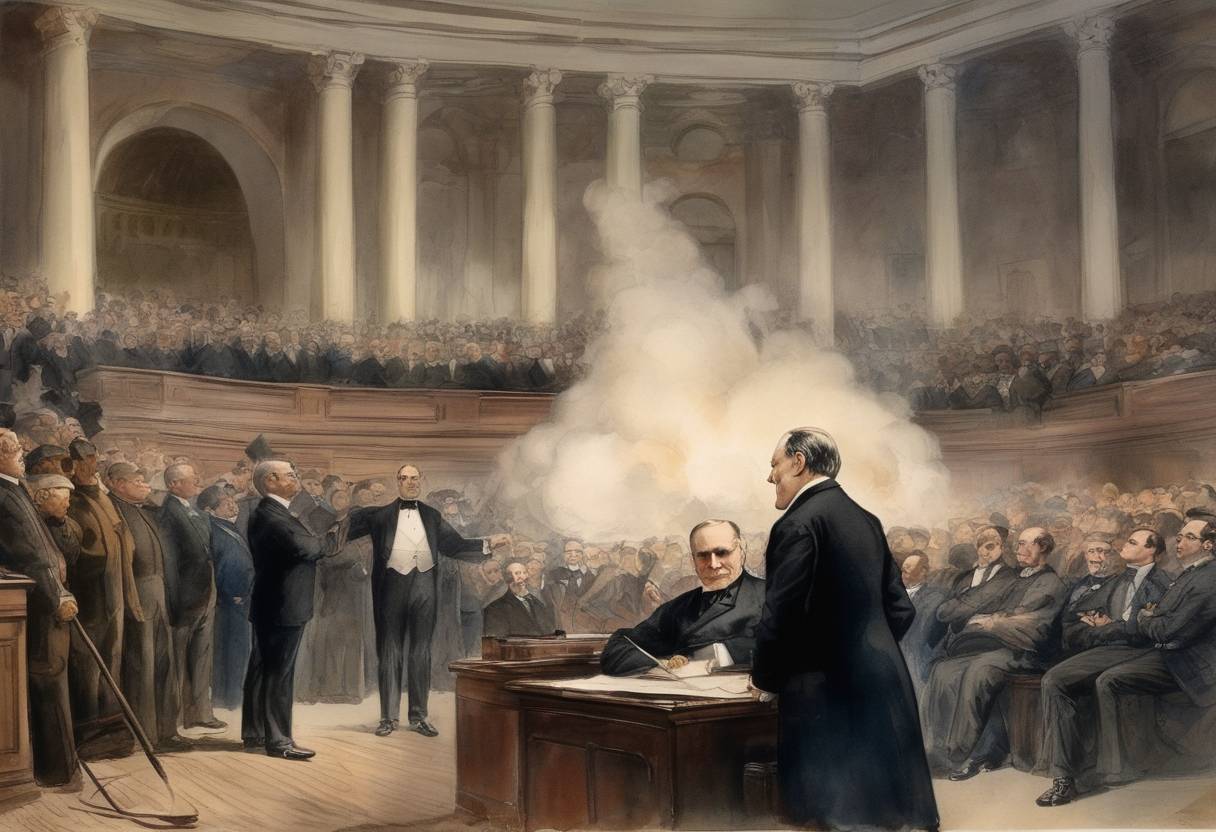
On November 3, 1896, the United States presidential election was held, marking a pivotal moment in American political history. William McKinley, the Republican candidate, defeated the Democratic contender, William Jennings Bryan, to become the 25th President of the United States. This election is often noted for its significant impacts on both the political landscape and economic policies of the nation.
The 1896 election was set against the backdrop of the Panic of 1893, a severe economic depression that had profound effects on American society. High unemployment and widespread business failures created a climate of economic anxiety. The core issue of the campaign revolved around monetary policy, specifically the debate over the gold standard versus the free coinage of silver.
Monetary Policy: William McKinley supported the gold standard, which was seen as a way to ensure economic stability and attract foreign investment. William Jennings Bryan advocated for the free coinage of silver, which he argued would inflate currency, making it easier for farmers and debtors to pay off loans—this stance was famously encapsulated in his “Cross of Gold” speech.
Tariffs: McKinley also favored protective tariffs to shield American industries from foreign competition, aligning with industrial interests primarily in the North and East.
The campaign was notable for its stark contrasts between the candidates’ visions for America’s economic future. McKinley’s campaign, managed by Mark Hanna, was well-financed and organized, focusing on raising vast sums of money from business leaders and employing a strong message emphasizing “sound money” and prosperity. In contrast, Bryan conducted an energetic campaign, traveling extensively and delivering fiery speeches to rally support from farmers and laborers.
McKinley’s victory was decisive, garnering 271 electoral votes to Bryan’s 176. His support was concentrated in the industrial North, Mid-Atlantic, and Midwest, whereas Bryan found backing largely in the rural South and West. The popular vote margin was smaller but still significant, with McKinley receiving about 51% compared to Bryan’s 47%.
Realigning Election: The election of 1896 is often considered a realigning election that marked the beginning of a new era of Republican dominance in national politics. It solidified the GOP’s position as the party of business and economic growth.
Economic Policy: McKinley’s presidency saw the passage of the Dingley Tariff Act of 1897, which raised import duties to protect domestic industries, and the Gold Standard Act of 1900, which formally placed the U.S. monetary system on the gold standard.
Populist Decline: Bryan’s defeat signified the fading influence of the Populist movement as an independent political force, as the Democrats absorbed many of its platforms.
This election underscores the intersection of economic interests and political power in shaping the trajectory of American history at the close of the 19th century.
Source: www.britannica.com