1819 · Watervliet, United States
Stanford University founder Leland Stanford was born.
January 4, 1809
Louis Braille, the inventor of a widely used tactile writing system for the visually impaired, was born. His work would later revolutionize reading and writing for the blind community worldwide.
Coupvray, France
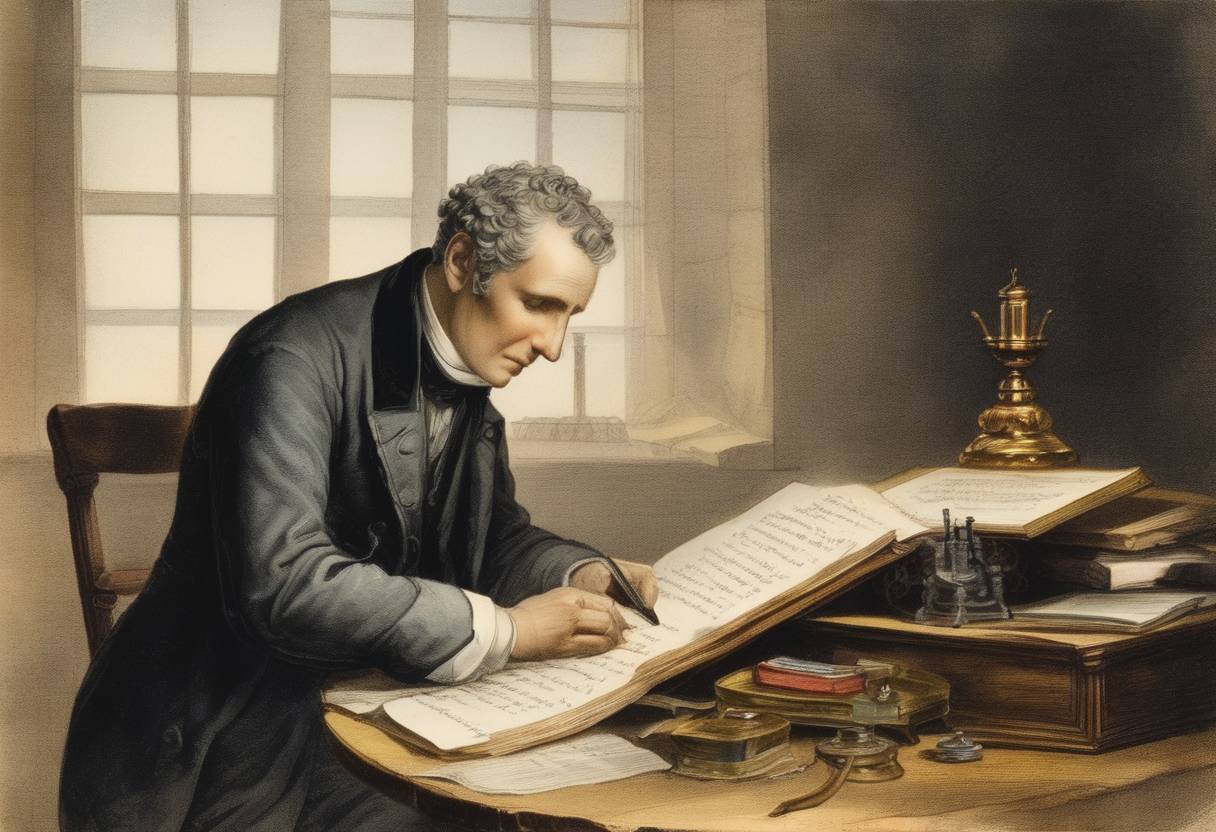
Louis Braille was born on January 4, 1809, in the small village of Coupvray, France, near Paris. Braille, who would go on to invent the Braille system, was the son of a harness maker. At a young age, he suffered an accident in his father’s workshop, which led to his eventual blindness. Despite this early challenge, Braille’s perseverance would lead to a monumental breakthrough in education and communication for the blind community worldwide.
Louis’ parents were committed to providing him with an education. At the age of 10, he was enrolled in the Royal Institution for Blind Youth in Paris, one of the first schools for blind children in the world. It was there that Braille began to explore reading and writing methods for the visually impaired. He learned of a communication system used by the French military, known as “night writing,” which used raised dots to convey information without light.
Inspired by the tactical night writing method, Braille refined and simplified it into a system of his own. By 1824, at the age of just 15, he had developed a system that used a grid of six dots to represent letters, numbers, and punctuation. This system proved versatile and allowed users to read by touch. Braille’s focus was on creating a method that was efficient and easy to learn, enabling blind individuals to read and write autonomously.
Although the Braille system was not widely adopted during Louis Braille’s lifetime, it eventually gained recognition as a revolutionary tool for the blind. His method was published and slowly integrated into educational practices, expanding significantly in the late 19th and early 20th centuries. Today, Braille’s system is used worldwide, transforming the ability of blind and visually impaired individuals to access written information, educate themselves independently, and communicate effectively.
Louis Braille’s pioneering work opened up new doors and opportunities for individuals with visual impairments, cementing his legacy as a pivotal figure in enhancing accessibility and inclusivity in education and literacy.
Source: en.wikipedia.org