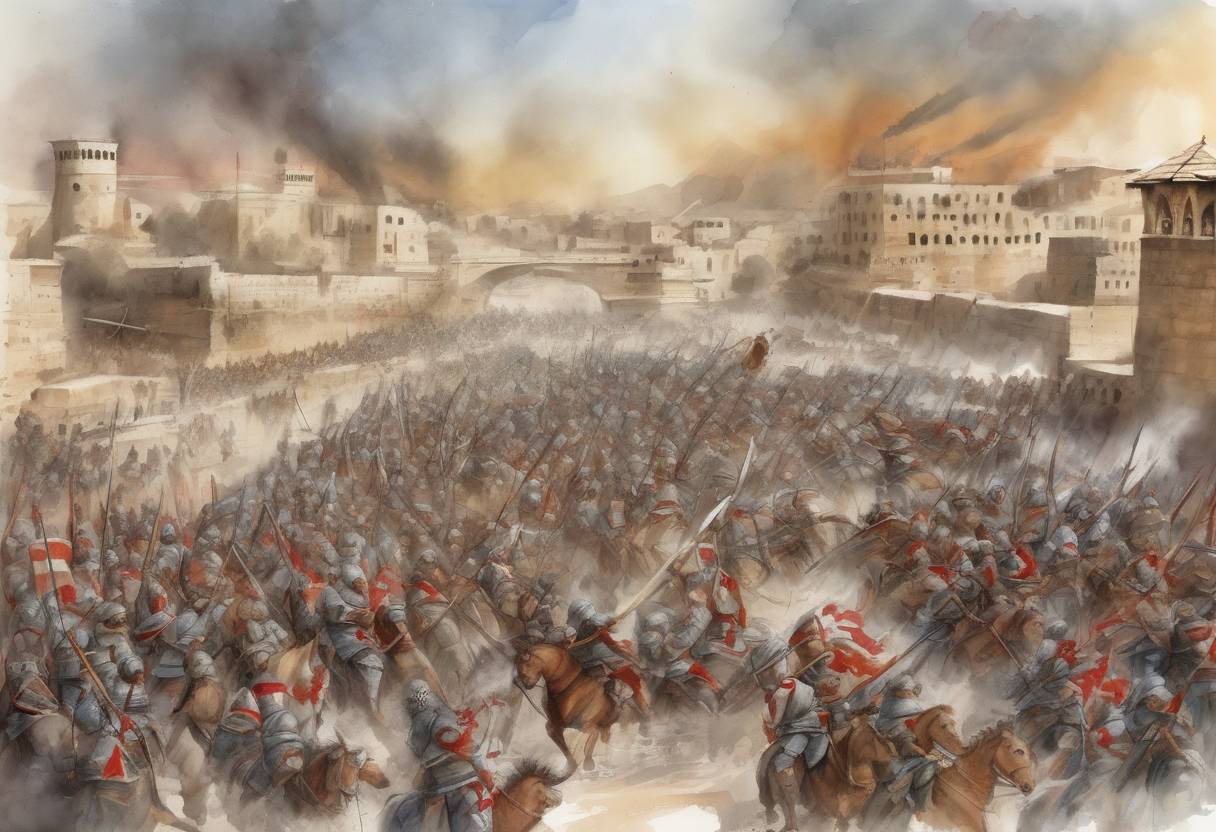
The Battle of Yarmouk: August 16, 636
The Battle of Yarmouk, which began on August 16, 636, stands as a pivotal moment in the history of the early Islamic conquests. This battle was fought between the forces of the Byzantine Empire and the Rashidun Caliphate, marking a decisive victory for the Muslim forces and significantly influencing the control of the Levant region.
Context and Prelude
The Rashidun Caliphate, under the leadership of Caliph Abu Bakr and later Caliph Umar ibn al-Khattab, embarked on a series of military campaigns to expand Islamic territory. The Levant, a region of strategic and economic importance, was under Byzantine control, and its conquest was crucial for the Rashidun Caliphate’s expansion.
Leading up to the battle, the Muslim forces, commanded by Khalid ibn al-Walid, had already achieved several victories in the region, including the capture of Damascus. The Byzantine Emperor Heraclius, recognizing the threat posed by the advancing Muslim armies, assembled a large force to repel them and maintain Byzantine dominance in the area.
The Battle
The Battle of Yarmouk took place near the Yarmouk River, in present-day Syria and Jordan. It unfolded over six days, from August 15 to August 20, 636. The Byzantine army, commanded by General Vahan, was significantly larger than the Muslim forces. However, the Muslims, under Khalid ibn al-Walid’s strategic leadership, utilized superior tactics, mobility, and the high morale of their troops to counter the Byzantine numerical advantage.
Key factors contributing to the Muslim victory included:
- Tactical Flexibility: Khalid ibn al-Walid’s ability to adapt to changing battlefield conditions and effectively utilize his cavalry played a crucial role.
- Unity and Morale: The Muslim forces were highly motivated, driven by religious zeal and a sense of unity.
- Byzantine Disarray: The Byzantine army, composed of various ethnic groups with differing motivations, struggled with internal divisions and coordination.
Aftermath and Significance
The victory at Yarmouk had profound consequences:
- Byzantine Retreat: The defeat forced the Byzantine Empire to withdraw from much of the Levant, leading to the rapid Muslim conquest of key cities such as Jerusalem and Antioch.
- Shift in Power: The battle marked a significant shift in the balance of power in the region, establishing Muslim dominance over the Levant.
- Legacy of Khalid ibn al-Walid: Khalid’s leadership and military prowess were cemented in history, earning him the title “The Sword of Allah.”
The Battle of Yarmouk is often regarded as one of the most significant military engagements in early Islamic history, setting the stage for further expansion and the eventual establishment of a vast Islamic empire.