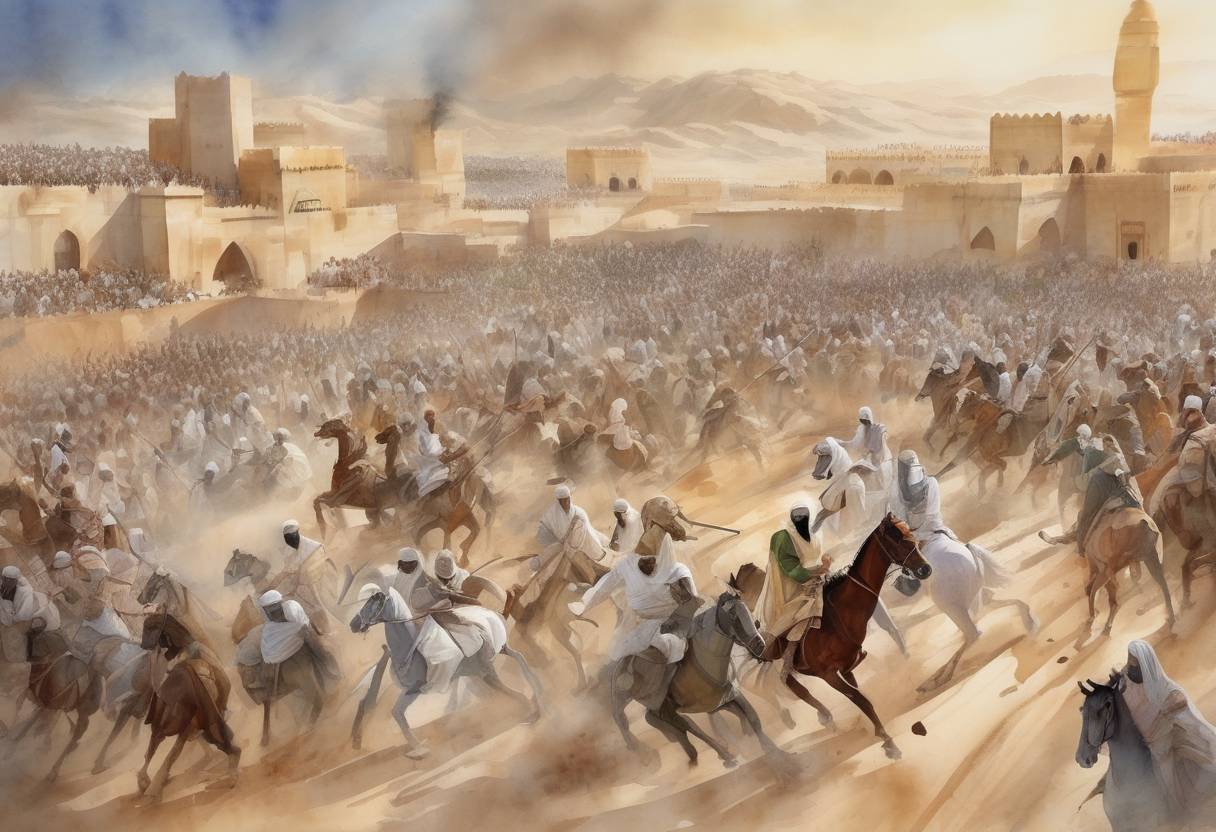
The Battle of Badr: March 20, 624
The Battle of Badr, fought on March 20, 624 CE, is one of the most significant battles in early Islamic history. It marked a pivotal moment for the nascent Muslim community led by the Prophet Muhammad and had profound implications for the spread of Islam.
Background
The battle occurred during a period of escalating tensions between the Muslims of Medina and the Quraysh tribe of Mecca. The Quraysh were a powerful merchant tribe that controlled Mecca and opposed Muhammad’s monotheistic teachings, which threatened their polytheistic traditions and economic interests.
After the Hijra, the migration of Muhammad and his followers from Mecca to Medina in 622 CE, the Muslims sought to establish themselves economically and politically. The Quraysh, however, continued to view them as a threat, leading to a series of skirmishes and raids.
The Lead-Up to the Battle
In early 624 CE, intelligence reached Muhammad that a large Quraysh caravan, led by Abu Sufyan, was returning from Syria to Mecca. The caravan was a lucrative target, and intercepting it would both weaken the Quraysh economically and strengthen the Muslim community.
Muhammad gathered a force of approximately 313 men, including both Muhajirun (emigrants from Mecca) and Ansar (helpers from Medina), and set out to intercept the caravan. However, Abu Sufyan, aware of the Muslim plan, altered his route and sent for reinforcements from Mecca.
The Battle
The Quraysh responded by assembling a force of about 1,000 men, significantly outnumbering the Muslim contingent. The two forces met at Badr, a well-known water source southwest of Medina.
Despite being outnumbered, the Muslims were strategically positioned and motivated by their cause. The battle commenced with traditional single combats, followed by a general engagement. The Muslims, under Muhammad’s leadership, demonstrated effective tactics and discipline.
Outcome and Significance
The Battle of Badr resulted in a decisive victory for the Muslims. Approximately 70 Quraysh were killed, and many others were captured, including several key leaders. The Muslims suffered relatively few casualties.
This victory had several important consequences:
- Boosted Morale: The triumph at Badr significantly boosted the morale and confidence of the Muslim community.
- Legitimacy and Support: It enhanced Muhammad’s status as a leader and attracted more followers to Islam.
- Political and Economic Impact: The defeat weakened the Quraysh’s economic power and political influence in the region.
- Foundation for Future Conflicts: The battle set the stage for future conflicts between the Muslims and the Quraysh, ultimately leading to the conquest of Mecca in 630 CE.
The Battle of Badr is remembered as a turning point in Islamic history, symbolizing divine support for Muhammad’s mission and the resilience of the early Muslim community.