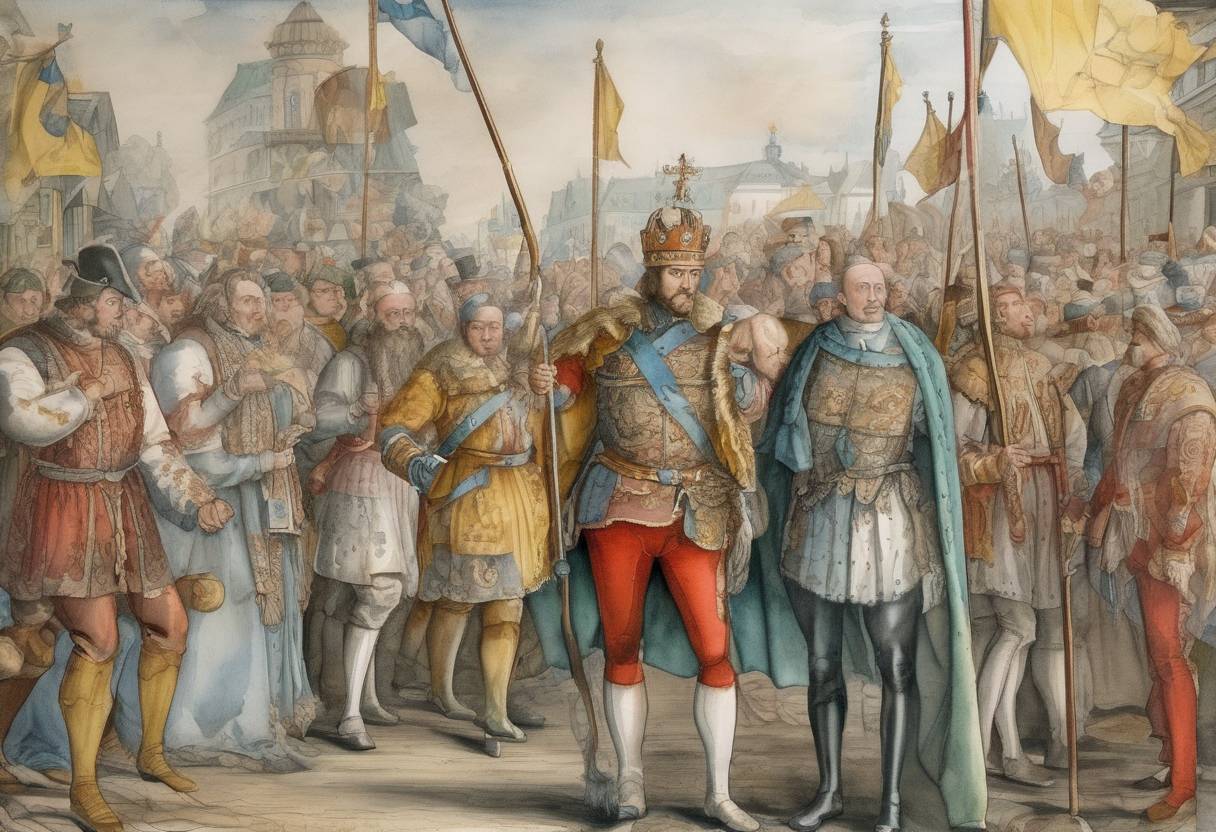
Gustav Vasa Elected King of Sweden - June 6, 1523
On June 6, 1523, Gustav Vasa was elected King of Sweden, a pivotal moment in Swedish history that marked the end of the Kalmar Union and the beginning of modern Sweden. This event is celebrated annually as Sweden’s National Day.
Background
The Kalmar Union
The Kalmar Union was a series of personal unions that united the three kingdoms of Denmark, Norway, and Sweden under a single monarch from 1397. The union was intended to consolidate power and provide mutual defense against external threats, particularly from the Hanseatic League and the Teutonic Knights. However, internal conflicts and differing national interests often led to tensions and unrest.
The Stockholm Bloodbath
A significant catalyst for the dissolution of the Kalmar Union was the Stockholm Bloodbath of 1520. Christian II of Denmark, who sought to assert his control over Sweden, invited Swedish nobles to a coronation ceremony in Stockholm. This event turned into a massacre, with Christian II executing around 80 Swedish nobles and clergy, which fueled widespread resentment and rebellion against Danish rule.
Gustav Vasa’s Rise
Early Life and Rebellion
Gustav Eriksson, later known as Gustav Vasa, was born into a noble family in 1496. After escaping from Danish captivity, he became a leader in the Swedish War of Liberation against Danish rule. His charismatic leadership and strategic acumen helped him rally support from various Swedish regions, including the influential Dalarna region.
The War of Liberation
Gustav Vasa’s rebellion gained momentum, and by 1521, he was recognized as the Regent of Sweden. Over the next two years, he successfully expelled Danish forces from Swedish territories, culminating in the capture of Stockholm in 1523.
Election as King
On June 6, 1523, Gustav Vasa was elected King of Sweden by the Swedish nobility in Strängnäs. This election effectively ended the Kalmar Union and established Sweden as an independent kingdom. Gustav Vasa’s reign marked the beginning of the Vasa dynasty, which would rule Sweden for over a century.
Significance and Aftermath
Establishment of Modern Sweden
Gustav Vasa’s reign is often considered the foundation of modern Sweden. He implemented significant reforms, including the centralization of power, the establishment of a hereditary monarchy, and the introduction of Lutheran Protestantism as the state religion, which aligned Sweden more closely with the Protestant Reformation sweeping across Europe.
Gustav Vasa also focused on strengthening the Swedish economy by promoting mining and trade. He reformed the administrative structure, creating a more efficient and centralized government that laid the groundwork for Sweden’s future as a major European power.
Legacy
Gustav Vasa’s election and subsequent reign transformed Sweden from a fragmented and divided region into a unified and independent nation. His legacy is celebrated in Sweden today, with June 6 recognized as the country’s National Day, commemorating the birth of the Swedish nation-state.
In summary, the election of Gustav Vasa as King of Sweden on June 6, 1523, was a turning point in Swedish history, marking the end of the Kalmar Union and the beginning of a new era of Swedish independence and statehood.