Terri Schiavo: A Landmark Right-to-Die Case
2005 · Pinellas Park, United States
Terri Schiavo, a woman in a persistent vegetative state, died after a lengthy legal battle over her right to die.
August 1, 2001
The Alabama Supreme Court Chief Justice Roy Moore had a Ten Commandments monument installed in the rotunda of the judiciary building, sparking a legal battle over the separation of church and state.
Montgomery, United States | Alabama Supreme Court
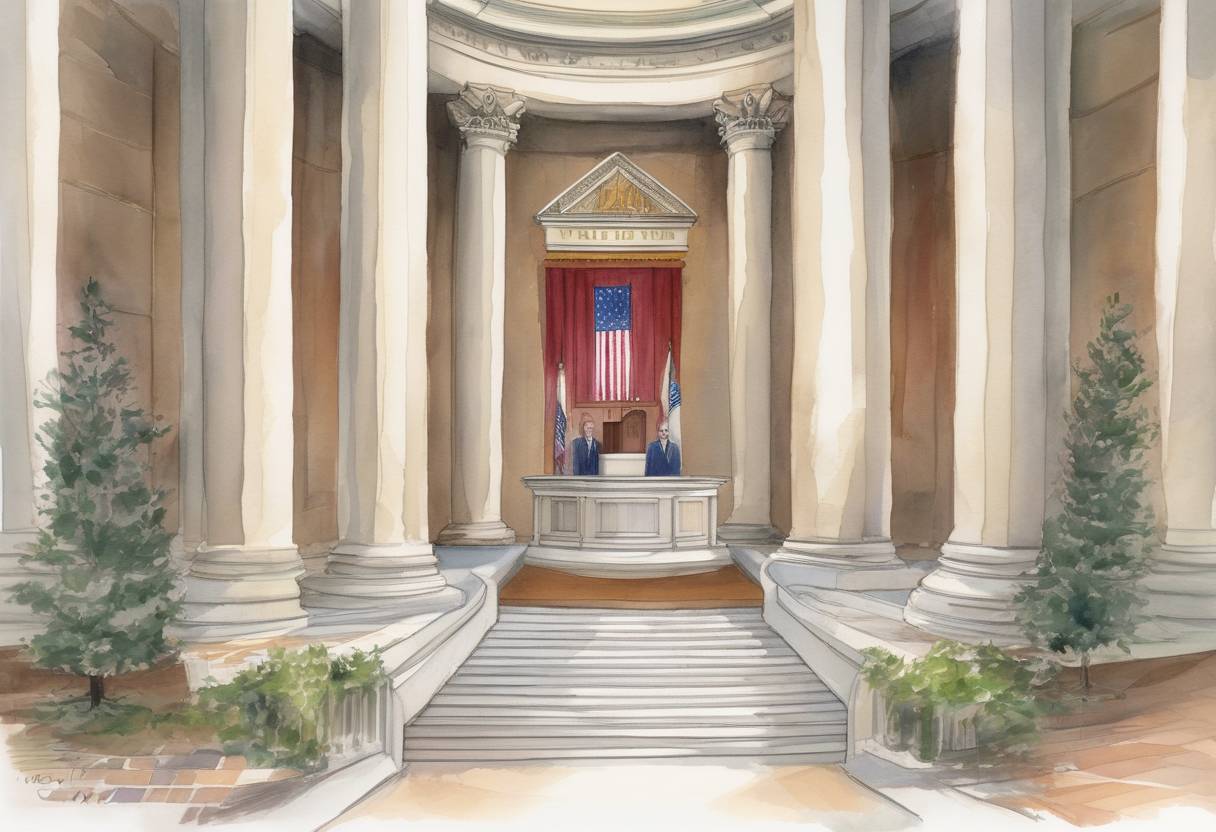
On August 1, 2001, Chief Justice Roy Moore of the Alabama Supreme Court installed a 5,280-pound granite monument of the Ten Commandments in the rotunda of the Alabama Judicial Building. This act was the culmination of Moore’s long-standing advocacy for the acknowledgment of God in public spaces and his belief that the Ten Commandments are the moral foundation of American law.
Roy Moore’s Rise to Prominence: Before becoming Chief Justice, Moore gained national attention as a circuit judge in Alabama for displaying a wooden plaque of the Ten Commandments in his courtroom. His actions sparked legal challenges and public debate, which played a significant role in his election as Chief Justice in 2000.
The Monument’s Installation: Moore commissioned the monument shortly after taking office. The installation was conducted in secrecy during the night to avoid immediate public scrutiny and legal intervention.
Initial Lawsuits: Following the installation, several civil liberties groups, including the American Civil Liberties Union (ACLU), filed lawsuits arguing that the monument violated the Establishment Clause of the First Amendment, which prohibits government endorsement of religion.
Federal Court Rulings: In 2002, U.S. District Judge Myron Thompson ruled that the monument was unconstitutional and ordered its removal. Moore appealed the decision, but the 11th Circuit Court of Appeals upheld the ruling in 2003.
Defiance and Consequences: Moore refused to comply with the federal court order, leading to a legal standoff. His defiance resulted in his suspension and eventual removal from office by the Alabama Court of the Judiciary in November 2003 for ethical violations.
Public Reaction: The case drew national attention, sparking debates over religious freedom, the role of religion in public life, and the interpretation of the Constitution’s Establishment Clause.
Moore’s Political Career: Despite his removal, Moore remained a polarizing figure in American politics. He was re-elected as Chief Justice in 2012 but faced further controversies, including another suspension in 2016 over his directives regarding same-sex marriage licenses.
Ongoing Debates: The controversy surrounding the Ten Commandments monument highlighted ongoing tensions in the United States regarding the separation of church and state, a debate that continues to influence legal and political discourse.
The Ten Commandments monument case remains a significant example of the complex interplay between personal beliefs, legal principles, and public policy in American history.
Source: en.wikipedia.org