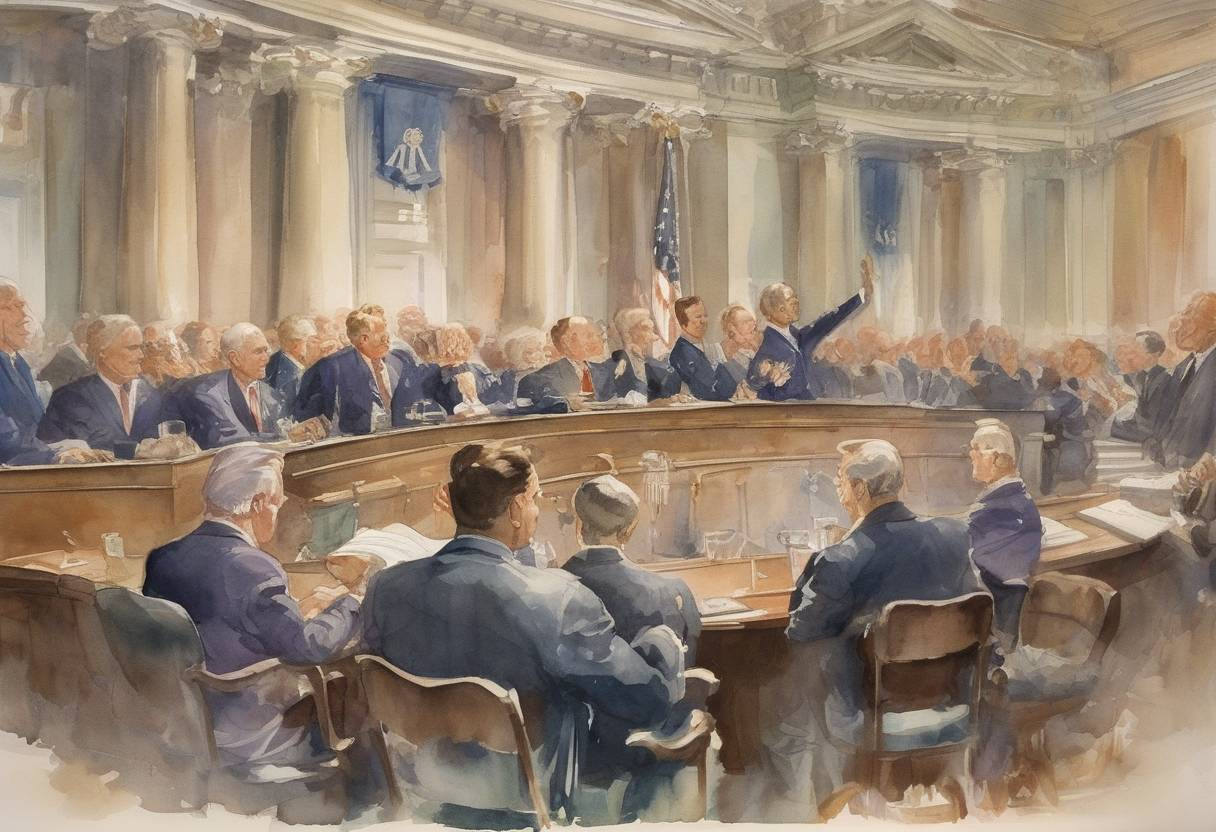
The Ratification of the Twenty-second Amendment
On February 27, 1951, the Twenty-second Amendment to the United States Constitution was ratified, establishing a two-term limit for the office of the President of the United States. This amendment was a significant development in American political history, reflecting the nation’s evolving views on executive power and leadership tenure.
Context and Background
The impetus for the Twenty-second Amendment arose from the unprecedented four-term presidency of Franklin D. Roosevelt. Elected in 1932, Roosevelt served from 1933 until his death in 1945, during a period marked by the Great Depression and World War II. His extended tenure broke the long-standing tradition set by George Washington, who voluntarily stepped down after two terms, a precedent followed by subsequent presidents.
Roosevelt’s four terms raised concerns about the concentration of power in the executive branch and the potential for a president to hold office indefinitely. In response, after World War II, there was a growing consensus among lawmakers and the public that constitutional limits were necessary to prevent future presidents from serving more than two terms.
Key Provisions
The Twenty-second Amendment was proposed by Congress on March 21, 1947, and ratified by the requisite number of states on February 27, 1951. The main provisions of the amendment are as follows:
Section 1: No person shall be elected to the office of the President more than twice, and no person who has held the office of President, or acted as President, for more than two years of a term to which some other person was elected President shall be elected to the office of the President more than once.
Section 2: The amendment would not apply to the sitting president at the time of its proposal, allowing Harry S. Truman, who was in office when the amendment was proposed, to run for another term if he chose to do so (though he ultimately did not).
Historical Significance
The ratification of the Twenty-second Amendment was a pivotal moment in American constitutional history. It formalized the tradition of a two-term limit, ensuring a regular turnover in presidential leadership and reinforcing the principle of checks and balances within the federal government. The amendment has since shaped the political landscape, influencing presidential campaigns and succession planning.
Aftermath and Consequences
Since its ratification, the Twenty-second Amendment has been a topic of debate, with some arguing that it restricts the democratic choice of the electorate, while others maintain that it is essential for preventing the abuse of executive power. Despite these debates, the amendment remains a cornerstone of the U.S. constitutional framework, underscoring the nation’s commitment to democratic principles and the peaceful transition of power.
In summary, the ratification of the Twenty-second Amendment on February 27, 1951, was a landmark event that codified a crucial aspect of American governance, reflecting the country’s dedication to maintaining a balanced and accountable executive branch.