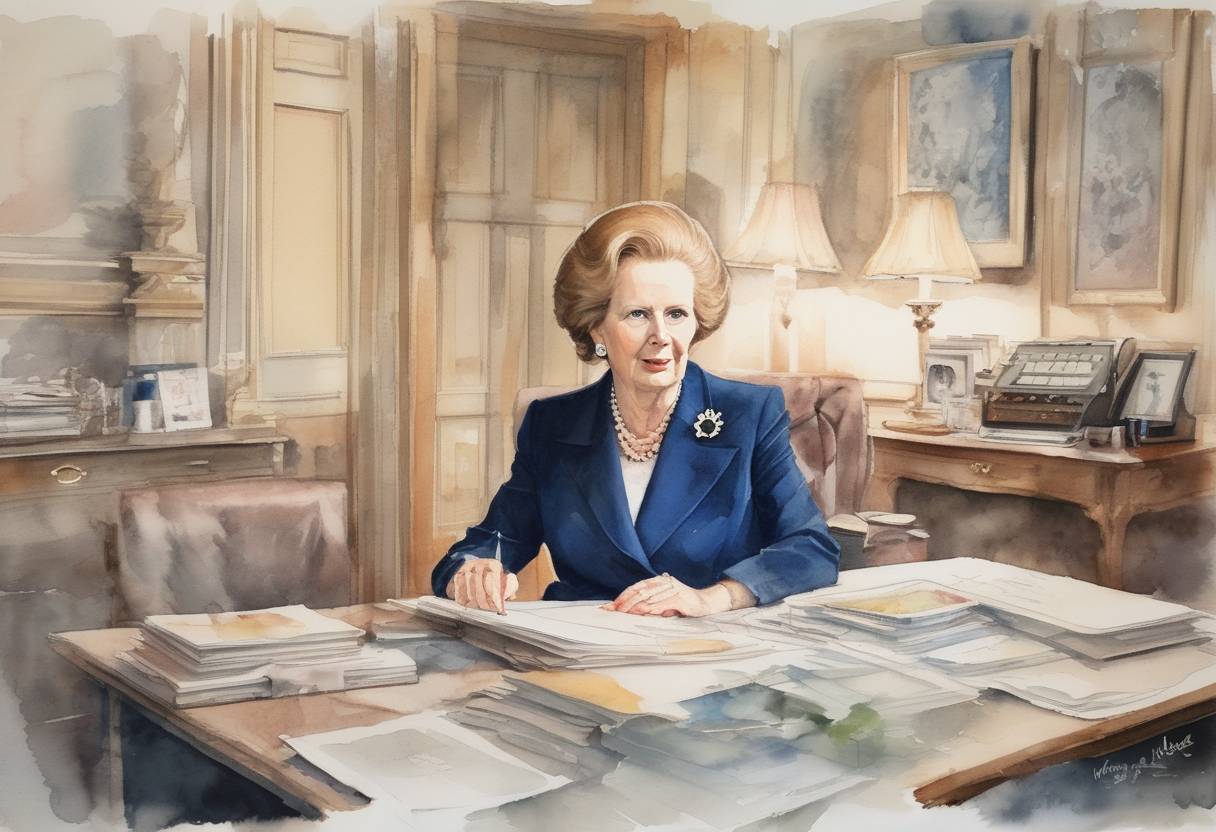
Margaret Thatcher Becomes the First Female Prime Minister of the United Kingdom
On May 4, 1979, Margaret Thatcher made history by becoming the first female Prime Minister of the United Kingdom. Her ascent to this position marked a significant moment in British political history and had a lasting impact on both the country and the world.
Background
Margaret Thatcher, born on October 13, 1925, in Grantham, Lincolnshire, was a chemist and barrister before entering politics. She was elected as the Member of Parliament for Finchley in 1959. Rising through the ranks of the Conservative Party, she became the Secretary of State for Education and Science from 1970 to 1974 under Prime Minister Edward Heath.
In 1975, Thatcher challenged Heath for the leadership of the Conservative Party and won, becoming the Leader of the Opposition. Her leadership style and policies earned her the nickname “The Iron Lady,” a testament to her strong and often uncompromising approach.
The 1979 General Election
The general election of 1979 was held against a backdrop of economic difficulties, including high inflation, unemployment, and widespread industrial unrest, famously culminating in the “Winter of Discontent” of 1978-79. The Labour government, led by Prime Minister James Callaghan, struggled to maintain public confidence amid these challenges.
Thatcher’s Conservative Party campaigned on a platform of economic reform, promising to curb inflation, reduce the power of trade unions, and promote free-market policies. Her message resonated with voters seeking change and stability.
Election Victory
On May 3, 1979, the Conservative Party won a decisive victory, securing 339 seats in the House of Commons compared to Labour’s 269. The following day, May 4, 1979, Margaret Thatcher was invited by Queen Elizabeth II to form a government, officially becoming the first female Prime Minister of the United Kingdom.
Significance and Legacy
Thatcher’s premiership, which lasted until 1990, was marked by significant economic and social changes. Her government implemented policies that emphasized deregulation, privatization of state-owned industries, and a reduction in the influence of trade unions. These policies were controversial and sparked significant debate and division within the UK.
Internationally, Thatcher was a key figure during the Cold War, maintaining a strong alliance with the United States and President Ronald Reagan. Her leadership style and policies influenced conservative movements worldwide.
Thatcher’s tenure as Prime Minister reshaped the British political landscape and left a complex legacy that continues to be debated today. Her role as a pioneering female leader in a male-dominated political arena also paved the way for future generations of women in politics.
In summary, Margaret Thatcher’s rise to become the first female Prime Minister of the United Kingdom on May 4, 1979, was a pivotal moment in history, characterized by her transformative and often contentious policies that left an indelible mark on the nation and beyond.