Kansas Admitted to the Union as the 34th State
1861 · Washington D.C., United States
Kansas was admitted to the Union as the 34th U.S. state.
August 16, 1841
President John Tyler vetoed a bill that would have re-established the Second Bank of the United States, leading to a significant political conflict with the Whig Party.
Washington D.C., United States | United States Congress
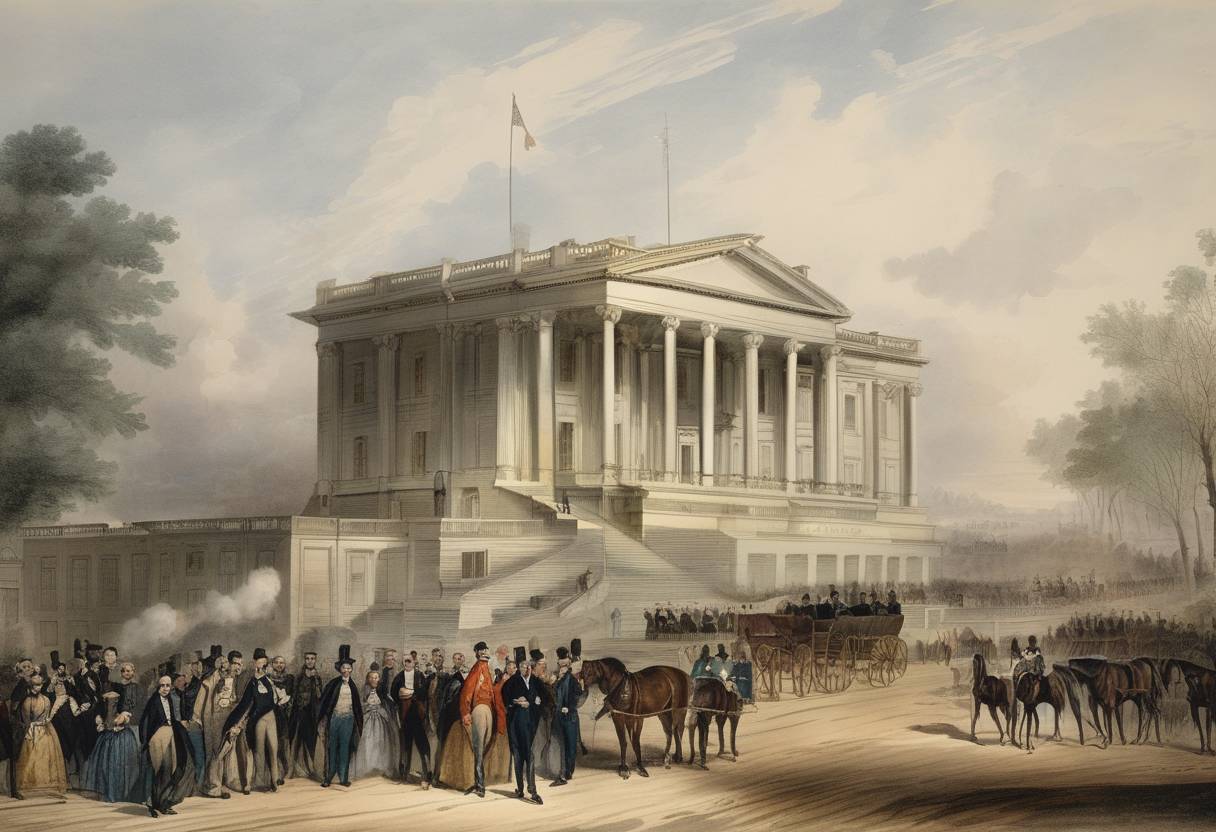
On August 16, 1841, President John Tyler exercised his veto power against a bill that sought to re-establish the Second Bank of the United States. This decision intensified tensions between Tyler and his political allies in the Whig Party, leading to significant political conflict.
The Second Bank of the United States had been a contentious issue in American politics. Founded in 1816, its charter was not renewed amid significant political opposition, particularly from President Andrew Jackson, who successfully campaigned against the Bank, culminating in its closure in 1836.
With the Panic of 1837 and subsequent economic hardships, many in Congress believed a national bank could stabilize the economy. As a result, a proposal to re-establish the bank was placed before the government, initially with the backing of the Whig Party, to which President Tyler ostensibly belonged.
Tyler, who became President after the death of William Henry Harrison, faced pressure from Whig leaders, particularly Henry Clay, to support the bank bill. However, Tyler held a strict constructionist view of the Constitution, opposing what he saw as overreach by the federal government. He deemed the creation of a national bank beyond the powers granted to Congress in the Constitution.
In his veto message, Tyler argued that the bill failed to address what he considered constitutional concerns and state rights issues. Therefore, he refused to sign the bill into law, applying the presidential veto.
The veto sparked intense political fallout. The Whig Party, which had elevated Tyler to the Vice Presidency, expected him to support their legislative agenda. Many Whig leaders viewed his veto as a betrayal. The conflict culminated in Tyler’s partial expulsion from the Whig Party, with cabinet members resigning in protest and the Whig-controlled Congress chastising him.
The veto’s political aftermath left Tyler without strong party backing, marking a definitive split and weakening his presidency. This division hindered his administration’s legislative effectiveness, shaping the remainder of Tyler’s term and his legacy as a president without a party.
Tyler’s veto of the bank legislation underscored the tensions inherent in American politics concerning federal authority, economic policy, and constitutional interpretation. It exemplified the challenge of maintaining political unity in the face of ideological differences and set a precedent for future conflicts over presidential veto power.
The event is a notable example of the Whig Party’s internal divisions, contributing to its eventual dissolution in the 1850s, as debates over federal power and economic policy continued to reshape American political landscapes.
Source: www.senate.gov