Declaration of War on Japan by the United States and the United Kingdom
1941 · Washington, D.C., United States
The United States and the United Kingdom declared war on Japan, following the attack on Pearl Harbor.
July 26, 1941
U.S. President Franklin D. Roosevelt orders the seizure of all Japanese assets in the United States in response to Japan's expansion in the Pacific.
Washington, D.C., United States | United States government
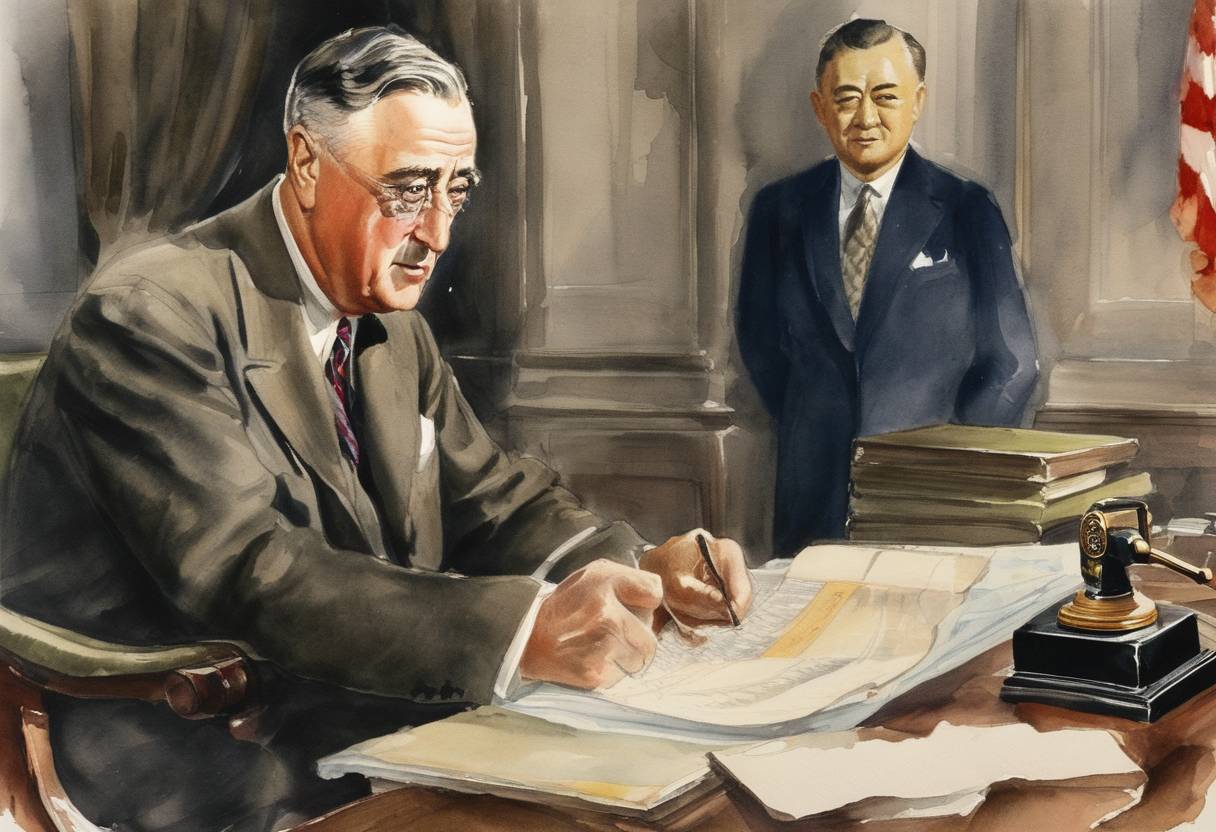
On July 26, 1941, U.S. President Franklin D. Roosevelt issued an order to freeze all Japanese assets within the United States. This decisive action was part of a broader strategy to counter Japan’s aggressive expansion in the Pacific, particularly following Japan’s occupation of French Indochina earlier that month.
Expansionist Moves: Throughout the late 1930s and into the early 1940s, Japan had been pursuing territorial expansion in Asia and the Pacific. The occupation of northern French Indochina in September 1940, and the subsequent move into southern Indochina in July 1941, were perceived as direct threats to U.S. interests and allies in the region.
U.S. Concerns: The United States viewed Japan’s military actions as destabilizing and aggressive. The occupation of territories allowed Japan to threaten British and Dutch colonies in Asia and obstruct vital sea lanes in the Pacific, which were crucial for American trade and strategic interests.
Scope of the Freeze: The order effectively immobilized all Japanese financial and commercial transactions within the United States. It prohibited the export of oil and other critical materials, significantly impacting the Japanese economy, which was heavily reliant on these imports.
Coordination with Allies: The United Kingdom and the Dutch East Indies, sensing similar threats, took parallel actions to restrict Japan’s access to vital resources. This collaborative economic pressure was intended to curtail Japan’s military operations.
Economic Repercussions for Japan: The asset freeze and subsequent embargoes severely strained Japan’s economy. Lacking domestic oil resources, Japan faced an energy crisis that jeopardized its military operations.
Escalation Toward Conflict: Instead of deterring Japanese militarism, these sanctions increased tensions. They contributed to Japan’s decision to pursue a more aggressive stance, ultimately culminating in the attack on Pearl Harbor on December 7, 1941, which propelled the United States into World War II.
President Roosevelt’s decision on July 26, 1941, remains a pivotal moment in U.S.-Japan relations, showcasing how economic strategies and international diplomacy can influence global conflict trajectories.
Source: www.history.com